TLB hire near you
Last updated
What a TLB does
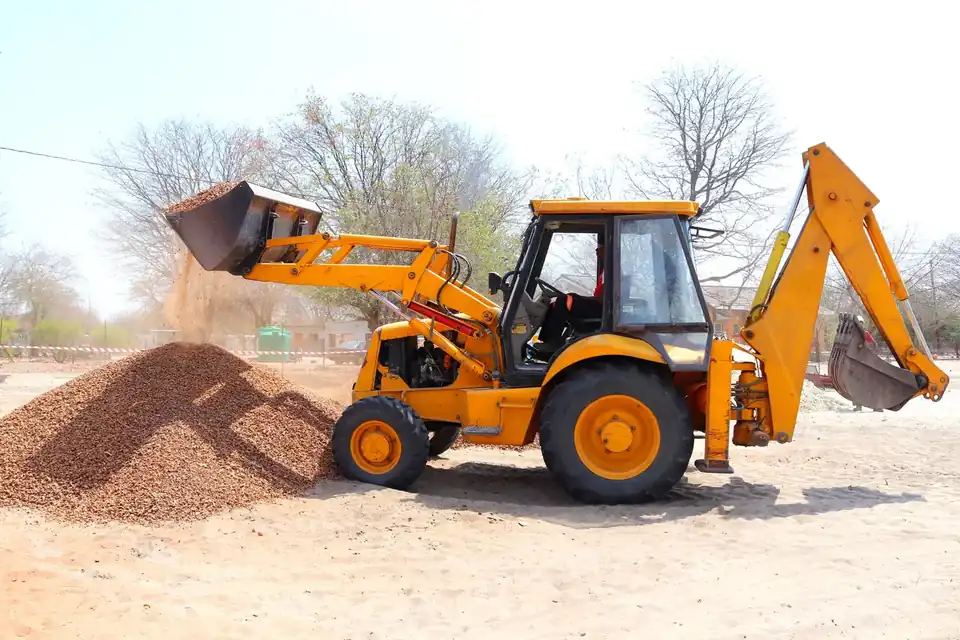
A TLB (tractor-loader-backhoe) is two machines in one: a loader bucket of about 1 m³ on the front and a backhoe digging arm on the back that reaches 4.4–4.8 m deep. One TLB and one operator can dig a trench, load the spoil onto a tipper and backfill the trench afterwards.
That versatility is why one TLB covers most house-plot, farm and small municipal jobs on its own. Whether you call it a TLB, a backhoe loader, a digger loader or a JCB, it's the same machine, and it drives from job to job on the road at up to about 40 km/h, so it starts work quickly.
Jobs a TLB does well
Trenches
Water, sewer and stormwater pipes, electrical cable and irrigation lines. The backhoe digs to 4.4–4.8 m with a standard dipper. See trenching.
Foundations
Strip footings for houses, boundary walls and outbuildings, plus septic tanks and soakaways. See earthworks and foundations.
Loading tippers
Rubble, soil and building waste. A 10 cube tipper takes about ten loader buckets. See tipper truck hire.
Clearing a plot
Rubble, light bush, small trees and stumps, and old fencing. Heavy bush needs a bigger machine. See site clearing.
Driveways and levelling
Spreading and shaping gravel and levelling small areas with the front bucket before a roller compacts. See gravel roads and driveways.
Breaking concrete and rock
With a hydraulic breaker in place of the bucket: slabs, old foundations, tar and rock bands in a trench. See demolition.
TLB specs: what a standard 4x4 TLB can do
The TLB we send for most jobs is a standard 4x4 machine, a JCB 3CX or Cat 428 or similar. These are the manufacturers' published figures.
| Spec | Standard 4x4 TLB |
|---|---|
| Operating weight | 7.6–8.3 t (JCB 3CX with cab about 7.6 t; Cat 428 8.27 t) |
| Max dig depth, standard dipper | 4.45 m (JCB 3CX) to 4.78 m (Cat 428) |
| Max dig depth, extending dipper | 5.63 m (JCB 3CX) to 5.70 m (Cat 428) |
| Backhoe reach from the swing pivot | 5.44 m, or 6.55 m extended (JCB 3CX) |
| Backhoe swing arc | 180° (JCB 3CX) |
| Loader bucket | 1.03 m³ multi-purpose bucket (Cat 428) |
| Loader lift at full height | 3,479 kg with the general-purpose shovel (JCB 3CX) |
| Loader dump height | 2.74 m (JCB 3CX) |
| Width over the front bucket | 2.35 m (JCB 3CX) |
| Width with stabilisers down | 3.30 m (JCB 3CX) |
| Travel length and height, backhoe folded | 7.19 m long, 3.43 m high (JCB 3CX) |
| Turning circle, outside the loader bucket | 10.7 m (Cat 428) |
| Road speed | 37–40 km/h (Cat 428) |
| Fuel tank | 130 litres (JCB 3CX) |
What these numbers mean on your site:
- Depth: a standard dipper reaches about 4.4–4.8 m. If you need 5–5.7 m, ask for a TLB with an extending dipper. Deeper than that, or a lot of digging, means an excavator.
- Access: the TLB is 2.35 m wide over the front bucket and needs about 3.3 m when its stabilisers are down for digging. A 3 m gate is a sensible minimum. It travels about 3.4–3.5 m high, so check carports, low wires and branches on the way in.
- Lifting: the loader arms are strong (about 3.5 t at full height on a JCB 3CX), but lifting suspended loads with a TLB brings the Driven Machinery Regulations into play. For lifting pipes, manhole rings or steel, a crane truck is usually the right machine.
TLB sizes
| Size | Example | Weight | Dig depth | Best for |
|---|---|---|---|---|
| Compact (mini) TLB | JCB 1CX or similar | about 3.2 t | 2.54 m (3.07 m extending) | Narrow sites, 1.58 m wide; exact price on WhatsApp |
| Standard 4x4 TLB | JCB 3CX, Cat 428 or similar | 7.6–8.3 t | 4.45–4.78 m (5.6–5.7 m extending) | Most jobs: trenches, foundations, loading, clearing |
| Large TLB, long dipper | JCB 4CX 15 ft or similar | about 8.9 t | 4.95 m (6.12 m extending) | Deeper trenches and bigger sites; exact price on WhatsApp |
TLB with a hydraulic breaker (pecker)
A TLB with a hydraulic breaker costs R5,000–R6,550 a day with operator. The breaker, also called a pecker or hammer, replaces the digging bucket on the backhoe arm and runs off the machine's hydraulics through hammer pipework.
Book the breaker TLB when your job includes concrete slabs, old foundations, tar, a driveway that has to come out, or a band of rock in a trench line. On a mixed job, the operator breaks the hard section and then swaps back to a bucket to dig and load. If it's a small patch of concrete, a hand-held breaker with a compressor may be enough: see compressor and breaker hire. For a full demolition, see demolition.
TLB hire prices
These are our prices for a TLB with an experienced operator, excluding VAT, with transport as its own line. A day is normally an 8 to 9 hour shift.
| Size | Rate | Price |
|---|---|---|
| Standard 4x4 TLB (about 8 t) | Per day, with operator | R3,900–R5,150 |
| Standard 4x4 TLB (about 8 t) | Per hour, dry (operator included, you pay the diesel) | R320–R410 * |
| Standard 4x4 TLB (about 8 t) | Per hour, wet (operator and diesel included) | R580–R720 * |
| Standard 4x4 TLB (about 8 t) | Per hour, with operator | R320–R580 |
| Standard 4x4 TLB (about 8 t) | Per 200-hour month, dry (operator included, you pay the diesel) | about R68,000 * |
| TLB with hydraulic breaker | Per day, with operator | R5,000–R6,550 |
* Few price points for this one, so treat it as a guide; the exact price comes back on WhatsApp.
Hourly, daily, weekly and monthly costs, worked examples and what pushes the price up or down are on TLB hire rates. All our machines are on plant hire rates.
Get a TLB price on WhatsAppWet or dry TLB hire: who pays the diesel
In South Africa, dry hire usually means the operator is included and you pay for the diesel the machine uses on your job: R320–R410 an hour for a standard TLB. Wet hire means the operator and the diesel are both included: about R580 an hour. Every TLB we send comes with its operator.
Which is better depends on the job. Dry hire suits long, steady jobs where you can keep an eye on fuel. Wet hire suits short jobs where you want one fixed number. We write the basis on your quote, so you know exactly what is in the price. The full explanation is in our guide to wet and dry hire.
TLB hire with operator: what's included
- An experienced, certified operator who does the daily pre-start inspection and records it in the machine's register.
- The TLB with its front bucket and a digging bucket, and a hydraulic breaker if you book the breaker TLB.
- Price in writing before the machine moves, with the hire, the basis (wet or dry) and transport each on their own line.
- A replacement machine on breakdown, or no charge for downtime. You don't pay for hours the machine stands broken.
- Copies of the operator's certificates before the machine arrives, on request.
Not included unless it's on your quote: diesel on dry hire, VAT, transport both ways, tipper trucks to remove spoil, and standing time if the machine can't work because the site isn't ready. Standing time and minimum hours are explained on TLB hire rates, and the rest of the terms are on hire terms.
Getting the TLB to your site
A TLB drives itself to site on the road, so you don't pay for a lowbed. In and around our main centres travel is small and is confirmed on WhatsApp with your price. Further out, transport is charged by the kilometre both ways and shown as its own line. Two examples:
- Hartbeespoort is about 39 km from Pretoria by road. Transport for a TLB there and back usually comes to R3,360–R4,060, shown as its own line on your quote.
- Bela-Bela is about 112 km from Pretoria by road. Transport for a TLB there and back usually comes to R9,640–R11,640, shown as its own line on your quote.
On the road the TLB follows the National Road Traffic Act like any other vehicle, and the Construction Regulations require plant working on public roads to comply with it. Under regulation 99 of the National Road Traffic Regulations, a Code B driving licence authorises driving mobile industrial machinery such as a TLB, and codes C1, C, EB, EC1 and EC include Code B.
TLB operators: certificates and the rules
Regulation 23 of the Construction Regulations, 2014 says construction vehicles and mobile plant, which includes TLBs, must be operated by a person who:
- has received appropriate training, is certified competent, holds proof of competency and is authorised in writing to operate the machine;
- holds a medical certificate of fitness to operate it, issued by an occupational health practitioner (Annexure 3 of the regulations).
The same regulation requires the operator to inspect the machine every day before use against a checklist and record the result in a register kept in the machine. Our TLB operators work this way, and we send copies of their certificates before the machine arrives if you ask. More on what we check: safety and certificates.
Lifting with a TLB: a TLB is construction plant. If it's used to lift suspended loads, it's being used as a lifting machine and the Driven Machinery Regulations apply to that work. Tell us up front if the job includes lifting, and we'll advise whether a crane truck is the safer choice.
TLB, excavator, bobcat or mini excavator: which do you need?
| Machine | Weight | Dig depth | Gets to site | Best for | Per day |
|---|---|---|---|---|---|
| TLB (JCB 3CX or similar) | 7.6–8.3 t | 4.45–4.78 m | Drives on the road | Dig, load and backfill with one machine | R3,900–R5,150 |
| Excavator, 20–25 t (Cat 320 or similar) | 22.6 t | 6.72 m | Lowbed | Deep, long or rocky digs; bulk earthworks | R3,500–R5,600 |
| Mini excavator, 1.5–6 t | 1.7–5.6 t | 2.2–4.0 m | Trailer | Tight access, back gardens, narrow side yards | R1,700–R3,000 |
| Bobcat (Bobcat S450 or similar) | 2.4 t | digs only with an attachment | Trailer | Moving and loading rubble, cleaning, attachments | R2,400–R3,700 |
- Pick a TLB when the job mixes digging and loading on an open site: a house-plot trench, foundations, a septic tank, loading a tipper, backfilling.
- Pick an excavator when you need to dig deeper than about 5 m, dig for days on end, or work in hard ground. It turns 360° and digs much faster, but it comes on a lowbed. See 20 ton excavator hire.
- Pick a mini excavator or bobcat when the gap is narrower than about 3 m. The smallest mini excavators are under 1 m wide.
TLB and tipper hire together
If the soil or rubble has to leave site, book a tipper with the TLB. The TLB's loader bucket holds about 1 m³, so it fills a 10 cube tipper in about ten buckets. A 10 cube tipper with its driver is R3,700–R5,250 a day. One TLB can usually keep one or two tippers busy, depending on how far the tip site is.
Tell us where the material goes (a municipal landfill, a builder's rubble site, or elsewhere on the property) and we'll price the TLB and tippers together on one quote. See tipper truck hire.
How hiring a TLB works
- WhatsApp us the job, the town and the dates, or use the price tool at the top of this page. A photo of the site and a map pin help.
- We confirm in writing: the TLB size, breaker or not, wet or dry, the start date, and the price with transport as its own line.
- Pay the deposit to book the TLB and operator for your dates.
- Your TLB arrives with an experienced operator, does its daily check and starts work.
- The balance and transport are settled as agreed on your quote.
The details, including breakdowns and changing dates, are on how it works.
Before the TLB arrives
- Find the underground services. Water pipes, sewer lines and electrical cables must be located and marked before digging. In a road reserve or on municipal land you need the municipality's wayleave first. See trenching for what that involves.
- Check access: a 3 m gate, firm ground for an 8 t machine, and nothing low across the driveway.
- Mark what you want dug with pegs or spray paint, with the depth and width you need.
- Decide where the spoil goes: stockpiled on site for backfill, or loaded onto tippers.
TLB hire near you, in all 9 provinces
We send TLBs with operators to towns, farms and building sites across South Africa. Pick your area for local prices, ground conditions and transport.
| Province | TLB hire in | All plant hire |
|---|---|---|
| Gauteng | Johannesburg, Pretoria | Plant hire Gauteng |
| KwaZulu-Natal | Durban, Pietermaritzburg | Plant hire KwaZulu-Natal |
| Western Cape | Cape Town | Plant hire Western Cape |
| Eastern Cape | Gqeberha (Port Elizabeth), East London | Plant hire Eastern Cape |
| Free State | Bloemfontein | Plant hire Free State |
| Limpopo | Polokwane | Plant hire Limpopo |
| Mpumalanga | Mbombela (Nelspruit) | Plant hire Mpumalanga |
| North West | Rustenburg, Hartbeespoort | Plant hire North West |
| Northern Cape | Priced per job on WhatsApp | Plant hire Northern Cape |
- TLB hire in Bloemfontein
- TLB hire in Cape Town
- TLB hire in Durban
- TLB hire in East London
- TLB hire in Hartbeespoort
- TLB hire in Johannesburg
- TLB hire in Nelspruit
- TLB hire in Pietermaritzburg
- TLB hire in Polokwane
- TLB hire in Port Elizabeth (Gqeberha)
- TLB hire in Pretoria
- TLB hire in Rustenburg
Not on the list? We cover every province and town. WhatsApp us your town and we'll confirm the transport line with the price.
WhatsApp us for a TLBQuestions people ask
How much is a TLB per hour?
A standard 4x4 TLB is R320–R410 an hour dry, which means the operator is included and you pay the diesel. Wet (diesel included) it's about R580 an hour. Most jobs are booked by the day, an 8 to 9 hour shift at R3,900–R5,150 a day with operator, because hourly hire usually carries a minimum number of hours. Every rate is on TLB hire rates.
How much does a TLB cost in SA?
To hire, a TLB costs R3,900–R5,150 a day with operator, excluding VAT, with transport as its own line. A full month of about 200 machine hours is about R68,000 dry. If you're weighing up buying one instead, the TLB rates page sets out hire against owning, cost by cost.
How much does it cost to hire a JCB?
In South Africa “a JCB” usually means a TLB, the backhoe loader that JCB made famous. Hiring one (JCB 3CX or similar) with an operator costs R3,900–R5,150 a day with operator, or R320–R410 an hour dry. With a hydraulic breaker on the back it's R5,000–R6,550 a day with operator.
How much do TLB drivers earn per month?
It depends on the region and the bargaining council that covers the work. One published example: the Western Cape building industry agreement sets the minimum for drivers and plant operators with a Code C1 licence at about R73 an hour up to 31 October 2026, rising 5.5% to about R77 an hour from 1 November 2026. On a 40-hour week that's roughly R13,400 a month before overtime, and experienced operators earn more. When you hire from us, the operator's pay is already inside the hire rate.
Where can I find TLB hire in Pretoria?
We send TLBs with operators across Pretoria, Centurion and the surrounding areas. Pretoria is one of our main centres, so the TLB drives to your site and travel is small. Local detail and prices are on TLB hire in Pretoria.
How much is it to hire a 3 ton digger for a week?
A 3 ton digger is a mini excavator (Bobcat E35z or similar, about 3.1 m dig depth). A five-day week with an operator comes to R8,500–R15,000 on our price guide, plus transport on a trailer. The exact price for the size comes back on WhatsApp. See mini excavator hire.
What does TLB stand for?
TLB stands for tractor-loader-backhoe: a tractor with a loader bucket on the front and a backhoe digging arm on the back. The same machine is also called a backhoe loader, a digger loader, or simply “a JCB”. The full explanation is in our guide: what is a TLB?
How much is a TLB for hire?
R3,900–R5,150 a day with operator for a standard 4x4 TLB with an experienced operator, or R5,000–R6,550 a day with operator with a hydraulic breaker. Prices exclude VAT, and transport both ways is shown as its own line on your quote.
Do you hire small or mini TLBs?
Most jobs get the standard 4x4 TLB (about 7.6 to 8.3 t). For tight sites, ask about a compact TLB such as a JCB 1CX or similar: about 3.2 t, 1.58 m wide and digging about 2.5 to 3.1 m deep. Mini TLBs are priced per job, so the exact price comes back on WhatsApp. For narrow access a mini excavator or bobcat is often the better fit.
Can I hire a TLB without an operator?
Our TLBs go out with an experienced, certified operator, because the Construction Regulations require the person running the machine to be trained, certified competent and authorised in writing. The operator is part of every TLB hire, and that keeps your site compliant.
Related
Sources we checked
- JCB 3CX and 4CX backhoe loader specifications (JCB spec sheet P995-B)
- Cat 428 backhoe loader specifications (Caterpillar)
- Cat 428 backhoe loader, South Africa specifications (Caterpillar)
- JCB 1CX compact backhoe loader specifications (JCB spec sheet)
- Cat 320 hydraulic excavator specifications (Caterpillar)
- Bobcat S450 skid-steer loader specifications (Bobcat)
- Bobcat E35z mini excavator specifications (Bobcat)
- Construction Regulations, 2014 (GN R.84), regulation 23: construction vehicles and mobile plant
- National Road Traffic Regulations, 2000 (GN R. 225), regulation 99: categories of driving licences
- Bargaining Council for the Building Industry, Cape of Good Hope: minimum basic wages (clause 18)
Need a TLB?
WhatsApp us the job, the town and the dates. We confirm the machine, the start date and the price in writing before the machine moves.
WhatsApp us now