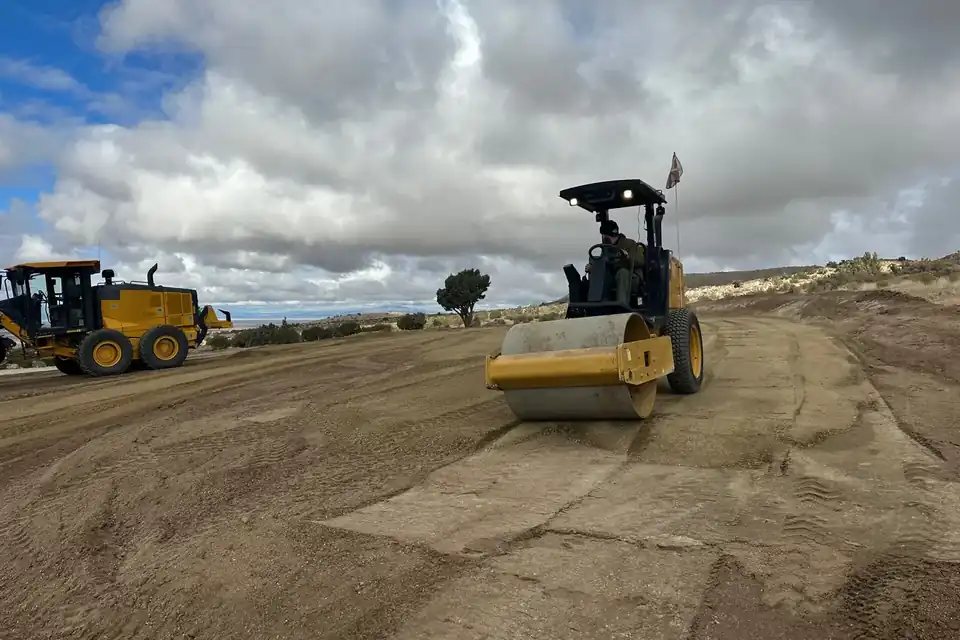
Soil compaction and land levelling
Last updated
What land levelling and compaction involve
Levelling and compaction go together: levelling gets the ground to the right height and slope, compaction makes it firm enough not to sink. Skip the compaction and a new driveway ruts, a slab cracks and a yard puddles within a season.
- Set the levels. Decide the finished height and the fall: hard surfaces need to slope away from buildings so water drains off. A surveyor or your builder sets pegs, string lines or a laser level.
- Cut and fill. A grader, TLB or bobcat cuts the high spots and pushes the soil into the low spots.
- Spread in thin layers. Fill goes down in layers the roller can compact all the way through, never in one thick heap.
- Get the moisture right. Dry soil won't compact and wet soil turns to mud under the roller. A water truck adds water evenly; in wet weather the work waits.
- Compact each layer with the right roller or plate until it stops moving under the drum.
- Test on engineered work, then trim to final level.
Land levelling equipment and compactors: which one
Machines with operators unless marked "machine only". Small compactors are usually hired without an operator and run by your own team.
| Machine | Best for | Per day |
|---|---|---|
| Grader, 140 class | Levelling large areas, farm roads, building pads; spreading fill in thin layers | R4,500–R6,000 |
| TLB | Rough levelling of yards and plots, moving fill, loading | R3,900–R5,150 |
| Bobcat | Spreading and levelling in tight yards and driveways | R2,400–R3,700 |
| Small roller, 1.5–3 t | Driveways, paths, small yards and slabs | R1,050–R1,800 |
| Roller, 10–12 t | Road compaction, building pads, big yards | R2,150–R5,600 |
| Roller, 15–18 t | Heavy road layers and bulk fill | R2,600–R2,850 |
| Tow-behind grid roller | Breaking and compacting rocky gravel on farm roads | about R1,800 (machine only) |
| Plate compactor | Paving bases, paths, small areas of sand and gravel | R270–R370 (machine only) |
| Reversible plate compactor | Thicker layers and tight spots | R400–R630 (machine only) |
| Rammer (trench compactor) | Backfill in trenches and around foundations | R350–R470 (machine only) |
| Water truck, 8,000–12,000 litre | Bringing the soil to the right moisture | R2,000–R2,300 |
Soil compaction methods by soil type: sand and gravel compact best under vibration (a vibrating roller or plate); clay compacts best under a kneading action (a padfoot drum) or impact (a rammer). A smooth drum on wet clay just seals the surface. Full roller prices and sizes are on roller hire rates.
Ask which compactor fits your jobSoil compaction in construction: why it matters
Soil compaction presses the soil particles together and squeezes out the air, so the ground gets denser and stronger. The importance of soil compaction in construction is simple: loose soil keeps settling under weight, and whatever sits on it settles unevenly. The advantages are a base that carries load, doesn't sink and lets less water in. The disadvantage is only the cost and time of doing it properly, layer by layer.
- Under slabs and foundations: fill under a slab must be compacted in layers, or the slab cracks as the fill settles. Foundation trenches are dug into firm ground and inspected before concrete.
- Road compaction: a gravel road is built in layers, each graded, watered and rolled. Rolling only the top leaves a soft layer underneath that turns into potholes. More on gravel roads and driveways.
- Trench backfill: backfill under driveways and paving needs a rammer in thin layers, or the trench line sinks.
Soil compaction tests and testers
On engineered work, your engineer specifies the density each layer must reach, usually as a percentage of the material's maximum dry density. A soils lab tests it:
- Maximum dry density and optimum moisture content are found in the lab under SANS 3001. This is the target.
- Field density is measured on site with a nuclear density gauge (SANS 3001-NG5) or by sand replacement (SANS 3001). The result says whether the layer passed or needs more rolling.
- A soil compaction tester for farmers is a penetrometer: a probe pushed into the ground with a gauge that shows where the soil gets hard. It finds plough pans and compacted lands, and is a quick check, not a construction test.
How long it takes and what it costs
| Job | Machines | Typical time |
|---|---|---|
| Level and compact a 200–400 m² yard or driveway | TLB or bobcat + small roller | 1–2 days |
| Building pad for a house, filled in layers | TLB, small or 10 t roller, water truck | 2–3 days |
| Reshape and compact 1 km of farm road | Grader, water truck, 10–12 t roller | 2–3 days |
| Levelling 1 hectare of lands for irrigation | Grader or bulldozer | 2–5 days |
A small yard: one TLB day (R3,900–R5,150) and one small roller day (R1,050–R1,800). Here is a worked example for road compaction on a farm road near Potchefstroom: two grader days, with the lowbed transport both ways.
| Example quote (for illustration only) | Amount |
|---|---|
| 140-class grader (about 18 t), 2 days at R4,500–R6,000 a day with operator | R9,000–R12,000 |
| Transport both ways to Potchefstroom | R7,740–R9,500 |
| Example total, excl. VAT | R16,740–R21,500 |
Add two days of a 10–12 t roller (R4,300–R11,200) and a water truck. Your price comes back in writing on WhatsApp before any machine moves. Every machine is on plant hire rates.
Get a levelling and compaction priceBenefits of land levelling on farms
On irrigated lands, levelling lets water spread evenly instead of pooling in low spots and missing the high ones, which saves water and evens out the crop. It also cuts erosion on slopes and makes planting and harvesting easier. Large farm areas are levelled with a grader or bulldozer to a laser or surveyed level. Keep heavy machines off wet lands, though: that is how compaction damage starts.
What you must sort out first
- Levels and falls: know the finished level and which way the water must run. Don't drain onto a neighbour.
- The right fill: topsoil, clay with roots and builder's rubble don't compact well. Your engineer or builder specifies the gravel for each layer.
- Water: a fill point for the water truck on bigger jobs: a borehole, dam or an arranged municipal point.
- Underground services: heavy rollers and cuts can damage shallow pipes and cables, so mark them first. Excavation near services must be made safe before work starts.
- Testing: on engineered work, book the soils lab so each layer is tested before the next goes on.
Clearing first? See site clearing. Bigger cut and fill? See earthworks. Keeping the dust down on site: dust suppression.
WhatsApp us your levelling jobQuestions people ask
What is land levelling?
Land levelling is reshaping the ground to a planned level or slope: cutting the high spots, filling the low spots and compacting the fill. On a building site it gives a flat, firm base with falls that take stormwater away; on a farm it spreads irrigation water evenly and stops ponding.
Why is soil compaction bad for farmland?
Because crops need the air spaces that compaction squeezes out. Compacted soil stops roots growing down, lets less rain soak in so more runs off and erodes, and stays waterlogged after rain. Heavy tractors and trucks driven on wet soil are the usual cause. On a building site the opposite is true: compaction is exactly what you want under a slab or road.
What are the types of soil compaction?
In farming, there are two main types: surface compaction (a crust or compacted top layer from traffic and rain) and subsoil compaction, such as a plough pan, a hard layer just below working depth. In construction, compaction is described by method: static weight (a smooth roller), vibration (vibrating rollers and plate compactors, best for sand and gravel), impact (a rammer) and kneading (a padfoot roller, best for clay).
What is soil compaction in agriculture?
It is the pressing together of soil particles by machinery, animals or rain, which reduces the pore space that holds air and water. It lowers yields because roots can't spread and water can't soak in. Deep ripping breaks a plough pan, and keeping heavy traffic off wet lands prevents it.
How do you test soil compaction?
On a construction job a soils lab compares the density of the compacted layer with the material's maximum dry density found in the lab under SANS 3001. On site it measures density with a nuclear density gauge (SANS 3001-NG5) or by the sand replacement method. Farmers use a soil compaction tester (a penetrometer), which shows the depth at which the soil gets hard.
Which roller or compactor do I need?
A plate compactor or rammer for trenches, paving bases and paths; a small 1.5–3 t roller for driveways and yards; a 10–12 t roller for roads, building pads and big yards; and a 15–18 t roller for heavy road layers. Clay compacts best under a padfoot drum; sand and gravel under vibration.
Related
Need a roller?
WhatsApp us the job, the town and the dates. We confirm the machine, the start date and the price in writing before the machine moves.
WhatsApp us now