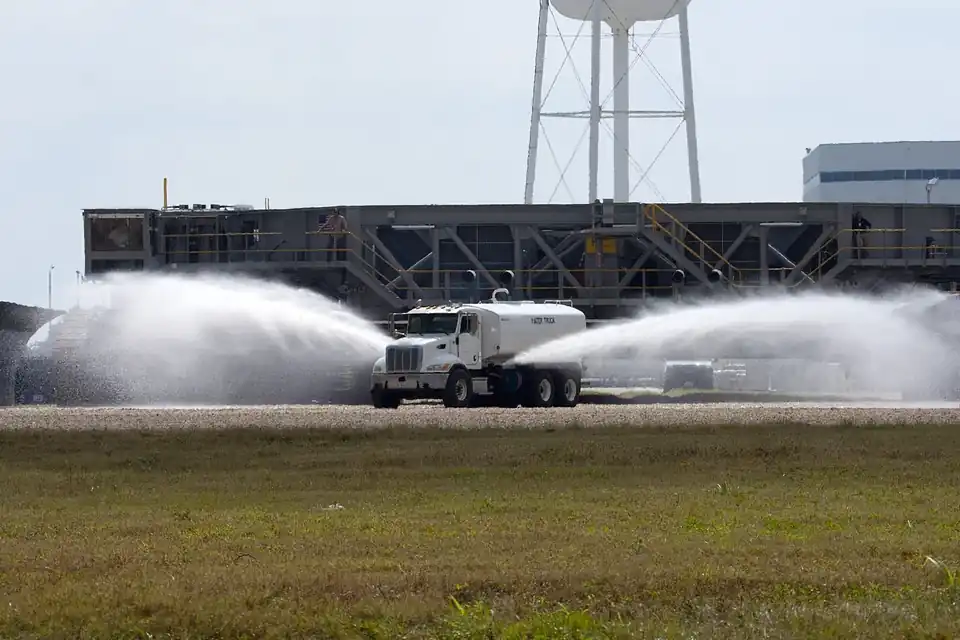
Dust suppression
Last updated
How dust suppression works
Dust comes from dry, loose surfaces being disturbed: tyres on gravel roads, machines on a site, wind over stockpiles. Wet or bound surfaces don't lift. The job is to keep the surface damp, or bound, for as long as the traffic runs.
- Map the dust sources. Haul roads, site entrances, stockpiles and the busiest work areas make most of the dust. Neighbours, schools and roads downwind are the places to protect.
- Pick the method. Water for most sites and short jobs; a chemical binder for long-term roads where water is scarce; physical measures (speed limits, covers, wind breaks) on top of both.
- Set the route and rhythm. The water truck works a loop over the dust sources, adjusting to the weather: more passes in sun and wind, fewer when it's cool or overcast.
- Arrange the water. A fill point close to the route saves hours: a borehole, dam, reservoir or an arranged municipal point.
- Check and adjust. If dust still lifts behind traffic, add passes or a binder. If the road is slippery, ease off.
Dust suppression trucks: water bowser sizes and prices
Every water truck comes with a driver. Bigger tanks mean fewer trips to the fill point; smaller trucks fit tighter sites and lighter roads.
| Size | Best for | Per day |
|---|---|---|
| 8,000–12,000 litre water truck | Building sites, estates, short gravel roads, compaction water | R2,000–R2,300 |
| 14,000–18,000 litre water truck | Civil sites, longer gravel roads, quarries | R2,400–R2,800 |
| 23,000–25,000 litre water truck | Mine haul roads and large sites | R4,000–R5,800 |
By the hour, an 8,000–12,000 litre truck is R230–R360 an hour dry. Monthly hire for mines and long civil contracts is priced in writing; use the long-hire quote below. Sizes and specs are on water truck hire.
Get a water truck price on WhatsAppThe 3 methods of dust suppression
1. Water
The quickest and most flexible method: a water truck with a spray bar wets the road or site, and water cannons or sprinklers cover stockpiles. It works from the first hour and needs nothing but water and a truck, but it dries out, so it has to be repeated all day in hot weather. Too much water makes roads slippery: mine water truck makers point to over-watering as a cause of poor traction at haul road intersections.
2. Chemical dust suppression
Magnesium chloride and calcium chloride are salts that pull moisture from the air and keep a gravel surface damp for longer. Molasses and lignosulphonate are binders that glue fine dust together. Polymer and bitumen-based products form a crust. They are usually sprayed with a water truck, so the truck and driver are the same; the product and dosage come from the product's maker or your engineer.
3. Physical measures
Speed limits on haul roads, wind breaks and fences, covering or wetting stockpiles, rumble grids and washing bays at exits, and finally sealing or paving the busiest roads. On long-term roads these cut the water bill more than anything else.
Dust suppression on gravel roads
Dust on a gravel road is the road's fine material blowing away. Lose the fines and the stones work loose, the road corrugates and potholes form, so dust suppression on gravel roads also protects the road itself. Farm roads, estate roads and site access roads are usually kept down with a water truck in the dry months; roads that carry traffic every day for months are often treated with a binder, then lightly watered.
A road that's already broken up won't hold water or binder well. Regrade and compact it first: see gravel roads and driveways and road compaction.
Dust suppression in mines and industry
Mine haul roads carry heavy trucks all day, so dust suppression in mining is constant work: big water trucks on a set loop, often with a binder on the main roads, and sprays on crushers, conveyor transfer points and stockpiles. Coal dust suppression around stockpiles and loading points matters for both health and fire risk. The Mine Health and Safety Act, 1996 applies to everyone working at a mine, so our drivers work under the mine's health and safety system, induction and road rules.
We hire water trucks with drivers to mines and contractors by the month, alongside side tippers, ADTs and excavators. See mining plant hire.
Dust suppression regulations
The National Dust Control Regulations, 2013 (GN R.827, published 1 November 2013 under the Air Quality Act) apply to any activity that raises dust, from construction and roads to mines and quarries.
| Area | Dustfall rate, 30-day average | Exceedances allowed |
|---|---|---|
| Residential | Below 600 mg/m²/day | Two a year, not in consecutive months |
| Non-residential | Below 1,200 mg/m²/day | Two a year, not in consecutive months |
- Monitoring: an air quality officer can require anyone whose activity raises dust to run a dustfall monitoring programme, using dust buckets to the ASTM D1739 method, and to report the results.
- Dust management plan: anyone who exceeds the standard must submit a dust management plan to the air quality officer within three months of the monitoring report, and start implementing it within one month of approval.
- Penalties: a first conviction can bring a fine of up to R5,000,000, up to five years' imprisonment, or both.
On mines, dust in the workplace is also covered by the mine's health and safety duties under the Mine Health and Safety Act.
What dust suppression costs
You pay for the truck and driver by the day (or month), plus transport. The water comes from your fill point, and a binder product is bought separately. Here is a worked example: a 14,000–18,000 litre water truck for five days on a site near Kriel in Mpumalanga, with the travel both ways from eMalahleni.
| Example quote (for illustration only) | Amount |
|---|---|
| 14,000–18,000 litre water truck, 5 days at R2,400–R2,800 a day with operator | R12,000–R14,000 |
| Transport both ways to Kriel | R4,480–R5,400 |
| Example total, excl. VAT | R16,480–R19,400 |
Prices exclude VAT; your price comes back in writing before the truck moves. Every machine is on plant hire rates.
What you must sort out
- A water source and permission to use it: a borehole, dam, reservoir or municipal point, close to the work.
- The route: which roads and areas, and which ones matter most (neighbours, site entrance, public road).
- Any binder product and its dosage, if you're using one.
- Monitoring if your site, mine or permit conditions require dustfall buckets.
Questions people ask
What is dust suppression?
Dust suppression is keeping dust on the ground instead of in the air, by wetting surfaces with water trucks or sprayers, binding them with a product such as magnesium chloride, or slowing and limiting traffic. On construction sites, gravel roads and mines it protects workers' lungs, keeps visibility safe for drivers and stops dust reaching neighbours.
Why is dust suppression important?
For health, safety and the law. Dust from roads and sites gets into people's lungs and homes, cuts visibility on haul roads, wears out engines and filters, and blows the fine material out of gravel roads so they corrugate and pothole. South Africa's National Dust Control Regulations, 2013 set legal dustfall limits, and anyone who exceeds them can be ordered to monitor and to submit a dust management plan.
What is a dust suppression system?
It is the set-up used to keep dust down on a site: water trucks with spray bars for roads and open ground, fixed sprinklers or misting cannons for stockpiles and conveyor points, and sometimes a chemical additive mixed into the water. On most construction sites and gravel roads the system is simply a water truck and driver working a set route.
What are the dust suppression regulations in South Africa?
The National Dust Control Regulations, 2013 (GN R.827 of 1 November 2013), made under the National Environmental Management: Air Quality Act. They set dustfall limits of under 600 mg/m² a day for residential areas and under 1,200 mg/m² a day for non-residential areas (30-day average, with no more than two exceedances a year, not in consecutive months). An air quality officer can require a dustfall monitoring programme, and anyone over the limit must submit a dust management plan within three months.
What are the 3 methods of dust suppression?
Water (spraying with water trucks, sprinklers or mist cannons), chemical (salts such as magnesium or calcium chloride, binders such as molasses or lignosulphonate, and polymer products that bind the surface) and physical (lower speed limits, wind breaks, covering stockpiles, or paving and sealing the road).
How often must a gravel road be watered?
As often as it takes to stop the dust, which depends on the sun, wind, traffic and soil. In hot, windy weather a busy road dries out fast, so the truck works a loop all day; in cool weather a few passes may do. Light, frequent passes beat one heavy soaking: over-watering makes the road slippery and washes out the fines.
Related
Need a water truck?
WhatsApp us the job, the town and the dates. We confirm the machine, the start date and the price in writing before the machine moves.
WhatsApp us now