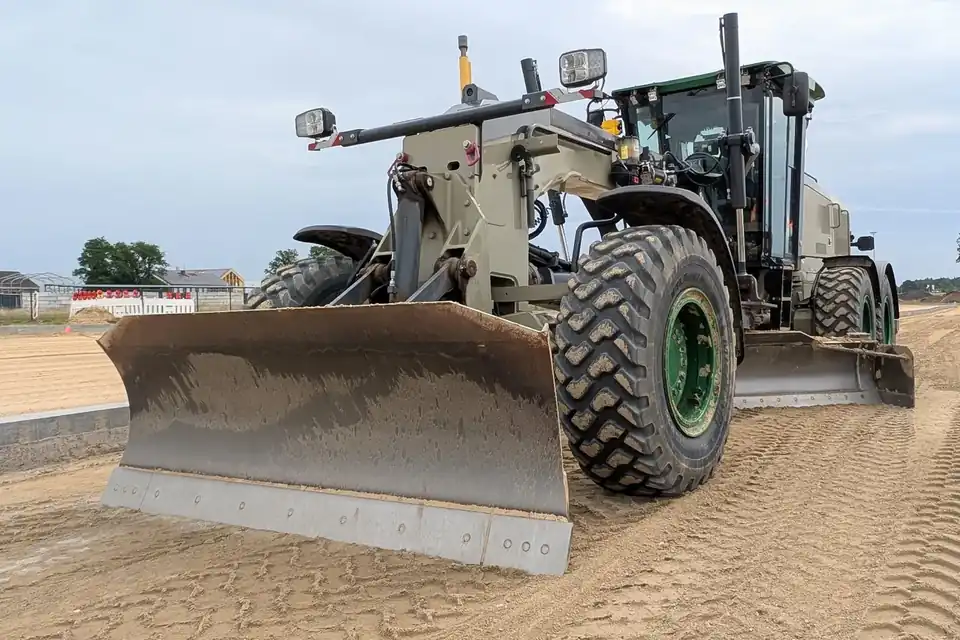
Grader hire
Last updated
Grader hire with an experienced operator
We send motor graders, each with an experienced grader operator, to farms, mines, estates, municipalities and building sites in all 9 provinces. A grader (also called a motor grader or road grader) is the machine for long, accurate levels: roads, building platforms, sports fields and large yards.
- Farm and game farm roads: re-shaping corrugated gravel roads, cutting a crown so rain runs off, and opening side and mitre drains.
- Building platforms and yards: spreading and levelling fill to a set height for warehouses, housing and container yards. See land levelling.
- New gravel roads and layerworks: spreading each road layer to thickness, with a water truck and roller. See gravel roads and driveways.
- Mine haul roads: keeping haul roads smooth and drained so trucks run faster with less tyre wear. See mining plant hire.
- Township and estate roads: regular blading of gravel streets, and shaping before paving or tar.
Grader sizes and specs
Specs are from the manufacturer's sheets for a common model in each class. The machine we send is that model or similar.
| Class | Example model | Operating weight | Blade width | Net power | Best for |
|---|---|---|---|---|---|
| 120 class | Cat 120 GC or similar | 14,254 kg | 3.7 m (12 ft) | 128 kW | Farm roads, estates, driveways, maintenance blading |
| 140 class | Cat 140 or similar | 18,400 kg | 3.7 m (12 ft) | 136 kW | New roads, layerworks, building platforms, municipal roads |
| 16 class | Cat 16 GC or similar | 31,809 kg | 4.9 m (16 ft) | 249 kW | Mine haul roads, wide roads, heavy cuts |
The Cat 140 figure is typically equipped, with a rear ripper that reaches 428 mm deep through 5 shanks; a front V-type scarifier reaches 467 mm. It travels at up to 46.6 km/h forward. The 16 GC figure includes its 4.9 m blade, push plate and ripper.
Which size? The 140 class is the all-rounder: heavy enough to cut hard gravel and spread road layers, light enough for farm and estate roads. Pick a 120 for lighter maintenance blading and a 16 class for wide mine haul roads. A mini grader isn't usually worth it: for a short driveway, a TLB or bobcat spreads and levels the gravel without a lowbed.
Grader hire rates
These are our prices with an operator, excluding VAT. Transport is always its own line.
| Size | Rate | Price |
|---|---|---|
| 120-class grader (about 14 t) | Per day, with operator | R3,900–R4,400 * |
| 140-class grader (about 18 t) | Per day, with operator | R4,500–R6,000 |
| 140-class grader (about 18 t) | Per 200-hour month, dry (operator included, you pay the diesel) | about R136,000 * |
| Large grader (14H / 16 class) | Per day, with operator | about R6,600 * |
| Grader, any size (hourly) | Per hour, with operator | R490–R610 |
* Few price points for this one, so treat it as a guide; the exact price comes back on WhatsApp.
The weight ranges in the price table are the classes we price by; the exact machine and its weight are on your quote. Rates marked * have few price points behind them; the exact price comes back on WhatsApp. For several days, multiply the day rate: a week (5 days) with a 140-class grader comes to R22,500–R30,000 before transport. Monthly hire on a road or mine contract is usually based on about 200 machine hours.
Get your grader price on WhatsAppGrader wet hire vs dry hire
- Dry hire: the operator is included and you pay the diesel. A 140-class on a dry month of about 200 hours is about R136,000.
- Wet hire: the operator and the diesel are both included. Wet rates for graders are priced per job, because fuel burn depends on how much cutting versus light blading the work needs.
- With operator: the rates above. Whether diesel is in or out is confirmed in writing before the machine moves.
Most bookings carry a full-day minimum, often 8–9 hours. If the grader is on site and ready but can't work for a reason on your side (no water truck, gravel not delivered, site closed), those hours are standing time at the rate on your quote. If it breaks down, we send a replacement or there's no charge for the downtime.
Grading a gravel road: the machines that work together
A grader on its own makes a road look right; a grader with water and a roller makes it last. On new roads and re-gravelling the usual team is:
| Machine | Job | Per day |
|---|---|---|
| Grader, 140 class | Spreads gravel to thickness, shapes the crown and drains | R4,500–R6,000 |
| Water truck, 14,000–18,000 litre | Brings each layer to the right moisture for compaction | R2,400–R2,800 |
| Roller, 10–12 t | Compacts each layer to the specified density | R2,150–R5,600 |
| Tipper truck, 10 cube | Brings gravel from the borrow pit or quarry | R3,700–R5,250 |
The grader works first: it scarifies or rips the old surface, mixes in the water and new gravel, then spreads and shapes it. The roller follows on each layer. Roads are built in layers rather than in one thick lift, because rollers only compact to a limited depth; layer thickness and density come from your engineer's specification. More on layers and compaction: roller and compactor hire.
Good drainage is what keeps a gravel road alive: a crown so water runs off the surface, side drains to carry it, and mitre drains to lead it away from the road before it builds up speed. The grader cuts all three.
Grader transport, operator and safety
We move graders by lowbed, quoted as its own line. Inside a main centre, transport there and back usually comes to R6,000–R9,500. Out of town it's charged by the road distance from the nearest main centre: for example, Lichtenburg is about 139 km from Rustenburg by road, and the lowbed there and back usually comes to R11,960–R14,460.
Graders are construction plant under Construction Regulation 23 (GN R.84 of 2014). The operator must be trained, certified competent, authorised in writing and hold a medical certificate of fitness, and must inspect the machine daily before use and record it in the register kept in the machine. The grader carries a hooter and an automatic reversing alarm. Copies of operator certificates come before the machine arrives, on request; see safety and certificates.
Grading on public roads, road reserves or next to traffic needs the road authority's permission and traffic control. If your road crosses a stream or wetland, check what authorisation is needed before the grader moves any material there.
Grader hire near you
We send graders to farms, mines and towns across South Africa, from Limpopo game farm roads to Mpumalanga coal mine haul roads and Free State farm roads. Local detail and transport: plant hire in Polokwane, eMalahleni (Witbank), Bloemfontein, Rustenburg, Pretoria and every area we cover.
How booking works
- WhatsApp the job: road length or area, what's there now (old gravel, bush, new fill), the town and dates. Photos help.
- We confirm in writing: the grader class, the rate basis, the minimum hours and transport as its own line.
- Pay the deposit to book, and the grader and operator arrive on your start date.
Full details: how it works. For bigger earthworks with excavators, dozers and tippers, see earthworks.
WhatsApp us your grader jobQuestions people ask
How much does it cost to hire a grader?
A 140-class grader costs R4,500–R6,000 a day with operator. A 120-class costs R3,900–R4,400 a day and a large 16-class about R6,600 a day. By the hour, any size is R490–R610 with operator. Transport is extra and shown as its own line.
What does a grader do?
A motor grader shapes and levels ground with a long blade set between its front and back wheels. It cuts and fills to a set level, shapes a road's crown and side drains, spreads gravel and road layers evenly, and keeps gravel roads smooth. A ripper or scarifier at the back breaks up hard or corrugated surfaces before re-shaping.
How wide is a grader blade?
A 120 or 140-class grader carries a 3.7 m (12 ft) blade; on a Cat 140 or similar it's 610 mm high. A 16-class grader carries a 4.9 m (16 ft) blade, 787 mm high, built for wide mine haul roads.
Can a grader build a gravel road on its own?
It shapes the road, but a road that lasts needs water and compaction too. The usual team is a grader to spread and shape, a water truck to bring the gravel to the right moisture, and a roller to compact each layer. See gravel roads and driveways.
Is a grader or a TLB better for a driveway?
For a short home driveway, a TLB spreads and levels the gravel and costs R3,900–R5,150 a day with operator without a lowbed. For a long farm or estate road, a grader cuts a proper crown and side drains far faster, so it costs less per kilometre even with transport.
Related
Need a grader?
WhatsApp us the job, the town and the dates. We confirm the machine, the start date and the price in writing before the machine moves.
WhatsApp us now