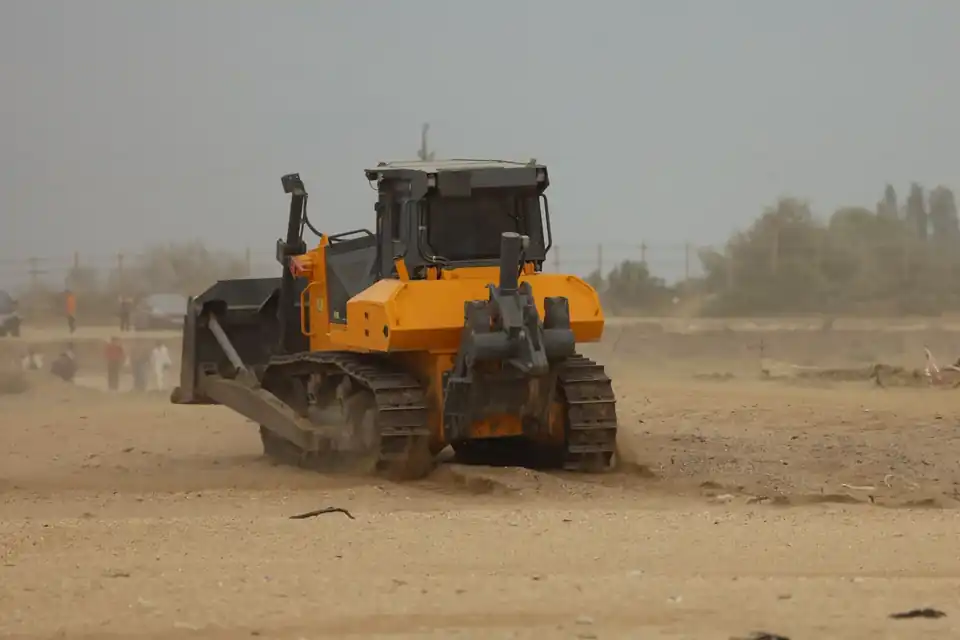
Bulldozer hire
Last updated
Dozer hire with an experienced operator
We send bulldozers (dozers), each with an experienced operator, to farms, mines, quarries, dam sites and big building sites in all 9 provinces. A bulldozer is a tracked tractor with a heavy blade on the front for pushing and spreading, and usually a ripper on the back for tearing up hard ground.
- Bush and land clearing: pushing out trees, stumps and bush, and stacking it in windrows. See site clearing.
- Dam walls: pushing up and spreading fill in layers for farm dams and shaping spillways. See dam building.
- Ripping: breaking calcrete, shale and soft rock with the rear ripper so it can be pushed or loaded, often cheaper than breaking with a hammer.
- Building platforms and fill: spreading fill for building platforms and yards before the grader trims to level. See land levelling.
- Mines and quarries: pushing overburden, ripping, building and maintaining haul road and dump edges, and managing stockpiles. See mining plant hire.
- Pioneer roads: cutting the first rough track into a site, farm or prospecting area.
Bulldozer sizes: D6, D8 and D9 specs
Dozer classes are named after the Cat models most people know. Specs are from the manufacturer's sheets for a common model in each class; the machine we send is that model or similar.
| Class | Example model | Operating weight | Net power | Blade capacity | Ripper |
|---|---|---|---|---|---|
| D6 class | Cat D6 or similar | 22,130–23,911 kg | 161 kW | 5.7 m³ semi-universal (SU) | Optional high-lift ripper, straight or curved shanks |
| D8 class | Cat D8 GC or similar | 37,557 kg | 226 kW | 8.7 m³ semi-universal (SU) | Single-shank or multi-shank |
| D9 class | Cat D9 or similar | 49,988 kg | 337 kW | 13.6 m³ SU or 16.6 m³ universal (U) | Single shank to 1,231 mm deep (1,727 mm deep-ripping shank); multi-shank to 798 mm |
Blades: a semi-universal (SU) blade has short wings and digs into hard material well; a universal (U) blade has bigger wings and carries more loose material over longer pushes; a straight blade is for fine grading. Low ground pressure (LGP) versions run wider tracks (up to 915 mm on a D6) for soft, wet or sandy ground.
The D9 figure is for an SU blade, single-shank ripper and 610 mm shoes. For coal stockpiles, the same class can carry a coal blade of 36.8 m³. Smaller D3 and D4 class dozers and bigger D10 class machines: exact price on WhatsApp. More on how dozers compare with other machines: the bulldozer guide.
Bulldozer hire rates
These are our guide prices with an operator, excluding VAT, with transport as its own line. We have fewer price points for dozers than for most machines, so the exact price comes back on WhatsApp.
| Size | Rate | Price |
|---|---|---|
| D6 class bulldozer (18–25 t) | Per day, with operator | R5,000–R7,750 * |
| D8 class bulldozer (35–40 t) | Per day, with operator | about R8,200 * |
| D9 class bulldozer (45–50 t) | Per day, with operator | R9,800–R11,000 * |
* Few price points for this one, so treat it as a guide; the exact price comes back on WhatsApp.
What moves the dozer price: the class, how long you need it (daily or a monthly contract on about 200 machine hours), whether diesel is in or out (wet or dry), how much ripping the job needs, and the lowbed distance. If the dozer is on site and ready but stands for a reason on your side, those hours are standing time at the rate on your quote; if it breaks down, we send a replacement or there's no charge for the downtime.
Get your exact dozer price on WhatsAppWhich dozer for which job?
| Job | Class that fits |
|---|---|
| Bush clearing on farms, firebreak lines, small farm dams, spreading fill on building platforms | D6 class |
| Bigger farm and municipal dams, heavy bush and trees, ripping calcrete and shale | D8 class |
| Mine overburden, quarry ripping, big earthworks dams, coal stockpiles | D9 class |
| Small plot clearing and levelling in town | A TLB or bobcat, no lowbed needed |
| Digging below ground, trenches, loading trucks | An excavator, not a dozer |
On dam walls and big fills, the dozer spreads each layer and a padfoot roller compacts it; a water truck brings the soil to the right moisture. On clearing jobs, an excavator with a grab often works alongside to load stumps and rocks into tippers.
Dozer transport, operator and safety
Dozers travel on a lowbed both ways; even a D6 class weighs about 23 t. Inside a main centre the lowbed there and back usually comes to R6,000–R9,500. Out of town it's charged by the road distance from the nearest main centre: for example, Ermelo is about 104 km from Middelburg by road, and the lowbed there and back usually comes to R8,940–R10,820. D8 and D9 class machines (about 38–50 t) need heavier multi-axle lowbeds and a route planned for their size and weight, so give us the site location early.
Under Construction Regulation 23 (GN R.84 of 2014), the operator of construction plant must be trained, certified competent, authorised in writing and hold a medical certificate of fitness. The operator inspects the dozer every day before use and records it in the register kept in the machine; the dozer carries a hooter, an automatic reversing alarm and a cab that protects the operator in a rollover or from falling material. Copies of certificates come before the machine arrives, on request. See safety and certificates.
Your side: mark underground services and power lines, show the operator where trees, fences and boundaries must stay, and check whether the clearing needs a permit (for example, protected trees or work near a river or wetland) before the dozer starts.
Bulldozer hire near you
We send dozers to farms, mines and dam sites across South Africa: Limpopo and North West bush, Mpumalanga coal mines, Free State and KwaZulu-Natal farms. Local detail and transport: plant hire in Polokwane, eMalahleni (Witbank), Rustenburg, Bloemfontein, Pietermaritzburg and every area we cover.
How booking a dozer works
- WhatsApp the job: clearing, dam, ripping or pushing; the area or volume; the town and dates. Photos of the site help.
- We confirm in writing: the dozer class and model (or similar), blade and ripper, the rate basis, minimum hours and the lowbed as its own line.
- Pay the deposit to book, and the dozer and operator arrive on your start date.
Full details: how it works. For big jobs with several machines, see earthworks.
WhatsApp us your dozer jobQuestions people ask
How much does it cost to hire a bulldozer?
A D6 class bulldozer costs R5,000–R7,750 a day with operator. A D8 class is about R8,200 a day and a D9 class R9,800–R11,000 a day. We have fewer price points for dozers than for most machines, so treat these as a guide: send the job, town and days on WhatsApp and the exact price comes back in writing, with lowbed transport as its own line.
Does bulldozer hire include an operator?
Yes. Every dozer comes with an experienced operator who is trained, certified competent and holds a medical certificate of fitness, as Construction Regulation 23 requires. Dozer work is a skill: a good operator spreads a layer flat, or cuts a dam wall to line, in far fewer passes.
Which dozer do I need, a D6, D8 or D9?
A D6 class (about 23 t, 5.7 m³ blade) suits bush clearing, farm dams, building platforms and spreading fill. A D8 class (about 37.6 t, 8.7 m³ blade) suits bigger dams, heavy clearing and ripping hard ground. A D9 class (about 50 t, 13.6–16.6 m³ blade) is for mines, quarries and big earthworks, and rips up to 1.23 m deep with a single shank.
Can I hire a small or mini bulldozer?
What is dry hire for a bulldozer?
In South Africa, dry hire means the operator is included and you pay the diesel. It suits farms and mines that already buy diesel in bulk. Dozers burn a lot of fuel when ripping and pushing, so dry and wet dozer rates are priced per job on WhatsApp.
Related
Need a bulldozer?
WhatsApp us the job, the town and the dates. We confirm the machine, the start date and the price in writing before the machine moves.
WhatsApp us now