Dam building
Last updated
How a farm dam is built, step by step
Most South African farm dams are earth dams: a wall of compacted clay soil across a valley or around a dug basin. Done properly, the wall holds water for decades. Done badly, it leaks through the foundation or washes away in the first big storm. This is the dam construction process.
- Check the site, the catchment and the permits. The size of the catchment above the dam decides how big the spillway must be. The water use and dam safety rules (below) decide what paperwork you need. A small dam is cheap to build in the wrong place and expensive to fix.
- Strip the topsoil under the whole wall footprint. Topsoil and roots under a wall let water seep through.
- Dig the key trench (cut-off trench) along the centre line of the wall, down to solid, watertight ground. FAO's manual on small earth dams gives 1 m as the minimum width for small dams; an excavator digs it.
- Fill the key trench and build the clay core in thin layers. Where machines do the work, FAO describes core layers of 75–150 mm, each wetted to the right moisture and compacted before the next.
- Build the wall up in layers to the designed side slopes. For a wall of one soil type, FAO's guide uses about 1:3 on the water side and 1:2 on the dry side. Add about 10% to the height for settlement.
- Cut the spillway in natural ground at one end of the wall, never over the fill. FAO's minimum for small dams is 10 m wide and 1 m deep for catchments up to 5 km², and 15 m wide and 1.5 m deep above that, leaving freeboard (dry wall height) above the spillway level.
- Install the outlet pipe with the wall, not afterwards. A dam built under the general authorisation for storing water after it took effect must have outlet works that can release the full volume within 30 days.
- Grass and protect the wall to stop erosion, and keep trees off it.
Machines for dam building
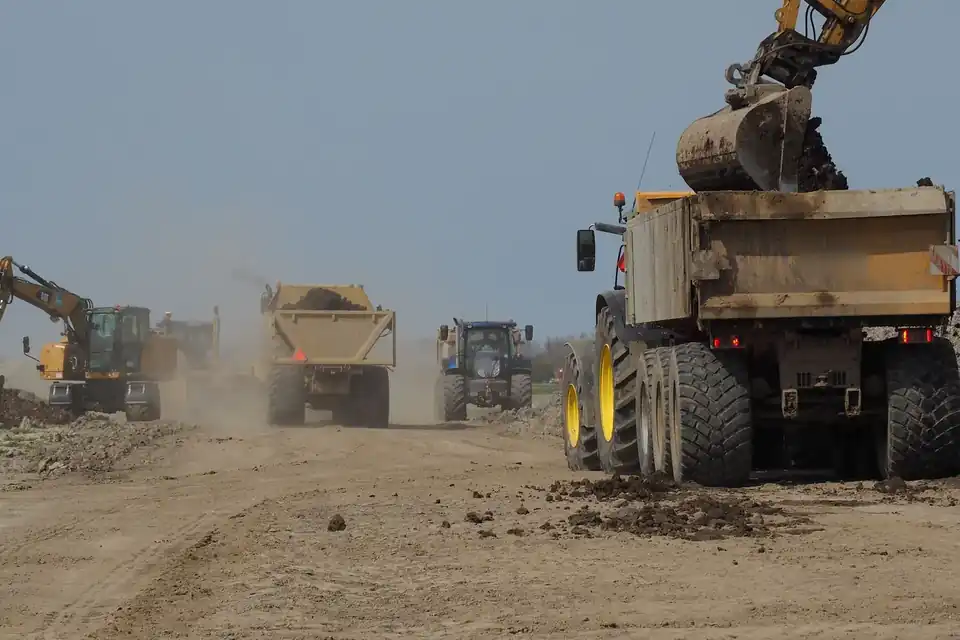
A dam is built by a team of machines, each with an experienced operator. The size of the team depends on the wall volume and how far the clay comes from.
| Machine | Job on the dam | Per day |
|---|---|---|
| Bulldozer, D6 class | Stripping topsoil, pushing clay onto the wall, shaping slopes | R5,000–R7,750 |
| Excavator, 20–25 t | Key trench, basin, spillway, loading clay from the borrow pit | R3,500–R5,600 |
| ADT, 20–25 t | Carrying clay from the borrow pit over rough farm ground | R4,000–R5,000 |
| Water truck, 14,000–18,000 litre | Wetting each clay layer to the right moisture | R2,400–R2,800 |
| Roller, 10–12 t | Compacting each layer of the wall and core | R2,150–R5,600 |
| TLB | Small dams and ponds, outlet pipe trench | R3,900–R5,150 |
For a big wall, a D8-class bulldozer (about R8,200 a day with operator) or a 36–55 t excavator (R6,500–R8,100 a day with operator) moves the volume faster. Every machine price is on plant hire rates.
Send us your dam site on WhatsAppHow big is the job? A quick wall volume estimate
The wall volume drives the machine days. Work out the cross-section of the wall and multiply by its length. Here's an example for a farm dam wall with a 3 m crest, 4 m high, side slopes of 1:3 and 1:2, and 60 m long:
- Crest part: 3 m × 4 m = 12 m²
- Slopes: (3 × 4 × 4 + 2 × 4 × 4) ÷ 2 = 40 m²
- Cross-section: 52 m², × 60 m = 3,120 m³, plus 10% for settlement = about 3,430 m³ of compacted fill
The real figure is lower because a wall tapers into the valley sides, and the key trench adds some. Your engineer or our team works out the true volume from a survey. A wall this size is a small farm dam: typically one to three weeks of machine time.
Farm dam construction cost: a worked example
Here is an example for a farm near Bela-Bela in Limpopo: ten days of a D6-class bulldozer, with the lowbed transport both ways from Pretoria.
| Example quote (for illustration only) | Amount |
|---|---|
| D6 class bulldozer (18–25 t), 10 days at R5,000–R7,750 a day with operator | R50,000–R77,500 |
| Transport both ways to Bela-Bela | R9,640–R11,640 |
| Example total, excl. VAT | R59,640–R89,140 |
A dam this size would usually add an excavator for the key trench and spillway, a roller and a water truck. Five roller days are R10,750–R28,000 and five water truck days R12,000–R14,000. Prices exclude VAT; your price comes back in writing before the machines move.
Get a dam building quoteWhat you must sort out: water use and dam safety rules
Storing water is a water use
Under the National Water Act, storing water needs authorisation. The national general authorisation for taking and storing water (GN 538 of 2016) lets a person who owns or lawfully occupies land store water off-channel (not in a river or stream), up to the maximum volume set for that catchment in the notice's Table 1. Store more than 10,000 m³ and you must register the water use with the Department of Water and Sanitation, and the right only applies once it is registered.
A dam built in a river, stream or drainage line is outside that general authorisation, so it needs a water use licence. Building in a watercourse also changes its flow and banks, which are water uses of their own.
Dams with a safety risk
Section 117 of the National Water Act defines a dam with a safety risk as one that can hold more than 50,000 m³ of water and has a wall more than 5 m high, measured from the lowest ground on the downstream side to the non-overspill crest. The Minister can also declare other dams or categories to be safety-risk dams.
- Whoever owns a dam with a safety risk must register it, within 120 days of it first being able to hold water (section 120).
- Design and construction work on these dams involves an approved professional person, an engineer approved for dam work, who issues completion certificates (section 119). Talk to the DWS Dam Safety Office before you build.
- The Minister can order a safety report or repairs at the dam's cost (section 118).
Environmental authorisation
Building in or near a watercourse, and clearing the basin, can trigger NEMA environmental authorisation. Clearing 1 hectare or more of indigenous vegetation for the basin is one of the listed activities on its own (activity 27 of GN R.983 of 2014). An environmental assessment practitioner checks which activities apply before you start. More on clearing rules: site clearing.
On the day
- Peg the wall line, the spillway and the borrow pit.
- Have the clay tested, and know where the topsoil stockpile goes.
- Plan for dry weather: wet clay can't be compacted.
The design side in more depth is in our dam building guide.
Small dams, ponds and tailings dams
Small dams and koi ponds
Building a small dam on your property for stock water, or a pond for koi or a garden, is usually a TLB or mini excavator job of one to three days. Ponds that rely on a liner need a smooth, stone-picked base. A dug pond that only collects rain is still storing water, so check the general authorisation limits if it is large.
Tailings dams on mines
Tailings dam construction on mines follows the mine's engineered design, and safety-risk dams must be registered under the same chapter of the Act. We supply bulldozers, excavators, ADTs, water trucks and rollers on monthly hire with operators for wall raises and rehabilitation. See mining plant hire.
Related jobs: earthworks and compaction and soil compaction.
WhatsApp us about your damQuestions people ask
How much does it cost to build a farm dam?
It depends on the wall size and how far the clay has to travel, so we price it by machine days. As a guide, ten days of a D6-class bulldozer are R50,000–R77,500, five days of a 10–12 t roller R10,750–R28,000 and five days of a 14,000–18,000 litre water truck R12,000–R14,000, plus transport. A worked example is in the cost section above; send the site and the size you want for a written quote.
Do I need a permit to build a dam on my farm?
Usually some form of authorisation, yes. Storing water is a water use. A dam off the river (not in a watercourse) can fall under the national general authorisation for storing water up to the limit set for your catchment, and must be registered with DWS once it stores more than 10,000 m³. A dam in a river, stream or drainage line needs a water use licence. A dam over 5 m high holding more than 50,000 m³ is also a dam with a safety risk under the dam safety rules.
What machine is used to build a dam?
A bulldozer pushes the soil and shapes the wall; an excavator digs the key trench, the basin and the spillway and loads ADTs or tippers carrying clay from a borrow pit; a water truck wets the clay; and a roller compacts each layer. A TLB is enough for a small pond or stock-watering dam.
How long does it take to build a farm dam?
A small farm dam of a few thousand cubic metres usually takes one to three weeks of machine time; bigger walls take months. Rain stops the work, because wet clay can't be compacted properly, so most farm dams are built in the dry season.
What soil is best for a dam wall?
Soil with enough clay to hold water once compacted. FAO's manual on small earth dams classes clay soil as over 55% clay, sandy clay as 33–55% and sandy clay loam as 20–30%; the less clay in the core, the more compaction and care it needs. Have the soil tested before you build, and keep sand and topsoil out of the wall.
Related
Sources we checked
- National Water Act 36 of 1998 - Chapter 12 (safety of dams)
- National Water Act 36 of 1998 - section 120 registration of dam with safety risk
- General Authorisation for the taking and storing of water (GN 538 of 2016) - section 5 (storing of water)
- General Authorisation for the taking and storing of water (GN 538 of 2016) - section 7 (registration)
- FAO Manual on small earth dams - a guide to siting, design and construction (Irrigation and Drainage Paper 64)
- EIA Regulations 2014 - Notice 1 of activities (GN R.983 of 2014 as amended) activity 27
Need a machine?
WhatsApp us the job, the town and the dates. We confirm the machine, the start date and the price in writing before the machine moves.
WhatsApp us now