What is the purpose of building a dam?
Last updated
Why dams are built: the main purposes
Rain in most of South Africa falls in one season and not the other. A dam stores the wet-season water so it can be used in the dry months, and it lets the people downstream control how much water reaches them. SANCOLD lists five common uses for a reservoir; FAO adds the ones that matter on a farm.
| Purpose | How the dam does it | Typical South African example |
|---|---|---|
| Water supply | Stores rain from the wetter months for homes and factories in drier periods, and releases water to keep rivers flowing | Vaal Dam, supplying Gauteng |
| Irrigation | Stores water in the rainy season and releases it through canals or pipes in the dry season | Hartbeespoort Dam; most farm dams |
| Hydroelectric power | Holds water above turbines; falling water drives the generators | Vanderkloof Dam |
| Flood control | Kept low in the rainy season so it can absorb small and medium floods; the spillway passes the rest | Quedisizi Dam (KZN) |
| Stock and household water | Stores water close to where animals and people need it | Farm stock-watering dams |
| Fish farming, groundwater recharge, drainage sumps, conservation | FAO lists these as secondary uses of small dams | Farm dams that also hold fish or recharge boreholes |
| Mining and industrial waste | A tailings dam stores fine waste from mines and plants, plus process water and stormwater | Gold and platinum slimes dams |
Navigation, a major use elsewhere in the world, doesn't apply here: SANCOLD notes that none of South Africa's dams are navigable.
What is dam construction?
Dam construction is building the barrier that holds the water back, plus the two parts that keep it safe: a spillway that passes floods around or over the dam without damaging it, and an outlet to draw water off. On a farm earth dam the work is mostly earthmoving: stripping topsoil, digging a key trench down to watertight ground, building a clay wall in thin compacted layers, and cutting the spillway in natural ground at one end. The step-by-step order, the machines and a worked cost are on our dam building page.
Dam construction types
A dam is built from concrete or from natural materials like earth and rock. SANCOLD describes five main types:
| Type | Built from | How it holds the water | Site it needs | Example |
|---|---|---|---|---|
| Arch | Concrete | Curved into the water; the arch shape carries the push into the valley sides | Narrow, steep valley with good rock in the floor and sides | Roode Elsberg Dam (W Cape); Katse Dam, 186 m, in Lesotho |
| Buttress | Concrete or masonry | A watertight face held up by triangular walls (buttresses) on the downstream side | Narrow or wide valley, sound rock | Bulshoek Dam (W Cape) |
| Embankment (earthfill or rockfill) | Compacted earth, or dumped and compacted rock, usually with a clay or concrete core | Its sheer mass, shaped like a bank; the core stops water passing through | Wide valleys; hard rock or softer soils | Goedertrouw Dam (KZN); almost every farm dam |
| Gravity | Concrete or masonry | Its own weight; roughly triangular in cross-section | Narrow or wide valley, sound rock | Clanwilliam Dam (W Cape) |
| Tailings (slimes) | Mine or plant waste | Built up in stages to store waste and process water | Engineered for each mine | Gold and platinum mine slimes dams |
Concrete dams need sound rock and specialist engineering. Embankment dams don't press as hard on their foundations, use material dug nearby (ideally from inside the future basin), and are the type earthmoving machines build.
Farm dam types
- Homogeneous earth dam: one type of soil throughout. FAO's guide uses side slopes of about 1:3 on the water side and 1:2 on the dry side, with a rock toe or gravel drain to relieve seepage. Cheap and reliable when built properly.
- Zoned earth dam: a watertight clay core, a semi-watertight section on the water side and a free-draining section on the dry side. Because the zones do different jobs, the slopes can be steeper (about 1:2 and 1:1.75), so the wall uses less material. The water-side face is protected with stone pitching.
- Valley (on-stream) dam: a wall across a stream or drainage line. It catches the runoff from the whole catchment above it, so it needs a big spillway, and building in a watercourse needs a water use licence.
- Off-channel dam: a basin dug beside the stream with a wall around it, filled by a pipe, pump or furrow. It can fall under the general authorisation for storing water, and its spillway only has to handle the rain falling on the dam itself.
Earth wall basics: what makes a farm dam hold water
An earth dam fails for a handful of reasons, and each part of the wall exists to stop one of them:
| Part | What it is | What it prevents |
|---|---|---|
| Key (cut-off) trench | A trench along the wall's centre line, taken down to firm ground or rock where possible, at least 1 m wide on small dams | Water seeping under the wall through the foundation |
| Clay core | The watertight centre, built in layers: 75–150 mm per layer when machines compact it (50–75 mm by hand), each layer moist and compacted | Water seeping through the wall |
| Side slopes | About 1:3 upstream and 1:2 downstream for a single-soil wall | Slips and slumps when the dam is full or drawn down fast |
| Settlement allowance | About 10% extra height | The crest settling below the design level |
| Spillway and freeboard | A channel cut in natural ground at one end, with dry wall height left above flood level | Floods running over the wall and washing it away |
| Grass and fencing | Grass on the wall, livestock fenced out of the water | Erosion of the wall and trampled, muddy edges |
Compaction is the whole job. FAO describes walls built with farm tractors, scoops and rollers, even tractors with water-filled tyres for extra weight; on a South African farm this is a padfoot roller working each wetted layer, with a water truck bringing the clay to the right moisture. Plastic sheeting as a core is an option FAO discusses, but it warns that termites and rodents attack it in warm climates.
Size limits worth respecting
FAO advises people using its manual to build earth dams no higher than 5 m from the streambed to the crest, and to get a hydrologist's advice for catchments over 25 km² or reservoirs over 50,000 m³. South African law draws a line in the same place: a wall over 5 m high holding more than 50,000 m³ is a dam with a safety risk, which brings in registration and an approved professional engineer.
Losses to plan for
- Seepage: "Seepage will always occur with an earth dam." FAO plans for about 10% of the stored water a year through a well-built wall.
- Evaporation: 0.3–2.5 m of water depth a year, depending on the climate. Over 1 hectare of surface (10,000 m²), 1.5 m of evaporation is 15,000 m³ a year, the whole contents of a small farm dam.
- Silt: FAO allows dead storage for sediment of up to 5% of the water stored.
That is why a deep, narrow basin is worth more than a shallow, wide one: the same volume with less surface loses less to the sun.
How dam building affects water systems and the environment
SANCOLD is direct about it: flooding land and managing the water behind a dam can harm people, wildlife and the environment, in the valley and downstream. The main effects:
- River flow changes. Water that would have run downstream is held back, so the river below gets less, and at different times.
- Sediment is trapped. Rivers slow down as they enter a reservoir and drop their silt, filling the dam (Welbedacht Dam in the Free State is SANCOLD's example) and starving the river and lands downstream of silt and nutrients.
- Water quality can drop. Rotting organic matter uses up oxygen, and runoff from farms and industry brings pollutants; Hartbeespoort Dam's water hyacinth is a well-known case.
- Plants and animals. The flooded valley is lost as habitat, and the wall blocks fish that migrate up and down the river unless a fish pass is built, as at Hoxani Weir in Limpopo.
- People and heritage. Large reservoirs have displaced whole communities and flooded graves and historic sites.
A farm dam is tiny by comparison, but the same effects apply on a small scale. FAO calls for environmental flows to be released downstream and for livestock to be fenced out of the water. In South Africa, building in a river or stream needs a water use licence, and clearing 1 hectare or more of indigenous vegetation for the basin is a listed activity needing environmental authorisation (activity 27 of GN R.983).
The rules in short
| Situation | What applies |
|---|---|
| Off-channel dam within your catchment's general authorisation limit | General authorisation; register with DWS once it stores more than 10,000 m³ |
| Dam in a river, stream or drainage line | Water use licence |
| Wall over 5 m high and over 50,000 m³ stored | Dam with a safety risk: register within 120 days of it first holding water; an approved professional person on design and construction |
The full detail is on dam building. An environmental assessment practitioner and the DWS regional office are the people to ask before the machines arrive.
Machines for building a farm dam
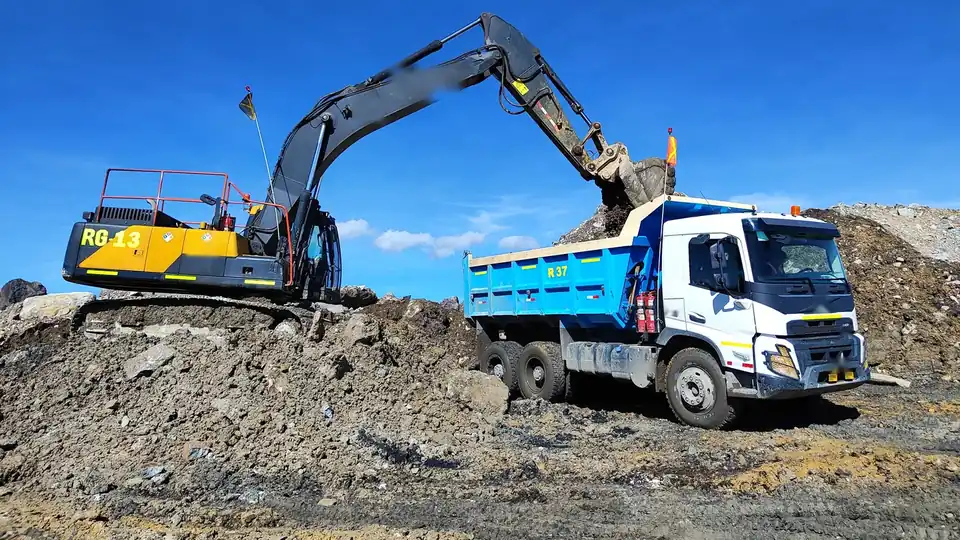
We send the whole team with experienced operators: a D6-class bulldozer at R5,000–R7,750 a day with operator to strip, push and shape; a 20–25 t excavator at R3,500–R5,600 a day with operator for the key trench and spillway; a 10–12 t roller at R2,150–R5,600 a day with operator; and a 14,000–18,000 litre water truck at R2,400–R2,800 a day with operator. Ten bulldozer days come to R50,000–R77,500 before transport and VAT. A small stock-watering dam or pond is often a TLB job of a few days.
Send us the site location, the wall length and height you have in mind, and where the clay comes from, and we'll come back with the machines, days and price in writing. See how hiring works.
Send us your dam site on WhatsAppQuestions people ask
What is the difference between a dam and a reservoir?
Strictly, the dam is the wall and the reservoir is the water behind it. In South Africa people use "dam" for both, as SANCOLD (the South African National Committee on Large Dams) points out; in many other countries the two words are kept apart.
Which type of dam is best for a farm?
An earth dam, nearly always. It is built from soil dug on site, suits the wide, shallow valleys most farms have, and can stand on softer foundations than a concrete dam, which needs sound rock. A wall with a clay core and a properly sized spillway in natural ground lasts for decades.
Why do farm dams fail?
Mostly in two ways: water flows over the wall because the spillway is too small for a big storm, or water seeps through or under the wall and washes the soil out. Both come from skipped basics: no key trench to watertight ground, sandy soil or topsoil in the wall, layers too thick to compact, or a spillway cut over fill instead of natural ground.
How much water does a farm dam lose a year?
More than most people expect. FAO's manual on small earth dams plans for about 10% a year lost to seepage through a well-built wall, plus evaporation of 0.3–2.5 m of depth a year depending on the climate. A shallow, wide dam loses far more to evaporation than a narrow, deep one.
Do I need permission to build a dam?
Usually some form of authorisation. Storing water is a water use under the National Water Act: an off-channel dam can fall under the general authorisation up to your catchment's limit (registered with DWS above 10,000 m³), a dam in a river or stream needs a water use licence, and a wall over 5 m high holding more than 50,000 m³ is a dam with a safety risk. Details are on dam building.
Related
Sources we checked
- SANCOLD (South African National Committee on Large Dams): Dams in general - types, uses and impacts of dams
- FAO Manual on small earth dams: a guide to siting, design and construction (Irrigation and Drainage Paper 64)
- National Water Act 36 of 1998, Chapter 12: safety of dams
- National Water Act 36 of 1998, section 120: registration of dam with safety risk
- General Authorisation for the taking and storing of water (GN 538 of 2016), section 5: storing of water
- General Authorisation for the taking and storing of water (GN 538 of 2016), section 7: registration
- EIA Regulations 2014, Notice 1 of listed activities (GN R.983 of 2014 as amended)
Need a machine?
WhatsApp us the job, the town and the dates. We confirm the machine, the start date and the price in writing before the machine moves.
WhatsApp us now