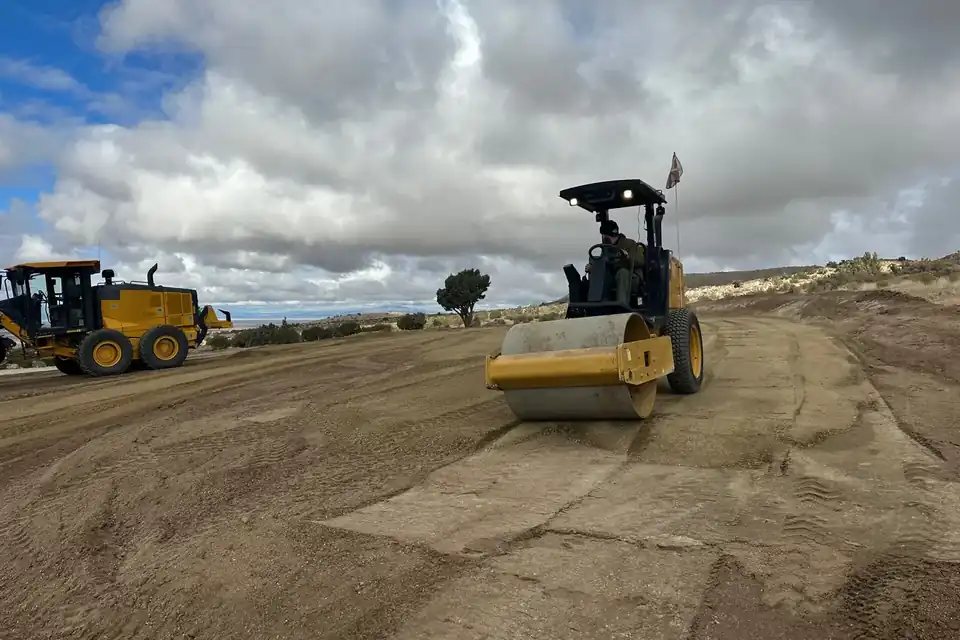
Gravel road construction
Last updated
Gravel road construction: the layers
A road is a stack of compacted layers, each stronger than the one below, so the wheel load spreads out before it reaches the soft ground. A gravel road keeps the stack short and uses a hard-wearing natural gravel as its top layer.
| Layer | What it is | On a gravel road? |
|---|---|---|
| Subgrade (roadbed) | The natural ground, or fill, shaped to the road levels and compacted in place | Always |
| Fill and selected layers | Imported soil or gravel that lifts the road and gives a stronger base for the layers above | Where the ground is soft, low or wet |
| Subbase | A strong gravel or stabilised (cemented) layer under the base | Usually only on roads that will be sealed or paved |
| Base | The main load-carrying layer, often crushed stone | Sealed and paved roads |
| Wearing course | The gravel you drive on: a natural gravel that binds into a hard surface | The top layer of every gravel road |
G-classes: how road gravel is graded
South African road specifications grade natural materials by class, from G1 (high-quality crushed stone) down to G10 (gravel-soil): the lower the number, the stronger the material and the higher up the road it can go. A real road cross-section filed with the Department of Water and Sanitation shows how the classes and compaction stack up:
| Layer | Thickness | Compaction |
|---|---|---|
| C4 subbase (cemented) | 150 mm | 98% |
| G6 selected layer | 150 mm | 97% |
| Fill, G7 or better | at least 150 mm a layer | 95% |
| Subgrade, G8 or better | in place | 93% |
Your engineer sets the classes and densities for your road; on a farm road nobody tests every layer, but the same rules make it last: good gravel, thin layers, the right moisture and enough roller passes. The SANS 3001 lab tests find each material's maximum dry density and optimum moisture, and a density test on site shows whether a layer passed. More on compaction: soil compaction and land levelling.
Camber and drainage: what keeps a gravel road alive
Water destroys gravel roads. It softens the layers, washes out the fines that bind the surface, and turns ruts into potholes. Three things keep it off:
- A crown (camber): the road is shaped higher in the middle than at the edges, so rain runs off sideways instead of standing in the wheel tracks. A gravel road needs a noticeably steeper crossfall than a tarred road because its surface is rougher.
- Side drains: shallow channels along both edges carry the water along the road.
- Mitre drains and culverts: mitre drains lead the water out of the side drains and away from the road at intervals, before it builds up speed and scours; pipe culverts carry it under the road at low points and stream crossings.
The road surface should also sit above the ground next to it, so water drains away from the road and not onto it. A grader cuts the crown and side and mitre drains in the same passes; a Cat 140 class grader (or similar) carries a 3.7 m blade. A TLB or excavator digs in the culverts.
Road construction equipment list, with prices
Every machine comes with an experienced operator or driver. Prices exclude VAT; transport is its own line.
| Machine | Job on the road | Per day |
|---|---|---|
| Grader, 140 class | Shapes the roadbed, spreads gravel to thickness, cuts the crown and drains | R4,500–R6,000 |
| Roller, 10–12 t | Compacts subgrade, fill and gravel layers (padfoot on clay, smooth drum on gravel) | R2,150–R5,600 |
| Small roller, 1.5–3 t | Driveways, parking bays and estate roads | R1,050–R1,800 |
| Water truck, 14,000–18,000 litre | Brings each layer to the right moisture before rolling; dust control | R2,400–R2,800 |
| Tipper, 10 cube with driver | Hauls gravel from the quarry or borrow pit, carts away spoil | R3,700–R5,250 |
| TLB | Driveway box cuts, loading, culverts and short roads | R3,900–R5,150 |
| Front end loader, 950 class | Loading tippers at the gravel pit or stockpile | R3,400–R3,800 |
| Excavator, 20–25 t | Road cuts, deep drains and culvert trenches | R3,500–R5,600 |
| Bulldozer, D6 class | Clearing the route, pioneer tracks, ripping hard ground | R5,000–R7,750 |
| Grid roller, tow-behind | Breaking down oversize stones in farm road gravel | about R1,800, machine only |
How a gravel road is built, step by step
- Peg the route and levels. A surveyor or your engineer sets the centre line, width and finished levels; on a farm road you walk it and mark it.
- Clear and grub. Bush, stumps and roots come out of the road width; roots left behind rot and leave soft spots. See site clearing.
- Strip the topsoil. It's too soft to build on, so it's pushed aside for the verges.
- Earthworks to the road levels. High ground is cut and low ground filled; the grader shapes the roadbed. See earthworks.
- Compact the subgrade. Rip it if it's hard, water it to the right moisture and roll it.
- Bring in the gravel. A loader or TLB loads tippers at the quarry, borrow pit or stockpile; the tippers tip in heaps along the road.
- Spread, water and roll each layer. The grader spreads the gravel to thickness (often about 150 mm compacted), the water truck brings it to optimum moisture and the roller compacts it. Then the next layer.
- Shape the crown and cut the drains. The grader trims the final crown and cuts side and mitre drains; culverts go in at low points.
How much gravel do you need?
Compacted volume = length × width × thickness. A 1 km farm road, 5 m wide, with a 150 mm gravel layer is 750 compacted cubes. Gravel is spread loose and shrinks when rolled: from Caterpillar's reference tables, natural gravel weighs about 1.93 t a loose cube and 2.17 t in the ground, so you need at least 12% more loose gravel, about 840 loose cubes or 1,620 t here.
Gravel goes by weight, not body volume: a 10 cube tipper's legal payload is about 17 t, which is about 8.8 loose cubes of natural gravel. So that kilometre of road is roughly 95 tipper loads. More on load weights: tipper loads and cubes.
Typical days and a cost example
| Job | Machines | Typical time |
|---|---|---|
| Gravel driveway on a house plot, about 60 m² | TLB or bobcat, small roller, 1–2 tipper loads | 1 day |
| Long farmhouse or lodge driveway, about 200 m | TLB, small roller, tippers | 1–2 days |
| Re-shaping and re-gravelling 1 km of farm road | Grader, water truck, 10–12 t roller, tippers | 3–5 days plus the gravel haul |
| New 1 km gravel road on undisturbed ground | Dozer, grader, water truck, roller, loader, tippers | 1–3 weeks |
Here is a worked example for re-gravelling a game farm road near Bela-Bela: a 140-class grader for four days, with the lowbed both ways from Pretoria.
| Example quote (for illustration only) | Amount |
|---|---|
| 140-class grader (about 18 t), 4 days at R4,500–R6,000 a day with operator | R18,000–R24,000 |
| Transport both ways to Bela-Bela | R9,640–R11,640 |
| Example total, excl. VAT | R27,640–R35,640 |
The roller and water truck work alongside the grader: four days of a 10–12 t roller is R8,600–R22,400 and four days of a 14,000–18,000 litre water truck R9,600–R11,200, each with transport on its own line. Tippers and the gravel itself come on top. Your own price comes back in writing on WhatsApp before any machine moves; every rate is on plant hire rates.
Get a gravel road quoteFarm roads and road maintenance
Most farm road work is maintenance, not new road. Traffic and rain wear the wearing course thin, corrugations form, and the crown flattens until water stands on the road. The fix is the same team: the grader rips or scarifies the surface, mixes in new gravel where it's thin, re-cuts the crown and the drains, and the water truck and roller compact it again. A tow-behind grid roller breaks oversize stones in pit gravel so the surface rolls smooth.
Blade the road after the rains, before the corrugations deepen, and re-gravel when the stones of the layer below start showing. A grader by the hour, any size, is R490–R610, useful for a few hours of re-shaping on one farm. Taking gravel from a borrow pit on your own land can need a permit, so check before a pit is opened.
Driveway construction: gravel, concrete and asphalt
Every driveway starts the same way. A TLB or bobcat digs the box cut (the driveway shape dug down to firm ground), the base is compacted, and a gravel layer is spread, watered and rolled with a small roller or plate compactor. What goes on top decides the type:
Gravel driveway
The compacted gravel is the finished surface. It's the quickest and lowest-cost option, and it suits long farm and lodge driveways. A 60 m² driveway at 150 mm is 9 compacted cubes, about 10 loose cubes: one 18 cube load or two 10 cube loads.
Concrete, paved and asphalt driveways
The compacted gravel becomes the base for concrete, interlocking pavers or asphalt laid by the surfacing team. A driveway is only as good as its base: if the base settles, the surface cracks or sinks with it, so the box cut and compaction are the parts to get right. Your engineer or surfacing contractor sets the base thickness and the concrete details.
Our tippers with drivers cart driveway gravel from the quarry or yard you buy from to your site: a 6 cube load in Gauteng is R1,250–R1,900. Residential and estate roads follow the full layer process above, with each layer tested where the engineer specifies.
What to sort out before a road project starts
- The route and levels pegged, and for estate and municipal roads the engineer's drawings with the layer specification.
- Underground services: Construction Regulation 13 requires the contractor to find out where electricity, water, gas and similar services are before excavation that could affect them. Get the service plans for the route.
- Gravel source: where the gravel comes from (quarry, commercial pit or approved borrow pit) and how far the tippers haul it; the haul distance drives the number of trucks.
- Water: a water point near the road for the water truck; long hauls for water slow the whole team.
- Permissions: wayleaves for work in a municipal road reserve, and advice from an environmental assessment practitioner if a new road crosses undisturbed land or a stream.
We send graders, rollers, water trucks and tippers with operators to farms, estates and sites in all 9 provinces. See areas we cover and how hiring a machine works.
WhatsApp us your road or drivewayQuestions people ask
What equipment is used in road construction?
For a gravel road: a grader to shape and spread, a roller to compact, a water truck for compaction water, tipper trucks to haul gravel and a front end loader or TLB to load them. Bigger jobs add an excavator for cuts and culverts, a bulldozer for clearing and pioneer tracks, and ADTs for long hauls on site. The full road construction equipment list, with day rates, is in the table on this page.
What is earthworks in road construction?
Earthworks is everything that happens to the ground before the road layers go on: clearing and grubbing the route, stripping topsoil, cutting high ground and filling low ground to the road levels, and shaping and compacting the roadbed (the subgrade). The gravel layers and drains are built on top of it.
How much does it cost to build a gravel road?
It's priced by machine days plus the gravel. As an example, four days of a grader, a 10–12 t roller and a 14,000–18,000 litre water truck working together come to R18,000–R24,000 for the grader, R8,600–R22,400 for the roller and R9,600–R11,200 for the water truck, before transport, tippers and the gravel itself. Send the length, width and location on WhatsApp and we'll price the days in writing.
How much does driveway construction cost?
A gravel driveway on a house plot is usually one day of a TLB (R3,900–R5,150 a day with operator) and a small roller (R1,050–R1,800 a day), plus the gravel and tipper loads to bring it. A 60 m² driveway at 150 mm thick takes about 10 loose cubes of gravel. Concrete, paved and asphalt driveways start with the same box cut and compacted base.
Can road construction block my driveway?
It can, for short periods while a trench is open or a layer is being rolled. Ask the site office of the road works, or the municipality's roads department, when your access will be closed and for how long. On driveway and estate road jobs we agree with you upfront when access is closed, so you can move your car out first.
How thick should a gravel driveway be?
For cars, a compacted gravel layer of about 150 mm on a firm, compacted base is a common choice; on soft clay or where trucks will drive, your engineer may ask for more layers. Gravel is spread loose and shrinks when rolled, so order at least 12% more loose gravel than the compacted volume.
Related
Sources we checked
- Typical road cross-section with layer compaction requirements, drawing P07495-00-WW-SWP-0001-001 (Department of Water and Sanitation filing)
- SANS 3001 civil engineering test methods list (CSIR)
- Caterpillar earthwork volumes reference tables (loose and bank material weights, load factors)
- Cat 140 motor grader specifications (Caterpillar South Africa)
- BOMAG BW 213 D-5, DH-5 and PDH-5 single drum roller technical data sheet (BOMAG)
- Tata Prima 2528.K 10 m³ tipper leaflet (GVM and tare)
- Construction Regulations 2014 (GN R.84) - regulation 13 (excavation work)
Need a machine?
WhatsApp us the job, the town and the dates. We confirm the machine, the start date and the price in writing before the machine moves.
WhatsApp us now