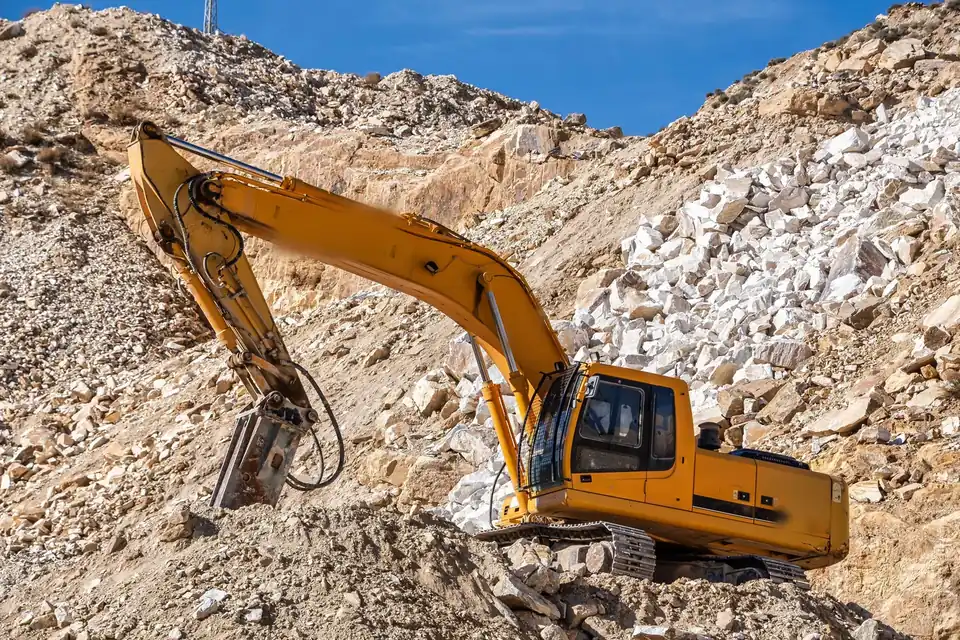
Excavator hire
Last updated
Excavator hire anywhere in South Africa
We send tracked excavators from 20 t to over 70 t, each with an experienced operator, to building sites, farms, mines and municipal jobs in all 9 provinces. You get one written price for the machine, the operator and the lowbed transport before anything moves.
An excavator (also called a digger, a 360 or a trackhoe) sits on steel tracks and swings its whole upper body a full 360 degrees. That lets it dig, swing and load a tipper without moving its tracks, which is why it out-digs a TLB on any trench longer than a few metres or any hole deeper than about 4 m.
- Trenches for sewer, water and stormwater pipes, from 600 mm wide to over 6 m deep.
- Bulk excavation: basements, foundations for complexes and warehouses, cut-to-fill on slopes.
- Loading tippers and ADTs: a 1.19 m³ bucket fills a 10 cube tipper in about 8–9 passes.
- Dams and rivers: digging and cleaning farm dams, shaping dam walls, clearing silt.
- Rock and demolition: breaking rock and concrete with a hydraulic breaker, sorting rubble with a grab.
- Mining and quarrying: overburden stripping and loading haul trucks with the 50 t and 70 t+ classes.
Excavator sizes and specs
Figures are from the manufacturer's spec sheets for a common model in each class. The machine we send is that model or similar; the exact model and its sheet come with your quote.
| Size | Example model | Operating weight | Max dig depth | Reach at ground | Bucket | Transport width |
|---|---|---|---|---|---|---|
| 20–25 t | Cat 320 or similar | 22,600 kg | 6.72 m | 9.86 m | 1.19 m³ | 2.98 m |
| 30 t | Cat 330 or similar | 31,400 kg | 7.25 m | 10.69 m | 1.76–1.80 m³ | about 3.4 m (800 mm shoes) |
| 36–55 t | Cat 352 or similar | 48,900–50,500 kg | 7.51–8.21 m | 11.71 m | 1.90–2.69 m³ | about 3.0 m (tracks retracted) |
| 70 t+ | Cat 374 or similar | 73,890 kg | 7.66 m (mass boom) | 11.47 m | 4.4–4.6 m³ | abnormal load, planned per route |
The 20 t figures are for a 5.7 m reach boom and 2.9 m stick; the 30 t for a 6.15 m boom and 3.2 m stick; the 50 t for a 6.9 m boom and 3.35 m stick (a longer stick takes it to 8.21 m); the 70 t for a short 7 m mass boom built for digging force. A longer stick digs deeper but carries a smaller bucket.
Need something smaller? Mini excavators run from 1.5 to 6 t: a Bobcat E35z or similar weighs 3,383 kg and digs 3.1 m deep. See mini excavator hire. For the full list of types, from wheeled and long-reach machines to amphibious ones, read our excavator guide.
Which excavator size do I need?
Pick the size by the depth you dig, the volume you move and the space you work in. Going one size too big costs more in hire and lowbed; going too small doubles the days.
| Job | Size that fits | Why |
|---|---|---|
| Garden, yard or behind-the-house trench, cable and irrigation lines | Mini, 1.5–6 t | Narrow access, digs about 3 m, light on paving and lawns |
| Sewer and water mains, house and complex foundations, stormwater, loading 10 cube tippers | 20–25 t | The all-rounder: 6.7 m depth, 1.19 m³ bucket, fits on one standard lowbed |
| Deep sewer lines, basements, bigger earthworks, loading 18 cube tippers | 30 t | 7.25 m depth and a bucket about 50% bigger than a 20 t |
| Bulk earthworks, dam walls, quarry faces, mine overburden | 36–55 t | 1.9–2.7 m³ bucket loads ADTs fast, heavy breakers for rock |
| Mine and quarry production loading, mass excavation | 70 t+ | 4.4 m³+ bucket and digging force for blasted rock |
Midi excavators of 8–14 t (also asked for as 8 ton, 13 ton or 14 ton excavators) sit between the mini and the 20 t: exact price on WhatsApp. Still not sure? WhatsApp us the trench depth and length or the volume, and we'll tell you the size that finishes it soonest for the least money.
Excavator hire prices
These are our prices with an operator, excluding VAT. Transport is always its own line. Hourly, dry and monthly rates for each size, plus a worked example, are on excavator hire rates and what changes the price.
| Size | Rate | Price |
|---|---|---|
| 20–25 t excavator | Per day, with operator | R3,500–R5,600 |
| 20–25 t excavator | Per hour, with operator | R340–R690 |
| 20–25 t excavator | Per hour, dry (operator included, you pay the diesel) | R340–R680 |
| 30 t excavator | Per day, with operator | about R4,500 * |
| 30 t excavator | Per hour, dry (operator included, you pay the diesel) | about R370 * |
| 30 t excavator | Per month, with operator | about R65,000 * |
| 36–55 t excavator | Per day, with operator | R6,500–R8,100 |
| 70 t+ excavator | Per day, with operator | about R11,000 * |
| 70 t+ excavator | Per hour, dry (operator included, you pay the diesel) | about R1,500 * |
| 70 t+ excavator | Per 200-hour month, dry (operator included, you pay the diesel) | about R189,000 * |
* Few price points for this one, so treat it as a guide; the exact price comes back on WhatsApp.
For a typical job: five days with a 20–25 t excavator comes to R17,500–R28,000 for the machine and operator, plus the lowbed both ways. A 30 t on a month's contract is about R65,000 with operator.
Get your excavator price on WhatsAppWet hire vs dry hire
In South Africa the words mean something specific, so read them on your quote:
- Dry hire: the operator is included and you pay the diesel, either by filling the machine yourself or paying for the litres used. A 20–25 t excavator on dry hire is R340–R680 an hour.
- Wet hire: the operator and the diesel are both included in one rate. Wet rates are higher because heavy digging and rock work burn more fuel; we price them per job.
- With operator: the rate in the table above. Whether diesel is in or out is confirmed in writing before the machine moves.
Dry hire usually works out better when you already buy diesel in bulk, for example on a farm or a mine. Wet hire is simpler on a short job where you don't want to manage fuel.
Minimum hours, standing time and breakdowns
Excavators are normally booked by the day, often an 8–9 hour working day, because the lowbed costs the same whether the machine digs for two hours or ten. If the machine is on site and ready but can't work for a reason on your side (no tippers to load, the site isn't open, services not yet marked), those hours are standing time at the rate agreed on your quote. If the machine breaks down, we send a replacement machine or you pay nothing for the downtime.
Lowbed transport for excavators
Excavators don't drive on public roads; they travel on a lowbed (low-loader) both ways. A 20–25 t excavator is 2.98 m wide on its tracks, wider than the 2.6 m limit for heavy goods vehicles in regulation 223 of the National Road Traffic Regulations, so it moves as an abnormal load. We arrange the lowbed and the paperwork and show it as one line on your quote.
- Inside a main centre (Johannesburg, Pretoria, Durban, Cape Town and the others): lowbed transport there and back usually comes to R6,000–R9,500.
- Out of town: charged by the road distance from the nearest main centre at R43–R52 a km, each way. For example, Secunda is about 106 km from eMalahleni (Witbank) by road, so the lowbed there and back usually comes to R9,120–R11,020.
- Far sites and mines: Lephalale is about 216 km from Polokwane by road, and the lowbed there and back usually comes to R18,580–R22,460.
On a long job, transport is a small part of the bill; on a one-day job it can be half of it. That's the main reason a TLB, which drives itself to site, often wins on short jobs.
What the lowbed needs on site: a firm, level spot to offload, room for a long truck and trailer to turn or reverse out, and no low wires or branches over the access. Send us a photo of the gate and road in, and we plan the delivery around it.
Operator, certificates and safety
Construction Regulation 23 (GN R.84 of 2014) covers construction vehicles and mobile plant, which includes excavators. Under it, the person operating the machine must have received appropriate training, be certified competent, hold proof of competency, be authorised in writing, and have a medical certificate of fitness from an occupational health practitioner. Our operators meet these rules, and we send copies of their certificates before the machine arrives if you ask.
- Daily inspection: the operator checks the machine every day before use against a checklist and records it in a register kept in the machine (reg 23(1)(k)).
- Warning devices: a hooter the operator can sound and an automatic reversing alarm (reg 23(1)(i) and (j)).
- Operator protection: a cab built to protect the operator from falling material and from being crushed in a rollover (reg 23(1)(h)).
- Lifting pipes or loads: an excavator lifting a suspended load, such as lowering a pipe into a trench on a chain, is then working as a lifting machine, and the Driven Machinery Regulations, 2015 apply to that lift. Tell us beforehand if you plan to lift.
Your side: mark underground services (water, sewer, electricity, Telkom and fibre) before digging, and arrange any wayleave the municipality needs for work in a road reserve. More on our certificates and safety files: safety and certificates.
Excavator vs TLB: which is cheaper for your job?
A TLB (JCB 3CX or similar) weighs about 7.9–8.6 t, digs up to 5.44 m with an extending dipper, carries a backhoe bucket of up to 0.43 m³ and drives to site at up to 40 km/h. A 20–25 t excavator digs 6.72 m and carries a 1.19 m³ bucket, almost three times as much, but needs a lowbed both ways.
| TLB (standard 4x4) | Excavator, 20–25 t | |
|---|---|---|
| Day rate with operator | R3,900–R5,150 | R3,500–R5,600 |
| Max dig depth | about 5.4 m (extending dipper) | 6.72 m |
| Digging bucket | up to 0.43 m³ | 1.19 m³ |
| Gets to site | Drives itself | Lowbed both ways |
| Also loads and levels | Yes, 1.0 m³ front shovel | Loads from the bucket; no front shovel |
Pick the TLB for a day or two of work, trenches under about 4 m, plots where you also need loading and levelling, and tight town sites. Pick the excavator for long trench runs, anything deeper than about 4–5 m, hard ground and rock, or when you're loading a steady line of tippers. More on the TLB: TLB hire. For digging plus hauling, add tipper trucks.
Excavator attachments: breaker, ripper, grab, auger and buckets
Ask for the attachment when you book, and it comes on the machine with its own line on the quote. Each is priced as an extra on the day rate; exact price on WhatsApp.
- Hydraulic breaker (hammer or pecker): breaks rock, concrete slabs and foundations. Hard rock can drop digging output to a fraction of normal, so rock jobs are priced by the day.
- Ripper tooth: loosens hard ground, calcrete and soft rock so the bucket can dig it, usually cheaper than breaking.
- Buckets: narrow trenching buckets for pipe trenches, wide digging buckets for bulk work, and wide ditch-cleaning or tilt buckets for canals, dams and banks.
- Grab or selector: picks up rocks, logs and demolition rubble and sorts it for loading.
- Auger: drills holes for posts, poles and piles. For fence posts on a smaller scale, a bobcat with an auger costs R3,000–R3,600 a day with operator; see bobcat hire.
- Mulcher head: grinds bush and small trees in place for land and line clearing. See site clearing.
Trench digger and digger hire
Most people searching for a trench digger need a trench of a set width and depth, and the right machine follows from that:
- Cable, irrigation and small water lines (300–600 mm wide, under 1.5 m deep) in yards and gardens: a mini excavator.
- House drains, plot trenches and foundations: a TLB or a mini excavator.
- Sewer, water and stormwater mains, long runs and anything deeper than 2–3 m: a 20–25 t or 30 t excavator, with a tipper to cart away spoil.
Trenches that people work in need shoring or battered (sloped) sides so they can't cave in, so plan that before the machine arrives. Prices by trench and the full method are on trenching and trenching rates.
Big excavators: 30, 40, 50 and 70 ton hire
For earthworks, dams, quarries and mines we send 30 t, 36–55 t (the 40 ton and 50 ton class) and 70 t+ excavators, each with an operator.
- 30 ton: about R4,500 a day or about R65,000 a month with operator. Digs 7.25 m, 1.8 m³ bucket.
- 40 to 50 ton: R6,500–R8,100 a day with operator. Weighs 48.9–50.5 t, digs 7.5–8.2 m, reaches 11.7 m.
- 70 ton and up (70, 80 ton class): about R11,000 a day, or about R189,000 for a dry month of about 200 machine hours.
Every excavator from 20 t up is wider than 2.6 m, and the 36 t and bigger machines also need multi-axle lowbeds, so give us the site location early and we plan the route and the abnormal-load permits. For monthly mine and quarry contracts, company documents and formal quotes, see mining plant hire. Big earthworks often pair an excavator with ADT dump trucks, a bulldozer and a roller.
Wheeled, compact and other excavators
- Compact and smallest excavators (1 t, 1.5 t, 3 t, 5 t, 6 t; also called bobcat excavators or bobcat diggers): these are mini excavators. See mini excavator hire.
- Wheeled excavators: drive between nearby sites on rubber tyres, at up to 35 km/h for a Cat M318 or similar. Useful on paved town work; exact price on WhatsApp.
- Excavator and tipper together: book both on one quote and the excavator loads as fast as the trucks cycle. See tipper truck hire.
Excavator hire near you
We send excavators to sites in all 9 provinces: city building sites, farms, mines and rural roads. Lowbed transport is worked out from the nearest main centre, so you see the real cost for your town before you book.
Local prices, ground conditions and the machines most hired in each area: Johannesburg, Pretoria, Durban, Cape Town, Gqeberha (Port Elizabeth), Bloemfontein, Polokwane, Mbombela (Nelspruit), eMalahleni (Witbank) and Rustenburg. Every town we cover is on areas we cover.
How excavator hire works
- WhatsApp the job: what you're digging, the depth or volume, the town and the dates. A photo of the site and the access road helps.
- We confirm in writing: the excavator size and model (or similar), the rate basis (with operator, dry or wet), the minimum hours, and lowbed transport as its own line.
- Pay the deposit to book the machine and operator for your dates.
- The lowbed delivers the excavator and the operator does the daily pre-use check before starting.
- The lowbed collects it when the job is done, and the balance is settled as agreed on your quote.
The written quote is your hire agreement: our standard hire terms cover deposits, standing time and breakdowns. More on the steps: how it works. For several machines on one job, see plant hire rates for every machine.
WhatsApp us your excavator jobQuestions people ask
How much does it cost to hire an excavator per day?
A 20–25 t excavator costs R3,500–R5,600 a day with operator. A 30 t is about R4,500 a day, a 36–55 t is R6,500–R8,100 and a 70 t+ is about R11,000. Lowbed transport both ways is extra and shown as its own line. Every size and unit is on excavator hire rates.
How much is excavator hire per hour?
A 20–25 t excavator costs R340–R690 an hour with operator, or R340–R680 an hour dry (operator included, you pay the diesel). Hourly hire usually carries a minimum, often an 8–9 hour day, because the lowbed costs the same whether the machine works two hours or ten.
Do your excavators come with an operator?
Yes. Every excavator arrives with an experienced operator who is trained, certified competent and holds a medical certificate of fitness, as Construction Regulation 23 requires. Copies of the operator's certificates come before the machine arrives, on request.
Can I hire an excavator on dry hire?
Yes. In South Africa “dry hire” normally means the operator is included and you pay for the diesel. A 20–25 t excavator on dry hire is R340–R680 an hour and a 30 t about R370 an hour. We confirm how diesel is handled in writing before the machine moves.
How deep can a 20 ton excavator dig?
A 20–25 t excavator such as a Cat 320 or similar digs to about 6.7 m with a 2.9 m stick and reaches about 9.9 m along the ground. For deeper work, a 30 t reaches about 7.25 m and a 50 t class about 7.5–8.2 m. See the 20 ton excavator page for that size in detail.
What is the smallest excavator I can hire?
Our smallest excavators are mini excavators of 1.5–6 t, at R1,700–R3,000 a day with operator. A 3.4 t mini (Bobcat E35z or similar) digs about 3.1 m deep and fits through gaps a big machine can't. See mini excavator hire.
Can an excavator break rock or concrete?
Yes, with a hydraulic breaker (pecker) on the arm in place of the bucket. The breaker is priced as an extra on the day rate, so tell us the rock or slab on WhatsApp and you get one price for both. Hard rock slows digging a lot, so we price rock work by the day rather than by the metre.
Related
Sources we checked
- Cat 320 hydraulic excavator specifications (Caterpillar)
- Cat 330 hydraulic excavator specifications (Caterpillar)
- Cat 352 hydraulic excavator key specifications (Caterpillar)
- Cat 352 technical specifications sheet (Caterpillar, via Lectura)
- Cat 374 hydraulic excavator specifications (Caterpillar South Africa)
- Bobcat E35z mini excavator specifications (Bobcat)
- JCB 3CX backhoe loader specifications (JCB)
- Construction Regulations 2014 (GN R.84) reg 23, construction vehicles and mobile plant
- National Road Traffic Regulations reg 223, overall width of vehicles
- Driven Machinery Regulations 2015 reg 18, lifting machines
Need an excavator?
WhatsApp us the job, the town and the dates. We confirm the machine, the start date and the price in writing before the machine moves.
WhatsApp us now