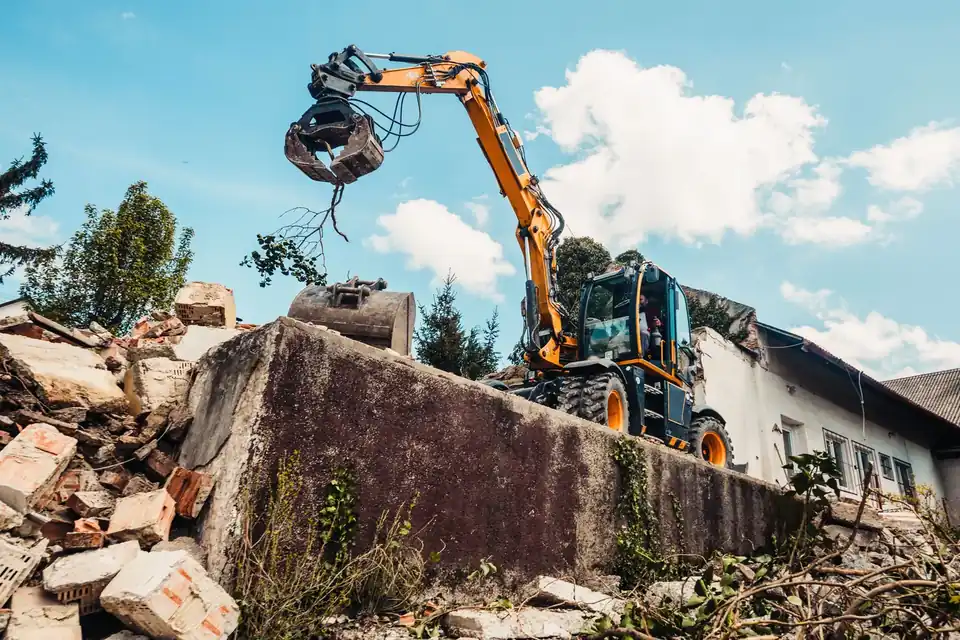
Demolition contractor machines with operators
Last updated
What a demolition involves
Demolition is more paperwork and planning than machine time. A single-storey house comes down in a few days, but the permits, the asbestos check and the services take weeks. This is the order a house or building demolition follows.
- Survey the building. Check for asbestos (old roof sheets, gutters, downpipes and ceiling boards are the usual places), check the age of the building for heritage, and on anything bigger than a simple house, have a structural survey done.
- Get the permits. Municipal written permission, at least 10 working days' notice to the municipality, and a heritage permit if any part is older than 60 years.
- Disconnect the services. Have electricity, water and gas disconnected and made safe at the boundary. The regulations require their location and nature to be established before demolition starts.
- Remove the asbestos, by a registered asbestos contractor, before any machine touches the building.
- Strip out what you want to keep. Doors, windows, roof timbers, steel and fittings can be salvaged and sold before the machine starts.
- Bring it down. The excavator or breaker TLB demolishes from the top down, away from neighbours and the street, and breaks the slab and foundations.
- Sort and load the rubble. Concrete and brick, steel and timber are separated where possible and loaded onto tipper trucks.
- Level the site and fill the foundation trenches, ready to sell or build.
Demolition machines and prices
Every machine comes with an experienced operator or driver. Most house demolitions need one demolition machine and a tipper or two.
| Machine | Demolition work it does | Per day |
|---|---|---|
| Excavator, 20–25 t | Houses, outbuildings, small commercial buildings; fitted with a hydraulic breaker or shear (attachment priced on WhatsApp) | R3,500–R5,600 |
| TLB with hydraulic breaker | Single-storey houses, slabs, foundations, boundary walls, swimming pools | R5,000–R6,550 |
| Bobcat with breaker or attachment | Interior demolition, floors, tight spaces, loading rubble | R3,000–R3,600 |
| Excavator, 36–55 t | Industrial and commercial demolition, heavy concrete, steel structures | R6,500–R8,100 |
| 10 cube tipper with driver | Carting rubble to the dump site | R3,700–R5,250 |
| Heavy jackhammer, 27–30 kg | Cutting openings, small walls and slabs by hand | R380–R610 (machine only) |
A breaker (a hydraulic hammer) smashes concrete, brick and rock; a shear or pulveriser crushes and cuts concrete and steel more quietly. Rock demolition in a trench or on a site is breaker work too. Tipper loads are also priced per load in Gauteng: about R2,300 for a 10 cube load.
Send photos of the building on WhatsAppHow long demolition takes
A rough guide to machine time once the permits are in place and the asbestos is out. Concrete-framed buildings, basements, steep sites and tight neighbours take longer.
| Job | Machines | Typical time |
|---|---|---|
| Boundary wall or garden wall demolition, up to about 30 m | Breaker TLB + tipper | Half a day to 1 day |
| Outbuilding, garage or cottage | TLB or excavator + tipper | 1 day |
| Swimming pool demolition (break the shell, backfill, compact) | Breaker TLB, tipper, rammer or roller | 1–2 days |
| Single-storey house, 120–200 m², with slab and foundations | Excavator or breaker TLB + tippers | 2–4 days |
| Double-storey house or small commercial building | Excavator with breaker + tippers | 4–8 days |
| Factory or warehouse | Large excavators, loaders, tippers | Weeks, planned with an engineer |
How much house demolition costs
A demolition price has four parts: the machine days, transport both ways, rubble carting, and dump fees at the landfill. Here is a worked example for a house demolition in Cape Town: three days of a 20–25 t excavator, with lowbed transport.
| Example quote (for illustration only) | Amount |
|---|---|
| 20–25 t excavator, 3 days at R3,500–R5,600 a day with operator | R10,500–R16,800 |
| Transport both ways to Cape Town | R6,000–R9,500 |
| Example total, excl. VAT | R16,500–R26,300 |
Add the tipper trucks: a 10 cube tipper with driver is R3,700–R5,250 a day with operator. A breaker attachment, asbestos removal and landfill fees are priced separately. Your full price comes back in writing on WhatsApp before the machine moves. All machine prices: plant hire rates.
Get a demolition pricePermits and rules: what you must sort out before demolition
Municipal permission and notice
- Written permission first. Regulation E1 of the National Building Regulations: no one may demolish any building without the local authority's prior written permission. The municipality can attach conditions for public safety and to protect neighbouring buildings.
- At least 10 days' notice. Regulation A22: the property owner must notify the municipality, in its required form, of the date demolition will start, at least 10 days before, not counting Saturdays, Sundays and public holidays.
- Method. Under regulation E3 the municipality may ban a demolition method it considers dangerous to people or property.
- Leave it safe. A part-demolished building or site may not be left in a condition dangerous to the public or neighbours.
Buildings older than 60 years
Section 34 of the National Heritage Resources Act: no one may alter or demolish any structure, or part of one, older than 60 years without a permit from the provincial heritage resources authority (Heritage Western Cape in the Western Cape, for example). Many South African suburbs were built more than 60 years ago, so check the date on the original plans or the title deed history before you book a machine.
Asbestos
Buildings with asbestos-cement roofs, gutters or boards are common in older South African towns. Under the Asbestos Abatement Regulations, 2020:
- a competent person must record all asbestos-containing material in an inventory of asbestos in place (regulation 4);
- the Department of Employment and Labour's provincial office must be notified in writing at least seven days before asbestos work starts (regulation 10);
- for removal work the client appoints an approved inspection authority and uses a registered asbestos contractor, and gets an asbestos clearance certificate after the work (regulation 11).
Safety on a demolition site
Regulation 14 of the Construction Regulations, 2014 requires a competent person, appointed in writing, to supervise demolition; a structural engineering survey and a written method statement before work starts; services located and made safe; adjoining buildings and roads kept stable; and no one working under unsupported parts of the structure. On a house this is straightforward; on a framed or multi-storey building it is an engineer's job.
Neighbours and dust
Tell the neighbours the dates, protect shared walls, and keep the dust down with a water hose or a water truck on bigger jobs (see dust suppression). The full checklist is in our demolition guide.
Demolition in Johannesburg, Pretoria, Cape Town and Gauteng
Demolition companies in Gauteng and Johannesburg
Most Gauteng demolitions are older houses on suburban stands being cleared for townhouses or a new build, and small commercial buildings. Johannesburg is one of the main centres we send machines from. Transport for an excavator there and back usually comes to R6,000–R9,500, shown as its own line on your quote. See plant hire in Johannesburg and Gauteng.
Demolition in Pretoria
Pretoria demolitions, permits and machines have their own page: demolition in Pretoria.
Demolition contractors in Cape Town
Much of Cape Town's older housing stock is more than 60 years old, so check early whether you need a Heritage Western Cape permit. Tight inner-city and suburban sites often suit a breaker TLB or bobcat. Cape Town is one of the main centres we send machines from. Transport for an excavator there and back usually comes to R6,000–R9,500, shown as its own line on your quote. See plant hire in Cape Town.
North West, Newcastle and the rest of South Africa
We send demolition machines to every province. Rustenburg in North West and Newcastle in KwaZulu-Natal are both main centres we send machines from, so lowbed transport for an excavator inside either town is R6,000–R9,500 both ways. See plant hire in Rustenburg, Newcastle and every area we cover.
Clearing the site afterwards or building next? See site clearing and earthworks.
WhatsApp us your demolition jobQuestions people ask
How much does house demolition cost in South Africa?
For a single-storey house, plan on two to four days of an excavator or breaker TLB plus the rubble carting. Three days of a 20–25 t excavator are R10,500–R16,800, or three days of a TLB with a breaker R15,000–R19,650, before transport and tipper loads. Asbestos removal, if there is any, and landfill fees are separate. Send photos and the floor area for a written price.
Do I need a permit to demolish a house?
Yes. Regulation E1 of the National Building Regulations says no one may demolish a building without the prior written permission of the local authority, and regulation A22 requires at least 10 days' notice (not counting weekends and public holidays) before demolition starts. If any part of the building is older than 60 years, section 34 of the National Heritage Resources Act also requires a permit from the provincial heritage resources authority.
How long does it take to demolish a house?
The machine work on a typical single-storey house takes two to four days, including breaking the slab and loading. The paperwork takes longer: the 10 working days' notice, the municipal permission, an asbestos inventory and, for old buildings, a heritage permit. Start the paperwork first.
Can a house with an asbestos roof be demolished?
Yes, but the asbestos comes off first, by a registered asbestos contractor. The Asbestos Abatement Regulations, 2020 require a competent person to list all asbestos in an inventory, the Department of Employment and Labour to be notified at least seven days before asbestos work, and a clearance certificate from an approved inspection authority after removal. Our machines start once the clearance is done.
What machines are used for demolition?
A 20–25 t excavator with a hydraulic breaker or shear for houses and small buildings; a TLB with a breaker for single-storey structures, slabs and walls; a bobcat with a breaker for interior and tight work; a 36–55 t excavator for bigger industrial structures; and tipper trucks to cart the rubble.
Related
Sources we checked
- National Building Regulations (GN R.2378) - regulation E1 (demolition of any building)
- National Building Regulations (GN R.2378) - regulation A22 (notice of intention to demolish)
- National Building Regulations (GN R.2378) - regulation E3 (prohibition of dangerous methods)
- Construction Regulations 2014 (GN R.84) - regulation 14 (demolition work)
- National Heritage Resources Act 25 of 1999 - section 34 (structures older than 60 years)
- Asbestos Abatement Regulations 2020 (GN R.1196 of 10 November 2020)
- Asbestos Abatement Regulations 2020 - regulation 4 (inventory of asbestos in place)
- Asbestos Abatement Regulations 2020 - regulation 10 (notification of asbestos work)
- Asbestos Abatement Regulations 2020 - regulation 11 (duties of asbestos client)
Need an excavator?
WhatsApp us the job, the town and the dates. We confirm the machine, the start date and the price in writing before the machine moves.
WhatsApp us now