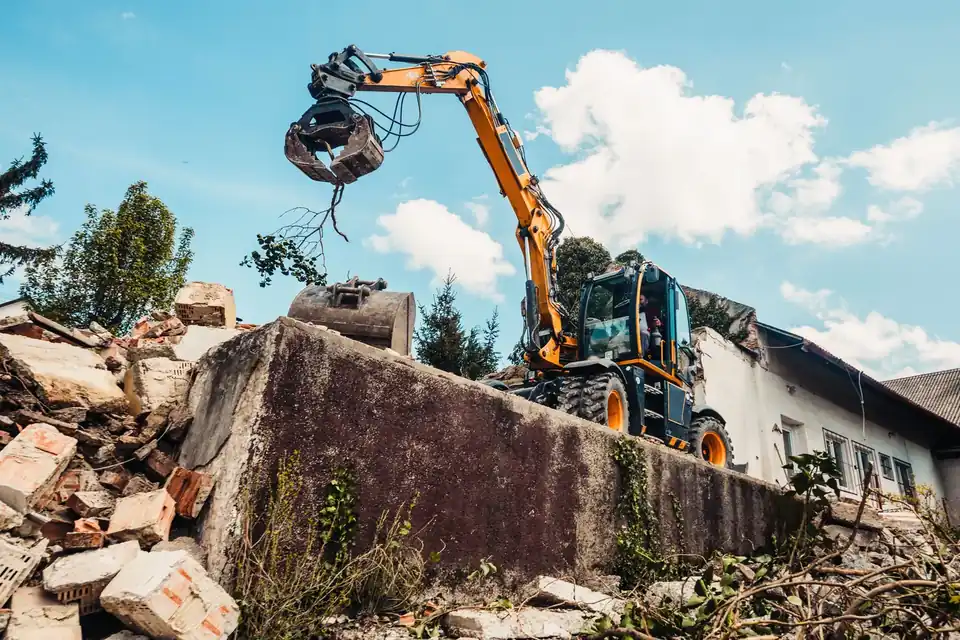
Demolition in Pretoria
Last updated
Demolition machines and prices in Pretoria
Every machine comes with an experienced operator or driver. Prices exclude VAT; transport is its own line.
| Machine | What it does on a demolition | Price |
|---|---|---|
| Excavator, 20–25 t | Pulls down walls and roofs, breaks slabs with a hydraulic breaker, sorts and loads rubble | R3,500–R5,600 a day |
| Excavator, 36–55 t | Bigger industrial structures and thick foundations | R6,500–R8,100 a day |
| TLB with hydraulic breaker | Single-storey houses, outbuildings, boundary walls, slabs and driveways | R5,000–R6,550 a day |
| Bobcat with breaker | Interiors, tight yards, shopfronts, loading in small spaces | R3,000–R3,600 a day |
| Tipper, 6 cube | Carting rubble to landfill or a crusher | R1,250–R1,900 a load |
| Tipper, 10 cube | Bigger volumes, all day | R3,700–R5,250 a day |
| Water truck, 8,000–12,000 litre | Dust control on bigger sites | R2,000–R2,300 a day |
| Heavy electric jackhammer | Hand breaking where no machine fits | R380–R610 a day, machine only |
The excavator comes on a lowbed: Pretoria is one of the main centres we send machines from. Transport for an excavator there and back usually comes to R6,000–R9,500, shown as its own line on your quote. A breaker TLB drives to site.
| Example quote (for illustration only) | Amount |
|---|---|
| 20–25 t excavator, 3 days at R3,500–R5,600 a day with operator | R10,500–R16,800 |
| Transport both ways to Pretoria | R6,000–R9,500 |
| Example total, excl. VAT | R16,500–R26,300 |
Demolition contractors in Pretoria: which machine for which job
An older house cleared for townhouses or a new build
The most common Pretoria demolition. A 20–25 t excavator takes down a single-storey brick house, breaks the slab and foundations, and loads the tippers, usually in two to four days. On a narrow stand where a lowbed can't park, a breaker TLB does the same job a little slower.
Outbuildings, boundary walls, pools and slabs
A breaker TLB for a day or two: it breaks the concrete, loads the rubble and levels the ground. A pool shell is broken up, the rubble hauled away, and the hole backfilled and compacted in layers so the ground doesn't settle later.
Interior strip-outs and shopfronts in the CBD
Inside buildings and on tight inner-city stands, a bobcat with a breaker and a jackhammer crew working into a tipper parked at the kerb. Parking the tipper in the street may need the City's permission to occupy the road.
Factories and sheds in Pretoria West and Rosslyn
Roof sheeting and steel come off first, often with a crane truck lowering the trusses; then a 36–55 t excavator (R6,500–R8,100 a day with operator) takes down walls and breaks thick floor slabs and machine bases.
Permits and rules for demolition in Pretoria
1. The City of Tshwane's written permission
Regulation E1 of the National Building Regulations: no one may demolish a building, or have it demolished, without the local authority's prior written permission. Tshwane can attach conditions for the safety, health and convenience of the public and for neighbouring buildings. Ask the City's building control office which form and documents it wants with your application, and apply before you book the machines.
2. At least 10 days' notice
Regulation A22: you must give the municipality notice of the date demolition starts, on its form, at least 10 days before, not counting Saturdays, Sundays and public holidays. Not giving notice is an offence. Book our machines for a date after the notice period ends.
3. Buildings older than 60 years
Section 34 of the National Heritage Resources Act: no one may alter or demolish any structure, or part of one, older than 60 years without a permit from the provincial heritage resources authority. In 2026 that catches anything built before about 1966, which includes much of Pretoria's older housing in suburbs such as Arcadia, Sunnyside, Brooklyn and Muckleneuk, and many buildings in the CBD. If the permit is refused, the authority must consider the place for formal heritage protection within three months. Check the date on the original building plans before you book a machine.
4. Asbestos survey first
Many Pretoria houses and factories of that age have asbestos-cement roofs, gutters, fascias or ceilings. Under the Asbestos Abatement Regulations, 2020 (GN R.1196):
- a competent person records all asbestos in an inventory of asbestos in place (regulation 4);
- the Department of Employment and Labour's provincial office (Chief Director: Provincial Operations) is notified in writing at least seven days before asbestos work starts (regulation 10);
- a registered asbestos contractor removes it, an approved inspection authority checks the work, and an asbestos clearance certificate is issued afterwards (regulations 12, 13 and 22).
Our machines start once the clearance certificate is in hand.
5. On the day: supervision and services
Regulation 14 of the Construction Regulations, 2014: the contractor must appoint a competent person in writing to supervise and control all demolition work on site. Before we arrive, have the City disconnect and seal the water and electricity, and mark any gas, sewer and fibre lines. Tell the neighbours the dates and protect shared walls.
6. Dolomite in the south
In Centurion and the dolomite areas south of the city, water getting into the ground is what triggers sinkholes. Basements, pool shells and foundation holes are backfilled in compacted layers straight after the demolition, and broken water and sewer pipes are capped, not left leaking.
How long a Pretoria demolition takes, and what it costs
| Job | Machines | Typical time | Machine cost, example |
|---|---|---|---|
| Boundary wall or outbuilding | Breaker TLB | 1 day | R5,000–R6,550 |
| Single-storey house, slab and foundations | 20–25 t excavator | 2–4 days | R10,500–R16,800 for 3 days |
| Same house, narrow stand | Breaker TLB | 3–4 days | R15,000–R19,650 for 3 days |
| Rubble carting | 6 cube tippers | Alongside the machine | R12,500–R19,000 for 10 loads |
The paperwork takes longer than the machine work: the 10-day notice, the City's permission, the asbestos inventory and seven-day notification, and a heritage permit for old buildings. Start those first. Rubble volume and loads: tipper loads and cubes.
Before the machine arrives
- Written permission from the City of Tshwane, and the 10-day notice given.
- Heritage permit if the building is older than 60 years.
- Asbestos inventory, and the clearance certificate if asbestos was removed.
- Water and electricity disconnected; other services marked.
- Access for a lowbed and tippers checked, and neighbours told.
The full method, permits and safety rules are in our demolition guide and on demolition. After the demolition: site clearing and earthworks. Every machine in the city: plant hire in Pretoria.
WhatsApp photos of your Pretoria demolitionQuestions people ask
Do I need a permit to demolish a house in Pretoria?
Yes. Under regulation E1 of the National Building Regulations nobody may demolish a building without the local authority's prior written permission, which in Pretoria and Centurion means the City of Tshwane. Regulation A22 adds at least 10 days' notice of the start date, not counting weekends and public holidays. If any part of the building is older than 60 years, a heritage permit is also needed.
How much does it cost to demolish a house in Pretoria?
For a single-storey house, plan on two to four machine days plus the rubble carting. As an example, three days of a 20–25 t excavator are R10,500–R16,800, or three days of a breaker TLB R15,000–R19,650, before lowbed transport and tipper loads. Asbestos removal, landfill fees and the permits are separate. Send photos and the floor area for a written price.
Who removes asbestos before a demolition?
A registered asbestos contractor, before our machines start. A competent person first lists all asbestos in an inventory, the Department of Employment and Labour's provincial office is notified in writing at least seven days before the asbestos work, and an asbestos clearance certificate is issued when it's done.
Do you do demolitions in Centurion too?
Yes. Centurion is part of the City of Tshwane, so the same permission and notice apply. On dolomite stands, basements, pool shells and foundation holes left by the demolition are backfilled in compacted layers rather than left open to collect water. See plant hire in Centurion.
Related
Sources we checked
- National Building Regulations (GN R.2378), regulation E1: demolition of any building
- National Building Regulations (GN R.2378), regulation A22: notice of intention to demolish
- National Heritage Resources Act 25 of 1999, section 34: structures older than 60 years
- Asbestos Abatement Regulations, 2020 (GN R.1196 of 2020)
- Asbestos Abatement Regulations, 2020, regulation 4: inventory of asbestos in place
- Asbestos Abatement Regulations, 2020, regulation 10: notification of asbestos work
- Construction Regulations, 2014 (GN R.84), regulation 14: demolition work
- Council for Geoscience, Development possibilities on dolomitic ground (2013)
Need an excavator in Pretoria?
WhatsApp us the job, the town and the dates. We confirm the machine, the start date and the price in writing before the machine moves.
WhatsApp us now