Plant hire in Centurion
Last updated
Centurion plant hire prices
Our rates for the machines Centurion hires most, excluding VAT. With an operator or driver unless it says machine only.
| Machine | Rate | Price |
|---|---|---|
| TLB, standard 4x4 | Per day with operator | R3,900–R5,150 |
| TLB with hydraulic breaker | Per day with operator | R5,000–R6,550 |
| Bobcat (skid steer) | Per day with operator | R2,400–R3,700 |
| Mini excavator, 1.5–6 t | Per day with operator | R1,700–R3,000 |
| Cherry picker, 12–15 m | Per day with operator | R2,400–R4,000 |
| Forklift, 2.5–3 t | Per day, machine only | R1,150–R1,600 |
| Tipper, 10 cube | Per day with driver | R3,700–R5,250 |
| Excavator, 20–25 t | Per day with operator | R3,500–R5,600 |
| Roller, 10–12 t | Per day with operator | R2,150–R5,600 |
| Rammer (trench compactor) | Per day, machine only | R350–R470 |
Every price is confirmed in writing before the machine moves. Hourly, weekly and monthly rates are on plant hire rates.
Get a Centurion price on WhatsAppDigging on Centurion's dolomite: what changes the job
The 1977 geological survey of the Pretoria area places the dolomite south of the city, with springs rising out of it in the Fountains, Kafferspruit and Sterkspruit valleys. Centurion (then Verwoerdburg) sits on that belt. Dolomite is hard rock, but rainwater slowly dissolves it along cracks, leaving voids under the soil. When water pours into the ground above a void, the soil arch over it can collapse into a sinkhole.
Water starts the sinkholes, not the machines
The Council for Geoscience lists three triggers: leaking water-bearing services, poor stormwater management, and a falling water table. Centurion shows the first two. One of its most active sinkholes opened in January 2025 after a blocked stormwater pipe made water overflow through manholes onto the ground around it, and leaking sewage washed soil away underground. By May 2025 the City of Tshwane had declared 63 sinkholes a disaster. The Gauteng MEC said Centurion's dolomitic ground "requires continuous monitoring and proactive infrastructure management".
The dolomite rules your engineer works to
Building on dolomite land follows SANS 1936, Development of dolomite land, in four parts: general principles, geotechnical investigations, design and construction, and risk management. A competent person investigates the stand and writes a dolomite stability report. The Council for Geoscience checks these reports, and the local authority (here the City of Tshwane) and the NHBRC act on its recommendations.
The report gives the ground an inherent hazard class from 1 to 8. Classes 1 and 2 allow all types of housing (at limited density), commercial and industrial development. Classes 3 to 5 allow only selected housing, with commercial or light industry. Classes 6 and 7 allow no housing, only selected commercial or light industry, and class 7 needs all surfaces sealed. Class 8 allows no development. Typical measures in the design: raft foundations, HDPE water and sewer pipes, gutters and downpipes, concrete aprons around buildings, and lined stormwater channels. Each of those is machine work, so send us the engineer's notes with your booking.
How our operators work on dolomite
- Short trenches, closed the same day. Dig only what the pipe crew can lay and backfill before the afternoon, so a storm can't fill an open trench.
- Backfill in compacted layers. Usually with a rammer (R350–R470 a day) in trenches and a roller on bigger areas, to the layer thickness in the spec.
- No ponding. Spoil heaps go where they won't dam stormwater, and the site is left sloping away from buildings.
- Water only as the engineer allows. Compaction and dust water from a water truck is used sparingly when the dolomite notes limit it.
- Stop and report. If the ground sinks, cracks or swallows water, the operator stops, keeps the machine back and tells you and your engineer.
Chert, boulders and hard digging
The upper dolomite carries bands of chert, a glassy rock harder than the dolomite, and chert breccia. Trenches in Centurion often meet chert gravel and boulders. A standard TLB digs through the gravel; for boulders and pinnacles, book the TLB with a hydraulic breaker (R5,000–R6,550 a day with operator) from the start rather than paying for two visits.
Summer storms, October to March
Gauteng is a summer-rainfall area: the South African Weather Service notes that the rain normally falls between October and March. On dolomite, storms matter twice: they stop work and they are the water that triggers sinkholes. Plan trenching and pool digs for dry spells where you can, and ask about standing time when we quote a summer job.
TLB hire in Centurion
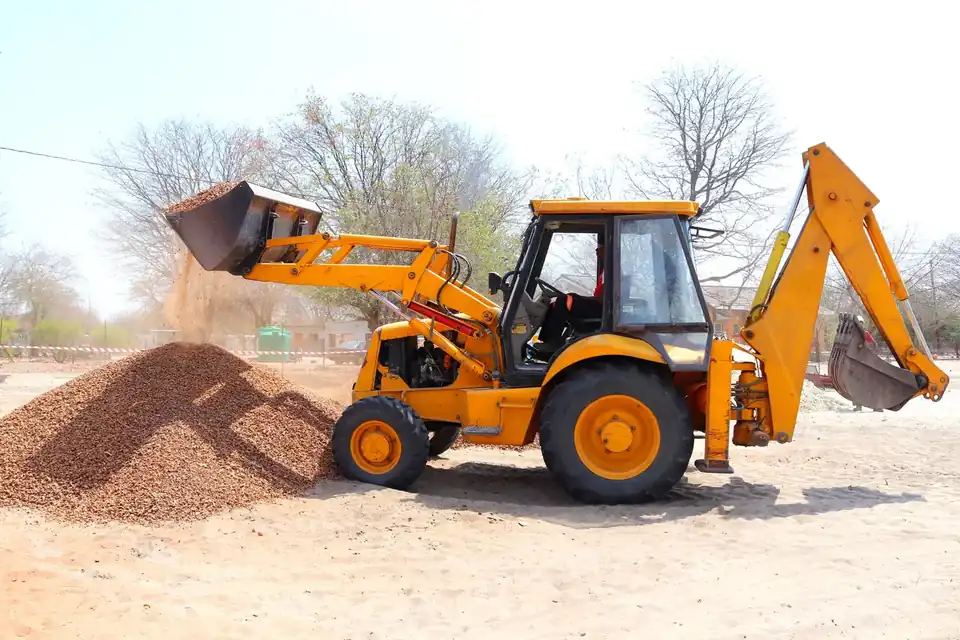
A TLB for hire in Centurion costs R3,900–R5,150 a day with operator, or R320–R410 an hour dry (operator included, you pay the diesel). The standard 4x4 machine (JCB 3CX or similar) digs to about 4.4–4.8 m and loads tippers with its front bucket.
Typical Centurion TLB jobs: extensions, pools and retaining-wall footings in Eldoraigne, Wierda Park and Lyttelton; raft foundation digs and service trenches on new stands in the Monavoni and Kosmosdal estates; sewer and water connections in Olievenhoutbosch; and yard drainage at factories in Hennopspark and Sunderland Ridge. In an estate, sort out working hours and the access list with the body corporate first, and measure the gate: the TLB needs about 3.3 m with its stabilisers down.
Nobody works inside a deep trench unless its sides are shored, braced or sloped back, or a competent person has confirmed in writing that the ground is stable (Construction Regulations, 2014, regulation 13). Centurion is one of the main centres we send machines from. The TLB drives to site, so travel is small and confirmed on WhatsApp with your price.
| Example quote (for illustration only) | Amount |
|---|---|
| Standard 4x4 TLB (about 8 t), 3 days at R3,900–R5,150 a day with operator | R11,700–R15,450 |
| Transport to Centurion | confirmed on WhatsApp |
More on TLBs across Tshwane: TLB hire in Pretoria. Specs and every size: TLB hire.
Bobcat hire in Centurion
A bobcat costs R2,400–R3,700 a day with operator, or R190–R370 an hour. With a breaker, auger or broom it's R3,000–R3,600 a day with operator. It's the machine for tight estate gardens and townhouse complexes: levelling for paving, spreading topsoil and G5 gravel, clearing renovation rubble and loading it into a tipper. It weighs far less than a TLB, which helps on paved driveways.
The bobcat comes on a trailer: transport there and back in Centurion is R1,300–R3,840. For augered holes on dolomite (fence posts, pergola footings), check the depth limit in the engineer's notes first. Pretoria detail: bobcat hire in Pretoria.
Cherry picker hire in Centurion
Centurion's office parks, shopping centres and warehouses keep cherry pickers busy: signage, façade glazing, high-bay lights, gutters and roof sheeting. Prices with a certified operator:
| Working height | Typical Centurion job | Per day |
|---|---|---|
| 12–15 m | Shopfront signs, gutters, double-storey houses, warehouse lights | R2,400–R4,000 |
| 16–17 m | Three-storey office blocks, taller warehouses | R4,150–R7,900 |
| 20–25 m | Higher façades and roofs | about R8,200 |
A 12–15 m machine is R11,500–R12,500 a week. Cherry pickers are lifting machines: ours carry a load-test certificate not older than 12 months and come with an operator certified by an accredited training provider (Driven Machinery Regulations, 2015, reg 18). On dolomite the outriggers go on pads on firm, dry ground, away from leaking pipes and stormwater inlets. Transport there and back is R1,300–R3,840. Sizes and reach: cherry picker hire.
Forklift hire in Centurion
Forklifts go to warehouses and light industry in Hennopspark, Sunderland Ridge and the Samrand business parks, and to building sites for offloading bricks and roof sheets. Machine-only day rates: R940–R1,600 for 1–2 t, R1,150–R1,600 for 2.5–3 t and R1,600–R1,900 for 3.5–5 t. A week on a 3.5–5 t forklift is about R8,500. Our operator can be added to your written price.
Whoever drives needs a certificate of training for that type of truck: a counterbalance forklift up to 3,000 kg is code F1 in the 2024 National Code of Practice, and a rough-terrain forklift for unpaved sites is F11. Transport there and back is R1,300–R3,840. Sizes and fuel types: forklift hire. For bigger warehouse fleets on the East Rand, see forklift hire in Boksburg.
Equipment hire in Centurion
Small plant comes machine only, and on dolomite most of it is about compaction:
- Rammer for trench backfill: R350–R470 a day.
- Reversible plate compactor for paving and slab bases: R400–R630 a day.
- Concrete mixer, 300–500 litre: R370–R470 a day.
- Heavy electric jackhammer for chert boulders and old slabs: R380–R610 a day.
- Portable generator up to 10 kVA: R320–R520 a day.
Excavators, tippers and crane trucks
For bulk earthworks on new developments, a 20–25 t excavator is R3,500–R5,600 a day with operator and comes on a lowbed, R6,000–R9,500 there and back. A 10 cube tipper is R3,700–R5,250 a day with operator; where the engineer wants poor soil swapped for imported gravel, plan loads both ways. An 8–10 t crane truck (R2,500–R5,200 a day with operator) places water tanks, prefab rooms and roof trusses. See crane truck hire in Pretoria.
Where we work in Centurion
Irene and Lyttelton
Older suburbs where the work is mostly renovations, pools, boundary walls and replacing old pipes. When pipes are replaced on a dolomite stand, the dolomite measures usually call for HDPE pipe, and the new trench has to go in carefully around the services already in the ground, so mark them before we dig.
Eldoraigne, Wierda Park and Rooihuiskraal
Established family suburbs: extensions, granny flats, pools and paving. A TLB or bobcat for a day or two covers most of it.
Monavoni, Kosmosdal and Samrand
The growth side of Centurion, with new estates, townhouse complexes and business parks. Expect raft foundations, estate service trenches, building pads with a roller, and forklifts and cherry pickers in the business parks.
Olievenhoutbosch
New houses, extensions and backyard rooms, with water and sewer connections. A TLB digs the footings and the connection trench in one visit.
Hennopspark and Sunderland Ridge
Centurion's industrial areas: factory yards, drainage, floor-slab breakouts with a breaker TLB, and forklifts and crane trucks for stock and machinery.
Midrand, next door
Midrand is reached from Centurion. Midrand is about 21 km from Centurion by road, inside our normal delivery area. The TLB drives to site, so travel is small and confirmed on WhatsApp with your price. Midrand detail is on plant hire in Gauteng, and the rest of Tshwane on plant hire in Pretoria.
How booking works: how it works. Operator and load-test certificates on request: safety and certificates.
WhatsApp your Centurion jobQuestions people ask
How much does plant hire cost in Centurion per day?
With an operator: a TLB is R3,900–R5,150 a day with operator, a bobcat R2,400–R3,700 a day with operator, a 12–15 m cherry picker R2,400–R4,000 a day with operator and a 10 cube tipper R3,700–R5,250 a day with operator. A 2.5–3 t forklift is R1,150–R1,600 a day, machine only. Prices exclude VAT, and transport is its own line on your quote.
Is all of Centurion on dolomite?
Much of it is. The dolomite belt lies south of Pretoria, and Centurion's dolomitic ground is why the City of Tshwane declared 63 sinkholes a disaster in 2025. But dolomite changes over short distances, so only a dolomite stability investigation for your stand says how risky it is and what may be built. Ask for that report before you plan trenches, a pool or a basement.
Do I need a wayleave to dig in Centurion?
Only for work in the road reserve, such as a trench across the pavement for a water, sewer or fibre connection. Centurion is part of the City of Tshwane, so the wayleave comes from the City. Inside your boundary no wayleave is needed, but on dolomite your engineer's notes still apply.
What should I do if a hole or crack opens on my property?
Keep people and vehicles away from it, turn off the water if a pipe could be leaking, and report it to the City of Tshwane. Cracks in walls and ground that settles are often the first warning signs of a sinkhole. Don't have it filled until an engineer has looked at it and said how it must be repaired; then we can send the TLB, tippers and compactor for the work.
Related
Sources we checked
- Council for Geoscience, Development possibilities on dolomitic ground / How safe is your house: the dolomite hazard (presentation to Parliament, 27 February 2013)
- Gauteng Provincial Government, MEC Mamabolo assessed areas affected by sinkholes in the City of Tshwane (May 2025)
- Explanation of the geology of the Pretoria area (Geological Survey, 1977)
- South African Weather Service, What kind of droughts does South Africa experience? (summer rainfall season)
- Driven Machinery Regulations, 2015 (GN R.540), regulation 18: lifting machines
- National Code of Practice, 2024: forklift (lift truck) codes F1 to F16
- Construction Regulations, 2014 (GN R.84), regulation 13: excavation work
Need a TLB in Centurion?
WhatsApp us the job, the town and the dates. We confirm the machine, the start date and the price in writing before the machine moves.
WhatsApp us now