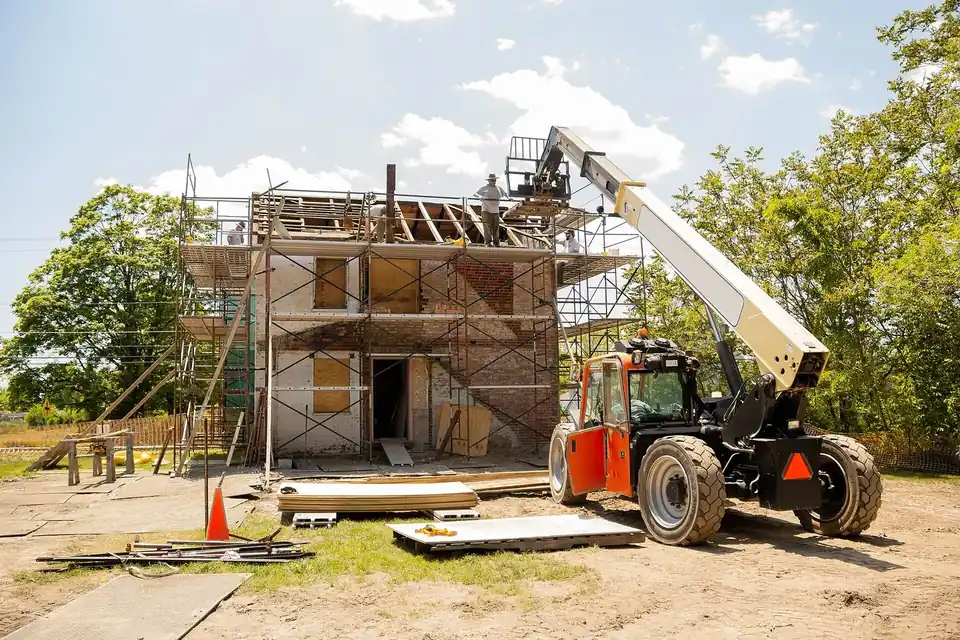
Telehandler hire
Last updated
Telehandler hire prices
We price telehandlers per job, so the exact figure comes back in writing on WhatsApp. To quote, we need:
- The heaviest load: its weight from the delivery note or packaging, and its size (a pallet, a bundle of roof sheets, a bale).
- Height and reach: how high it must go and how far forward from where the machine can stand, for example "onto a scaffold 9 m up, 4 m back from the edge of the paving".
- Attachments: forks, bucket, work platform or jib.
- Days, town and operator: how long, where, and whether you want our certified operator.
Delivery is its own line. For a compact machine inside a main centre it's R1,300–R3,840 there and back; further out it's charged per kilometre from the nearest main centre, for example: Brits is about 53 km from Pretoria by road. Transport for a telehandler there and back usually comes to R4,560–R5,520, shown as its own line on your quote. Weekly and monthly hires cost less per day than single days, which suits building contracts and harvest season.
Get a telehandler price on WhatsApp7 m, 14 m or 17 m? Telehandler sizes
Telehandlers come in reach classes. On JCB machines the model number reads straight off: a 535-140 is rated 3.5 t (the "35") with a lift height of 14 m (the "140", in tenths of a metre).
| Class | Typical model | Rated load | Lift height | Typical jobs |
|---|---|---|---|---|
| Mini / small | JCB 516-40 or similar | about 1.6 t | about 4 m | Tight sites, inside sheds, landscaping, loading bakkies and small trucks |
| Compact 7 m | JCB 531-70 or similar | about 3.1 t | about 7 m | Farms, yards, double-storey houses, pallets onto first-floor slabs |
| 14 m | JCB 535-140 or similar | 3.5 t | 13.8 m | Bricks and blocks onto scaffolds, roof sheets and trusses to roof level on three- and four-storey work |
| 17 m | JCB 540-170 or similar | about 4 t | about 17 m | Taller buildings, warehouses and placing loads further back from the edge |
| 360 rotating | Manitou MRT 2150 or similar | about 5 t | about 21 m | Placing loads all around a building from one set-up |
Capacity at height and reach
The rated load is the most the machine lifts close in, with the boom low and short. As the boom extends forward, capacity falls fast: a JCB 535-140 or similar lifts 3.5 t close in but 1,250 kg at its full 9.6 m forward reach with the stabilisers down, and only 200 kg there with them up. Every telehandler has a load chart in the cab showing what it may lift at each height and reach, and 14 m and bigger machines usually have front stabilisers that raise the chart when they're down. Send the weight, height and reach and we check them against the chart for the machine we send.
Example: pallets of blocks onto a scaffold at 9 m, but the machine can only stand 5 m back because of a trench. A compact 7 m machine can't reach the height. A 14 m machine reaches it, but at that reach it lifts well under its 3.5 t rating, so we check the pallet weight against its chart, and if it's too heavy, split the pallets or send the 17 m class.
Forks, buckets and work platforms
Pallet forks
The standard set-up: bricks, blocks, cement, roof tiles, tanks and anything palletised. Ask for longer forks for bundles of roof sheets or timber.
Bucket
Loose material: sand, stone, feed, manure and grain on farms, and cleaning up a site. A general-purpose bucket turns the telehandler into a high-reach loader for filling trucks and silos.
Work platform
A basket on the boom for people. On a telehandler this is a man-cage, so it must be built to an approved SANS standard, approved for that use by an inspector, and used after a risk assessment (Driven Machinery Regulations, reg 18(8)). The code of practice gives man-cage work its own special-operation code (T). For most work at height, a boom lift or cherry picker is simpler.
Jib and hook
For lifting suspended loads such as steel, trusses and precast, with slings and a rigger. For heavy or long-reach lifts, a mobile crane is the right machine.
What telehandlers are hired for
Roofing
Lifting bundles of roof sheets, tiles, insulation and trusses to roof level and placing them on the wall plate, without a crane on standby for the whole job.
Bricks and blocks to scaffolds
Pallets straight onto the scaffold loading bay or upper slab, beside the bricklayers, instead of hand-carrying up ladders.
Farms
Stacking bales, loading feed and fertiliser, filling planters and spreaders, cleaning pens with a bucket, and loading trucks at harvest.
Yards and industrial sites
Unloading trucks where the ground is too rough for a forklift, stacking steel and pipes, and moving material around a site.
Solar and steel
Pallets of panels and mounting rails onto roofs and carports, and steel members placed for the erection crew.
Telehandler, forklift or crane?
| Telehandler | Forklift | Crane truck / mobile crane | |
|---|---|---|---|
| Ground | Rough, sloped or muddy sites (4x4) | Hard, level floors and yards | Stands on outriggers; reaches over obstacles |
| Reach | Forward and up, about 4–17 m (21 m on a 360) | Straight up only | Up, out and over buildings |
| Best for | Pallets and bundles placed high, all day on site | Loading and stacking in warehouses | Single heavy lifts, long radius, delivery and lift in one (crane truck) |
| Price | Exact price on WhatsApp | From R940–R1,600 a day, machine only | Crane truck R2,500–R5,200 a day with operator |
A telehandler earns its keep when material arrives all day and must go up and forward on a rough site. For a single heavy lift, or loads over a building, take a crane.
Operator certificate and load test
- Operator: a telehandler is a lifting machine, listed in the National Code of Practice (Notice 5588 of 2024) as a telescopic boom handler, code C46. Nobody may operate it without a certificate of training from an accredited training provider (Driven Machinery Regulations, reg 18(11)). The licence card is valid for up to 24 months. On a construction site, the Construction Regulations (reg 23) add a medical certificate of fitness, written authorisation and an inspection before each day's use.
- Load test: a thorough examination and performance test by a lifting machinery inspector of a registered lifting machinery entity at intervals of no more than 12 months (reg 18(5)(a)), and a six-monthly examination of its safety devices by a competent person (reg 18(6)).
- Your register: if you use a hired machine, keep a register on site with its latest performance test and service records, not older than 12 months (reg 18(7)(b)). We send copies before the telehandler arrives, on request.
Before it arrives, check the ground where it will work (firm and roughly level, away from trench edges and new fill) and look up for power lines: nobody may come inside a line's safety clearance with a boom or load without permission from the utility that runs it (Electrical Machinery Regulations, reg 19(5)). More on safety and certificates.
How telehandler hire works
- WhatsApp the job: the load, height, reach, attachment, town and dates. A photo of the site helps.
- We size the machine and confirm in writing: the class, attachments, operator, dates and delivery as its own line.
- Pay the deposit to book.
- Your telehandler arrives with its operator, and copies of the load-test and operator certificates if you asked for them. If it breaks down, you get a replacement machine or no charge for the downtime.
We send telehandlers to building sites, farms and yards in all 9 provinces; see plant hire in Johannesburg, Cape Town and Durban for local prices on other machines. Full steps: how hiring works.
WhatsApp us the load and the heightQuestions people ask
How much does telehandler hire cost?
Exact price on WhatsApp. It depends on the reach class (compact, 14 m or 17 m), the attachments (forks, bucket, work platform or jib), the days or weeks, whether you take our certified operator, and delivery to site, which is its own line: for a compact machine inside a main centre, R1,300–R3,840 there and back. Weekly and monthly hires cost less per day than single days.
Can I hire a telehandler with an operator?
Yes. Our telehandlers come with a certified operator who holds the C46 (telescopic boom handler) certificate, so you don't need anyone trained on site. That's what "telehandler and driver hire" and "telehandler operator hire" mean.
How much does a JCB telehandler weigh?
A 14 m machine (JCB 535-140 or similar) weighs about 10.9 t on the maker's sheet; compact 6–7 m machines are lighter and the 17 m class heavier. The exact operating weight is on the machine's plate and in its specification sheet, and it matters for delivery, for driving over paving and for any suspended slab or bridge on the way in.
What is a 360 telehandler?
A rotating telehandler: the boom sits on a turret that slews all the way round, like a crane, and the machine stands on four outriggers. A Manitou MRT 2150 or similar reaches about 21 m and is rated 5 t. It places loads around a building from one spot, with forks, a hook or a work platform. Exact price on WhatsApp.
Is a telehandler the same as a forklift?
No. A forklift lifts straight up on a mast and needs hard, level ground. A telehandler has a telescopic boom that reaches forward and up, on big 4x4 tyres, so it places loads over trenches and walls and onto upper floors on rough sites. See forklift hire for yards and warehouses.
Related
Sources we checked
- JCB Loadall 535-125 / 535-140 HiViz specification sheet (lift performance with stabilisers extended and retracted, weight)
- National Code of Practice for Training Providers of Lifting Machine Operators, 2024 (Notice 5588): crane codes incl. C46 telescopic boom handler and T man-cage
- National Code of Practice, 2024: clause 14, certification
- Driven Machinery Regulations, 2015 (GN R.540), regulation 18: lifting machines
- Construction Regulations, 2014 (GN R.84), regulation 23: construction vehicles and mobile plant
- Electrical Machinery Regulations, 2011 (GN R.250), regulation 19: overhead power lines
Need a telehandler?
WhatsApp us the job, the town and the dates. We confirm the machine, the start date and the price in writing before the machine moves.
WhatsApp us now