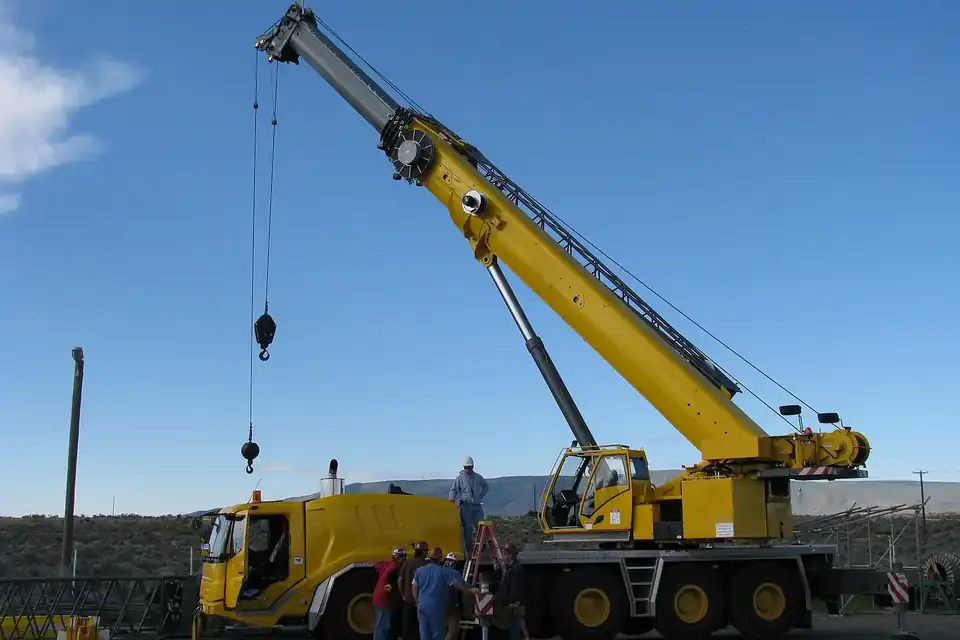
Lifting machinery: load tests and certificates
Last updated
Get a written price
- Send the job on WhatsApp: what you are doing, the town and the dates.
- Get your quote: the machine, the operator, transport and the total, in writing.
- Pay to book and the machine arrives on site with its operator.
We reply Monday to Friday 07:00–17:00, Saturday 07:00–13:00.
What counts as lifting machinery?
The Driven Machinery Regulations, 2015 (Government Notice R.540 of 24 June 2015, under the Occupational Health and Safety Act 85 of 1993) define a lifting machine as a power-driven machine designed and built to raise or lower a load or move it in suspension. Elevators, escalators and hand-powered lifting devices are left out of that definition, but hand-powered devices are covered by the same regulation 18.
| Machine | Lifting machine? | Operator code |
|---|---|---|
| Mobile crane (hydraulic) | Yes | C43 up to 15 t, C33 up to 50 t, C35 above 50 t |
| Truck-mounted crane (crane truck) | Yes | C32 |
| Cherry picker or boom lift (mobile elevated work platform) | Yes | C53 |
| Telehandler (telescopic boom handler) | Yes | C46 |
| Forklift (lift truck) | Yes | F1 counterbalanced up to 3,000 kg, F2 up to 7,000 kg, F3 up to 15,000 kg, F4 above |
| Overhead crane | Yes | C30 pendant or radio, C31 cab |
| Tower crane | Yes | C41 top slewing, C42 bottom slewing |
| Hoists and winches | Yes | C54 |
| TLB or excavator | Construction plant; a lifting machine only when used to lift a suspended load | Construction Regulations reg 23; F11 covers rough-terrain equipment with lift-truck attachments |
Lifting tackle is everything between the hook and the load: chain, wire rope and webbing slings, master links, hooks, shackles, swivels, eye bolts, spreader beams and lifting clamps. It has its own rules, below.
Load tests: what regulation 18 requires
The user of every lifting machine must have the whole installation, its working parts and the ancillary lifting equipment put through a thorough examination and a performance test by a lifting machinery inspector of a lifting machinery entity (reg 18(5)(a)):
- before it is first used;
- every time it is dismantled and re-erected;
- and after that at intervals of no more than 12 months.
The test follows the standard the machine was built to. Where there is no manufacturing standard, the whole installation is tested with 110% of the safe working load over its complete lifting range, so that every part is stressed.
Moving to a new site doesn't restart the clock. Mobile cranes, self-erecting cranes and mobile elevated work platforms are excluded from the performance test after each redeployment within the 12-month period (reg 18(5)(c)). That's why a hired crane arrives with a certificate from its last test rather than being tested at your gate.
The other checks between load tests
| What | How often or when | Who | Reg |
|---|---|---|---|
| Thorough examination and performance test of the machine | First use, re-erection, then every 12 months at most | LMI of a registered LME | 18(5) |
| Ropes, chains, hooks, sheaves, brakes and safety devices | Every 6 months at most | Competent person | 18(6) |
| Lifting tackle (slings, shackles, beams) | Every 3 months at most, results recorded and signed | Competent person appointed in writing | 18(10)(e) |
| Safe working load marked on the machine, with a load chart where it varies | Always | User | 18(1)(b) |
| Manufacturer's plate: maker, design standard, serial number, country of origin | Always | User | 18(1)(c) |
| Load indicator (machines over 5,000 kg) and/or load-limiting device | Always | User | 18(9) |
| Daily pre-use inspection, recorded in a register on the machine | Every day on construction sites | The authorised operator | Construction Regs 23(1)(k) |
Lifting tackle must also be marked with its safe working load and traceable identification, and thrown out at any sign of damage, wear or distortion (reg 18(10)). The minimum safety factors are 6 for steel-wire rope slings, 7 for man-made fibre rope and webbing, 10 for natural-fibre rope, 5 for steel chain and 4 for high-tensile or alloy chain.
Lifting machinery entities (LMEs) and inspectors (LMIs)
Registered lifting machinery entity
An LME is a legal entity approved and registered by the chief inspector under regulation 19. It applies on the form in Annexure A to the regulations, must have the competency and operational ability to examine and performance-test lifting machines, and gets a certificate of registration that is entered into the national database. An LME must produce that certificate on request to an inspector or to anyone it intends to test for (reg 19(4)), and report any change affecting its registration within 14 days (reg 19(5)).
Lifting machinery inspector
An LMI is a person employed by an LME and registered with the Engineering Council of South Africa under the Engineering Profession Act, 2000. The inspector must know the erection, load testing and maintenance of the type of machine being tested (reg 18(5)(b)). So when you check a load-test certificate, look for three things: the LMI's name and ECSA registration, the LME's name and registration, and a serial number that is the same as the one on the machine's plate.
Registers, and the rules for hired machines
- Your own machines: the user keeps a register on the premises with full particulars of every performance test, examination, modification and repair, available to an inspector on request (reg 18(7)(a)).
- Hired (leased) machines: the user keeps a register on the premises with the machine's latest performance test and service records, not older than 12 months (reg 18(7)(b)).
- The hire company: keeps full service history records for leased equipment for at least 10 years (reg 18(7)(c)).
In practice: when you hire a crane, crane truck, cherry picker, forklift or telehandler, ask for the load-test certificate and the service record before it arrives and file them in your site register. We send copies on request, so the paperwork is done before the first lift.
Operator certificates
Regulation 18(11) says every lifting machine must be run by an operator trained for that type of machine. For machines listed in the National Code of Practice for Training Providers of Lifting Machine Operators, nobody may operate one without a certificate of training from an accredited training provider. The current code is Notice 5588 of 2024 (Government Gazette 51657, 29 November 2024), which replaced the 2015 code published as R.539.
- The certificate shows the operator's name and ID number, the machine code, its capacity and any restrictions, the training provider's accreditation number and the assessor's registration number (clause 14.1).
- The licence (carry) card is valid for up to 24 months; a temporary licence lasts up to 6 months and is marked "under supervision only" (clauses 14.2 and 14.3). Nobody may operate a listed machine without a valid certificate and carry card (clause 14.5).
- Who can be trained: people of at least 18, physically able to do the work, with a medical fitness declaration and an eye test or a valid professional driving permit (clause 12). New entrants for mobile jib cranes and tower cranes also need a driver's licence for the vehicle and Grade 12 or NQF level 4 (clause 12.3).
- On construction sites: the operator of mobile plant also needs proof of competency, a medical certificate of fitness from an occupational health practitioner (Annexure 3) and written authorisation to operate (Construction Regulations, reg 23(1)(d)).
Lifting people
No user may move or support a person with a lifting machine unless it is fitted with a man-cage built to an approved SANS standard, approved for that purpose by an inspector, and after a risk assessment (reg 18(8)). Mobile elevated work platforms are left out of the man-cage definition because they are designed to carry people. So for work at height, hire a cherry picker or boom lift, not a bucket on a crane or a TLB.
What to ask for before a crane arrives
- The load-test certificate: dated within the last 12 months, signed by an LMI with an ECSA registration, issued by a registered LME, for the serial number on the machine's plate.
- The LME's certificate of registration, if you want to check it: the LME must show it on request.
- The service record, for your register of leased machines.
- The operator's certificate and carry card: the right code (C33 or C35 for a mobile crane, C32 for a crane truck, C53 for a cherry picker), a capacity at least as big as the machine, and an expiry date after your job. On a construction site, also the medical certificate of fitness and your written authorisation.
- Lifting tackle records: slings and shackles marked with their safe working load and ID, examined in the last three months.
- On the day: the load chart in the cab, a working load indicator on cranes over 5,000 kg, and the operator's daily inspection recorded.
Every Basalt crane, crane truck and cherry picker is load-tested and comes with a certified operator; copies of the load-test and operator certificates come before the machine, on request. See safety and certificates, or price a lift on mobile crane hire. Prices for every machine are on plant hire rates, and booking step by step on how hiring works.
Questions people ask
How often must a crane be load tested in South Africa?
Before it is first used, every time it is dismantled and re-erected, and then at intervals of no more than 12 months (Driven Machinery Regulations, reg 18(5)(a)). Its ropes, hooks, sheaves, brakes and safety devices also get a thorough examination by a competent person at least every six months (reg 18(6)).
Who is allowed to load test a crane?
A lifting machinery inspector (LMI) employed by a lifting machinery entity (LME). The LME must be approved and registered by the chief inspector of the Department of Employment and Labour (reg 19), and the LMI must be registered with the Engineering Council of South Africa and know the erection, load testing and maintenance of that type of machine (reg 18(5)(b)).
Does a hired crane need a new load test at my site?
No, as long as its last performance test is less than 12 months old. Mobile cranes, self-erecting cranes and mobile elevated work platforms are excluded from the performance test after each redeployment within the 12-month period (reg 18(5)(c)). You must keep the crane's latest test and service records in a register on your premises (reg 18(7)(b)).
Does a forklift need a load test?
Yes. A forklift is a lift truck, which the regulations define as a mobile lifting machine, so the same 12-monthly examination and performance test applies, and the operator needs a certificate for the right forklift code (for example F1 for a counterbalanced lift truck up to 3,000 kg). See forklift hire.
How long is a crane operator's licence valid?
The licence (carry) card is valid for up to 24 months, after which the operator is re-licensed. A temporary licence lasts up to 6 months and is restricted to operating under supervision (National Code of Practice, 2024, clauses 14.2 and 14.3).
Related
Sources we checked
- Driven Machinery Regulations 2015 (GN R.540), reg 18 lifting machines, hand-powered lifting devices and lifting tackle
- Driven Machinery Regulations 2015, reg 1 definitions
- Driven Machinery Regulations 2015, reg 19 approval and registration of lifting machinery entity
- Notice 5588 of 2024 (GG 51657, 29 November 2024), National Code of Practice for Training Providers of Lifting Machine Operators
- National Code of Practice 2024, crane codes
- National Code of Practice 2024, forklift codes
- National Code of Practice 2024, clause 12 entrance qualification conditions
- National Code of Practice 2024, clause 14 certification
- Construction Regulations 2014 (GN R.84), reg 23 construction vehicles and mobile plant
Need a machine?
WhatsApp us the job, the town and the dates. We confirm the machine, the start date and the price in writing before the machine moves.
WhatsApp us now