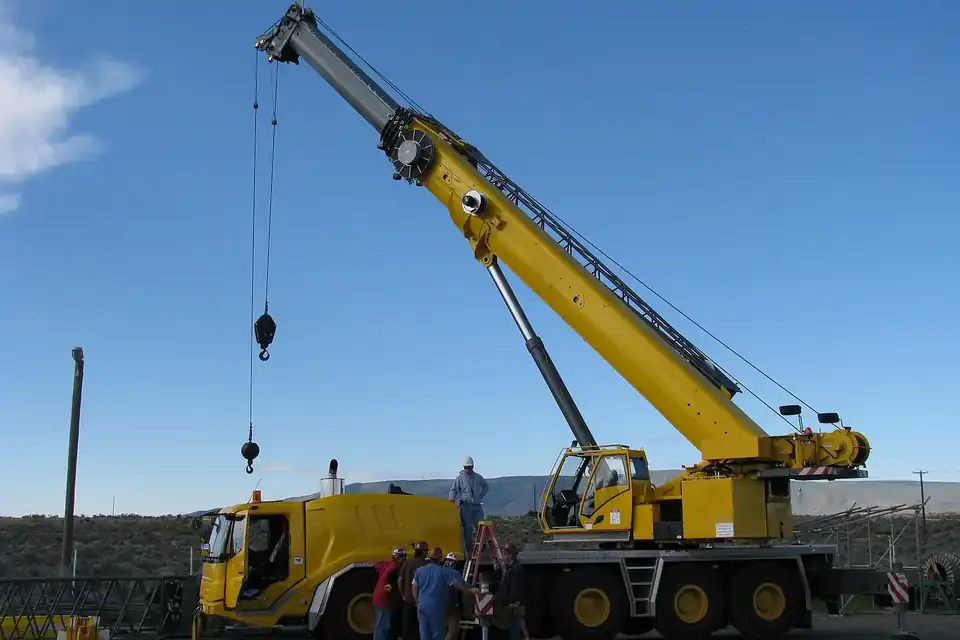
Mobile crane types
Last updated
Get a written price
- Send the job on WhatsApp: what you are doing, the town and the dates.
- Get your quote: the machine, the operator, transport and the total, in writing.
- Pay to book and the machine arrives on site with its operator.
We reply Monday to Friday 07:00–17:00, Saturday 07:00–13:00.
Types of mobile cranes
A mobile crane is any crane that travels to the job on its own wheels or tracks. South Africa's operator certificate codes (National Code of Practice, 2024) split them the same way the industry does, so the code is listed with each type.
| Type | How it moves and lifts | Best for | Operator code |
|---|---|---|---|
| All-terrain crane | Road-going, 2 to 5+ axles, all-wheel steer; hydraulic telescopic boom; sets up on four outriggers | Most hired cranes: drives to site at road speed, lifts the same day, from 40 t on two axles to 100 t on five | C33 (up to 50 t), C35 (above 50 t) |
| Rough-terrain crane | Two axles, big tyres, one cab; four-wheel steer; telescopic boom | Rough and tight sites; a 25 t (Tadano GR-250N or similar) turns in a 5.1 m radius | C43 (up to 15 t), C33 |
| Truck-mounted telescopic crane | Telescopic crane on a truck chassis, separate driving and crane cabs | General lifting where the roads are good | C33 / C35 |
| Knuckle-boom crane truck ("hiab") | Folding crane behind the truck cab; carries the load on its deck | Lift and deliver: containers, tanks, steel, pallets | C32 |
| Crawler crane | On tracks, usually a lattice boom assembled on site | Very heavy or long-reach lifts on one site for weeks | C38 (up to 50 t), C40 (above 50 t) |
| Pick-and-carry crane | Drives with the load hanging from the hook, no outriggers | Moving loads around yards, plants and mines | C34 (up to 50 t), C36 (above 50 t) |
| Tower crane | Fixed mast; top-slewing or bottom-slewing; erected on site | Building projects that need lifting daily for months | C41 (top slewing), C42 (bottom slewing) |
Spider and mini cranes are small tracked cranes that fit through doors and work inside buildings. Lattice-boom truck cranes (C37 and C39) are the older or very large road cranes with a framework boom.
Types of construction cranes and what each does
On a building site you'll meet four kinds of crane, each with its own job:
- Mobile cranes for short, heavy lifts: steel frames, trusses, precast and plant. They come for hours or days.
- Crane trucks to deliver and place lighter loads in one trip.
- Tower cranes for multi-storey work, lifting formwork, rebar and concrete skips every day for the length of the project.
- Material hoists and telehandlers for moving pallets up and around the site; a telehandler is a lifting machine with its own code (C46, telescopic boom handler).
How do tower cranes get built?
A top-slewing tower crane is assembled on its base by a mobile crane, section by section: mast sections, then the slewing unit, cab, jib and counterweights. Self-erecting tower cranes arrive folded and unfold themselves. Either way, under Construction Regulations reg 22 the crane must be designed and erected under a competent person's supervision, with a risk assessment and method statement, a wind-speed device that warns the operator, and a firm, level and secured base. That assembly lift is one of the most common jobs for a big mobile crane.
Overhead crane types, gantry cranes and hoists
These don't drive to the job; they're built into a workshop, yard or port:
- Overhead (bridge) cranes run on rails along the walls of a building, with a hoist that travels across the bridge. Single-girder cranes suit lighter loads, double-girder cranes heavier ones. Operators need code C30 (pendant or radio controlled) or C31 (cab controlled).
- Gantry cranes stand on legs: rail-mounted gantry (C52) and rubber-tyred gantry (C55) cranes work in container yards, and small mobile gantries lift engines and moulds in workshops.
- Hoists and winches (C54) lift straight up. Hand chain blocks, lever hoists and rope pullers are "hand-powered lifting devices" under the Driven Machinery Regulations, with their own inspection rules.
Gantry crane sizes and crane rail sizes are set by the building's design: the span, the lift height and the wheel load decide the girder and the rail, so they're an engineering specification, not a hire choice.
How do mobile cranes work?
- Outriggers go out and down, lifting the wheels and spreading the crane's base. The wider the spread, the more it lifts: a 25 t crane lifts 7.8 t at 10 m with its outriggers fully out (6.6 m) and only 3.2 t with them at 3.6 m.
- Counterweight on the back of the crane balances the load. Larger cranes carry it separately: 22.5 t on a 90 t or 100 t all-terrain crane.
- The boom luffs and telescopes: a hydraulic ram raises it and the sections extend. The 25 t crane's boom runs from 9.35 m to 30.5 m.
- The superstructure slews on a slewing ring, and radius is measured from its centre.
- A load indicator and limiter watch every lift. The Driven Machinery Regulations (reg 18(9)) require a load indicator on power-driven lifting machines over 5,000 kg capacity and/or a device that stops any motion that would overload the crane at that radius.
The load chart is the rule book. Close to the crane, the limit is the strength of the boom; further out, the limit is the crane tipping. That's why capacity falls so fast with radius.
Mobile crane sizes, lifting capacity and reach
A crane's tonnage is its biggest lift at its shortest radius. The real question is what it lifts at your radius. These are manufacturer load charts with the crane on full outriggers, slewing a full circle:
| Radius | 25 t (Tadano GR-250N) | 40 t (Liebherr LTM 1040-2.1) | 90 t (Liebherr LTM 1090-4.2) | 100 t (Liebherr LTM 1100-5.3) |
|---|---|---|---|---|
| 3 m | 25.0 | 30.6 | 59.2 | 59.2 |
| 10 m | 7.8 | 9.1 | 24.7 | 26.5 |
| 20 m | 2.15 | 3.0 | 9.9 | 11.2 |
| 30 m | out of reach | 1.2 | 4.9 | 6.2 |
| 40 m | out of reach | out of reach | 2.8 | 3.5 |
The headline tonnage only appears over the rear at very short radius: 40 t at 2.5 m, 90 t at 3 m and 100 t at 3 m. Those charts count the hook block as part of the load. They also assume wind of no more than 9 m/s (33 km/h) on a load with about 1 m² of surface per tonne; sheets and panels need a lower limit.
Mobile crane maximum height
- 25 t rough-terrain (Tadano GR-250N): 31.3 m lifting height on the main boom, 27.9 m maximum radius.
- 40 t all-terrain (Liebherr LTM 1040-2.1): 35 m boom, 44 m hoist height with the folding jib.
- 90 t all-terrain (Liebherr LTM 1090-4.2): 60 m boom, 76 m hoist height, 62 m maximum radius.
- 100 t all-terrain (Liebherr LTM 1100-5.3): 62 m boom, 76 m hoist height, 64 m maximum radius.
At full height a crane lifts very little, so height jobs (antennas, steeples, tower crane parts) are planned on the chart for that exact boom length.
Crane truck (Palfinger) sizes
Knuckle-boom cranes are rated by lifting moment in tonne-metres, and Palfinger's model numbers roughly follow it: PK 18500 is 18.3 t·m (8,000 kg max, 14.6 m hydraulic outreach), PK 32080 is 30.4 t·m (8,500 kg, 14.3 m), PK 42002 SH is 41.1 t·m (15,000 kg, 21 m) and PK 65002 SH is 62 t·m (22,000 kg, 20.4 m). A 30.4 t·m PK 32080 lifts 2.9 t at 9.9 m. More in the crane truck guide.
How to pick a crane size from load and radius
- Total weight on the hook: the load plus slings, shackles, spreader beam and hook block.
- The worst radius: from where the crane's centre can stand to the furthest point the load must reach, pick-up or landing.
- The height: the boom has to clear walls, roof edges and trees. More boom means less capacity at the same radius.
- Find the crane whose chart covers weight at radius, with margin. Then check the outrigger space and the ground.
Example: a 1.5 t water tank goes onto a 10 m stand, 16 m from the only spot where a crane can set up. The 25 t crane lifts 3.45 t at 16 m: enough, with room for the slings and hook block. Move the same tank to 24 m and the 25 t crane is down to 1.4 t, so the 40 t (2.1 t at 24 m) becomes the right crane.
Send us the weight, radius and a photo and we do this sum for you before we price: mobile crane hire.
Crane comparisons people ask about
Mobile crane vs crawler crane
Wheels and a telescopic boom versus tracks and, usually, a lattice boom. The mobile crane drives in and lifts the same day; the crawler arrives on trucks, is assembled, and pays off on long, heavy jobs on firm, prepared ground.
Mobile crane vs tower crane, and crawler vs tower crane
A tower crane stands in one place for months and lifts all day; mobile and crawler cranes come for the heavy or occasional lifts. Tower cranes also need a mobile crane to build and dismantle them.
Excavator vs crane
An excavator digs and loads; a crane lifts suspended loads to a load chart. Using an excavator's bucket hook to lift pipes makes it a lifting machine for that lift. For the right machine for digging, see excavator hire.
Who uses cranes?
- Builders and steel erectors: trusses, steel frames, precast and roof sheeting.
- Mines and industry: plant shutdowns, conveyor parts, motors, tanks and transformers.
- Farms: silos, pivot parts, tanks and borehole equipment.
- Municipalities and utilities: pump stations, reservoirs and substations.
- Homeowners: pools, trees, roof trusses and plant over the house.
Every crane on a South African site must hold a load-test certificate not older than 12 months and be run by a certified operator; see lifting machinery load tests. Ready to price a lift? See mobile crane hire rates, crane truck hire for lift-and-deliver, or cherry picker hire for work at height. For pallets and materials, a forklift or telehandler is usually cheaper than a crane. Prices for every machine: plant hire rates; booking step by step: how hiring works.
Questions people ask
What is the difference between a telescopic crane and a mobile crane?
Most mobile cranes are telescopic cranes: the boom extends in sections, driven by hydraulics. “Mobile” describes how the crane gets around (on wheels or tracks, to any site), and “telescopic” describes the boom. The other boom type is the lattice boom, a steel framework assembled on site, used on crawler cranes and the biggest truck cranes.
What is the difference between a rough-terrain crane and a mobile crane?
A rough-terrain crane is one kind of mobile crane: two axles, big tyres and one cab, built to drive around rough sites. An all-terrain crane is the road-going kind, with several axles and suspension that lets it drive on public roads and onto site. A 25 t rough-terrain crane (Tadano GR-250N or similar) steers on all four wheels with a 5.1 m turning radius, which suits tight sites.
Is a crawler crane better than a mobile crane?
For very heavy lifts that stay on one site for weeks, often yes: tracks spread the weight and lattice booms lift a lot at long radius. But a crawler crane comes to site in pieces on trucks and needs assembly, while a wheeled mobile crane drives in, sets up and lifts the same day. For one-day lifts, a mobile crane wins.
Tower crane or mobile crane?
A tower crane suits a building project that needs lifting every day for months, standing in one place. A mobile crane suits lifts that take hours or days. Tower cranes carry extra rules under Construction Regulations reg 22: supervised design and erection, a risk assessment and method statement, a wind-speed alarm, a firm and level base, and an operator with a medical certificate of fitness.
Can an excavator be used instead of a crane?
An excavator is built to dig. When it lifts a suspended load, for example pipes on a sling from the bucket, it is being used as a lifting machine and the lifting rules apply to that lift. For regular lifting, hire a crane: its load chart and load indicator are made for it.
Related
Sources we checked
- Tadano GR-250N 25 t crane specifications and load chart
- Liebherr LTM 1040-2.1 technical data
- Liebherr LTM 1090-4.2 product data
- Liebherr LTM 1090-4.2 technical data
- Liebherr LTM 1100-5.3 product data
- Liebherr LTM 1100-5.3 technical data
- Palfinger PK 18500 technical data
- Palfinger PK 32080 leaflet
- Palfinger PK 42002 SH technical data
- Palfinger PK 65002 SH technical data
- National Code of Practice for Training Providers of Lifting Machine Operators 2024 (Notice 5588), crane codes
- Driven Machinery Regulations 2015 (GN R.540), reg 1 definitions
- Driven Machinery Regulations 2015, reg 18 lifting machines
- Construction Regulations 2014 (GN R.84), reg 22 cranes
Need a machine?
WhatsApp us the job, the town and the dates. We confirm the machine, the start date and the price in writing before the machine moves.
WhatsApp us now