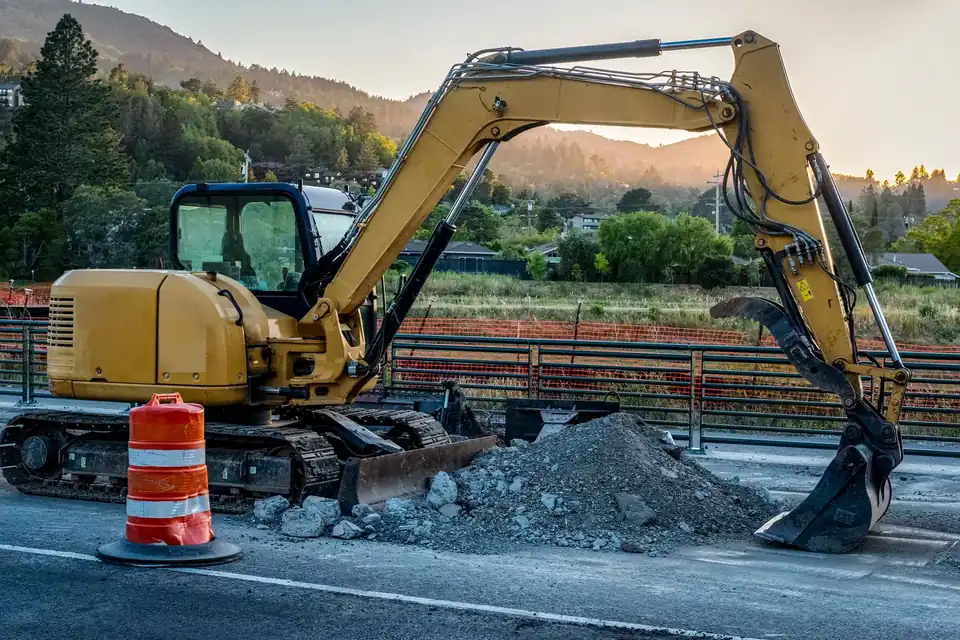
Trenching machine hire
Last updated
Which trenching machine: TLB, mini excavator, excavator or chain trencher
A trench digging machine is chosen by three things: how deep the trench goes, how wide the access is, and how hard the ground is. These are the machines we send with operators, with typical specs for a common model "or similar".
| Machine | Weight | Max dig depth | Best for | Per day |
|---|---|---|---|---|
| TLB (JCB 3CX or similar) | about 7.3 t | about 4.45 m (5.6 m extending arm) | Water and electrical connections, sewer lines, foundation trenches, farm pipelines | R3,900–R5,150 |
| Mini excavator (Bobcat E35i or similar) | about 3.6 t | about 3.1 m | Back yards, narrow side access, under carports, trenching around trees and paving | R1,700–R3,000 |
| Excavator, 20–25 t (CAT 320 or similar) | about 22.6 t | about 6.7 m | Deep sewer and stormwater trenches, bulk pipelines, rocky ground | R3,500–R5,600 |
| TLB with hydraulic breaker | about 7.3 t | breaks rock in the trench line | Rock trenching on plots and farms | R5,000–R6,550 |
What about a chain trencher? A chain trencher (the machine with a digging chain on a boom) cuts a narrow, neat slot and is quick on long, straight runs of cable or irrigation pipe in soft ground without stones. It struggles in rock and rubble and can't dig a wide trench or backfill. For most South African sites a TLB is more useful, because it digs, lifts out rocks and roots, and backfills. If your run is long and the ground is soft, ask us on WhatsApp.
Micro trenching for fibre is a different method: a saw cuts a thin slot in the road or pavement surface for the duct. In Cape Town it needs a wayleave like any other trenching in municipal ground.
Ask which trenching machine fits your jobTrench widths and depths: water, sewer, electrical cable and drainage
The depth of a trench is set by whoever designs and signs off the service going into it, not by the machine. Get the depth and width from them before we dig, and the operator will dig to that line.
| Trenching job | Who specifies depth and width | Usual machine |
|---|---|---|
| Trenching for a water line (house connection, garden, farm pipeline) | Your plumber, or the municipality for the connection to its main | TLB; mini excavator in tight yards |
| Sewer and drain lines | Your plumber or engineer: drains need a steady fall, so the depth changes along the trench (SANS 10400-P covers drainage) | TLB; excavator when deep |
| Electrical trenching and cable trenching | Your electrician, who must comply with SANS 10142-1 and issue the certificate of compliance | TLB or mini excavator |
| Fibre trenching and micro trenching | The fibre company's design and the municipal wayleave | Mini excavator or a slot saw |
| Trenching for drainage (French drains, cut-off drains) | Your engineer or landscaper | TLB |
| Trenching for sprinklers and irrigation | Your irrigation designer | Mini excavator or TLB |
| Foundation trench excavation | The approved building plans; the municipal inspector checks the trenches | TLB; excavator on big sites |
The trench comes out roughly as wide as the bucket, so tell us the width you need and we fit a bucket to suit. A wider bucket than the pipe needs only adds digging, bedding sand and backfill.
Trenching in sand, clay, rock and through tree roots
- Sand: digs fast but the sides run in. Deeper trenches in sand need shoring or sloped sides before anyone steps in.
- Clay: stands well when dry, turns sticky and slippery when wet. Clay sides can crack and fall after rain, which is why the regulations require an inspection after rain.
- Rock: the TLB rips soft rock; hard rock needs a breaker on the TLB or excavator, which is slower and is priced as a breaker day.
- Tree roots: the operator digs around thick roots and cuts them clean. Trenching right next to a tree you want to keep can kill it, so route the trench away from the trunk where you can.
How long trenching takes
A rough planning guide for a TLB in normal soil on an open site. Rock, roots, wet ground, existing services and hand-digging around them all slow the work.
| Job | Typical time |
|---|---|
| House water or electrical connection, 10–30 m, shallow | Half a day to 1 day, including backfill |
| Sewer connection from house to the municipal point | 1 day; longer if deep or rocky |
| Foundation trenches for a three-bedroom house | 1–2 days |
| 100–300 m irrigation or cable run on a farm | 1–2 days |
| Deep sewer or stormwater line over 500 m | A week or more, with an excavator and shoring |
What trenching costs
You pay for machine time plus transport. Backfilling is part of the same machine time, because the TLB fills the trench with its front bucket.
- TLB: R3,900–R5,150 a day with operator, or R320–R410 an hour dry for a short job.
- Mini excavator: R1,700–R3,000 a day with operator, delivered on a trailer.
- Excavator, 20–25 t: R3,500–R5,600 a day with operator, delivered on a lowbed.
- Compacting the backfill: a rammer (trench compactor) is R350–R470 a day machine only. Backfill under paving and driveways must be compacted in layers or it sinks.
Here's a worked example for trenching machine hire in Pretoria: two TLB days.
| Example quote (for illustration only) | Amount |
|---|---|
| Standard 4x4 TLB (about 8 t), 2 days at R3,900–R5,150 a day with operator | R7,800–R10,300 |
| Transport to Pretoria | confirmed on WhatsApp |
The TLB drives to site on the road, so inside Pretoria the travel is small and confirmed with your price. Hourly, weekly and rock rates are on the trenching rates page, and every machine is on plant hire rates.
Get a trenching price on WhatsAppTrenching and shoring: the safety rules
Trench collapses kill. Regulation 13 of the Construction Regulations, 2014 sets the rules for excavation work, and they apply to every trench where someone has to work inside:
- Excavation work must be supervised by a competent person appointed in writing, who checks ground stability before digging starts.
- No one may work in a trench that isn't adequately shored or braced, unless the sides are sloped to at least the soil's angle of repose, or the trench is in stable material and the competent person has given written permission. If there is any doubt, a professional engineer or technologist decides, in writing.
- Nothing heavy near the edge: no spoil, material, plant or machines close enough to collapse the sides, unless shoring is in place.
- A safe way in and out, no further than 6 m from where anyone in the trench is working.
- Inspection by the competent person every day before the shift, after rain, after any fall of ground and after damage to supports, recorded in a register on site.
- A barrier at least 1 m high where the public can reach the trench or it is next to a road, with warning lights at night, and warning signs where people are working.
- Find the services first: the contractor must establish where electricity, water, gas and similar services are before digging near them.
Our operator digs from the top and keeps the machine back from the edge; nobody needs to stand in the trench while the machine digs. A trenching risk assessment for the job should cover the soil, the depth, the services, traffic and who goes into the trench, and when. More on certificates: safety and certificates.
What you must sort out before we dig
- Find the underground services. Get the municipal service plans and any as-built drawings, and mark the line of every pipe and cable you know about. Where a cable or pipe might be close, have it located with a cable detector or hand-dig a test hole before the machine goes near.
- Get a wayleave for public ground. Any trenching in a road reserve or pavement needs municipal permission. In Johannesburg the Johannesburg Roads Agency issues wayleaves for work in the road reserve. In Cape Town the Wayleaves By-law, 2026 requires a wayleave and a permit to work before excavation, trenching or micro-trenching on municipal property; a services verification meeting, requested at least five working days ahead, comes first, and work must start within 90 days of the wayleave.
- Know the depth, width and route. Peg the line and write the depth on a sketch for the operator.
- Book the inspection for foundation trenches. The National Building Regulations require at least two working days' notice to the municipality that foundation trenches are ready, and no concrete may go in until the inspector has approved them.
- Tell the neighbours if the trench runs near their wall: digging next to a wall or road can undermine it, and the regulations require steps to keep adjoining structures stable.
The depths, shoring options and paperwork in more detail are in our trenching guide. For bigger digs see earthworks and excavation; for clearing the route first see site clearing.
WhatsApp us the trench length and depthQuestions people ask
What is the best machine for digging trenches?
A TLB, for most jobs. It digs the trench with the backhoe, then turns round and backfills it with the front bucket, so one machine and one operator do the whole job. Choose a mini excavator when the access is narrower than a TLB or the lawn and paving must survive, and a 20–25 t excavator for trenches deeper than about 4 m, long pipelines or hard ground.
How deep can a TLB dig a trench?
A JCB 3CX or similar digs to about 4.45 m with the standard arm and about 5.6 m with an extending arm. A 3.5 t mini excavator such as a Bobcat E35i digs to about 3.1 m, and a 22.6 t CAT 320 or similar to about 6.7 m. Remember that nobody may work inside a deep trench unless its sides are shored, braced or sloped safely.
How much does trenching cost per metre?
We price trenching by the machine day, because the metres you get from a day depend on depth, soil and obstacles. As an illustration only: if a TLB at R3,900–R5,150 a day digs and backfills 100 m of shallow trench in soft soil, that works out to R39–R52 a metre. In rock, clay or a crowded yard the metres drop. Send the length, depth and a photo and we'll price it in writing.
Do I need a permit to dig a trench?
On your own property, usually not, but you must find the underground services first. Digging in a road reserve or pavement needs a wayleave from the municipality (in Johannesburg from the Johannesburg Roads Agency; in Cape Town under the Wayleaves By-law, 2026, which also covers trenching and micro-trenching). Foundation trenches must be inspected by the municipal building inspector before concrete goes in.
When does a trench need shoring?
Whenever people have to work inside it, unless the sides are sloped back to the soil's natural angle of repose or a competent person has confirmed in writing that the ground is stable (Construction Regulations 2014, regulation 13). The regulation sets no safe depth: loose sand, wet clay and fill can collapse in a shallow trench.
Can a TLB dig through rock?
Soft rock and hard clay, yes, slowly. For solid rock the TLB swaps its bucket for a hydraulic breaker: a TLB with a breaker is R5,000–R6,550 a day with operator. For a short rocky stretch in a yard, a heavy jackhammer (R380–R610 a day machine only) may be enough.
Related
Sources we checked
- Construction Regulations 2014 (GN R.84) - regulation 13 (excavation work)
- National Building Regulations (GN R.2378) - regulation A22 (notices and inspection of foundation trenches)
- City of Cape Town Wayleaves By-law 2026
- Johannesburg Roads Agency - wayleaves for work in the road reserve
- JCB 3CX backhoe loader specification sheet (dig depth and operating weight)
- Bobcat E35i mini excavator specifications
- Cat 320 hydraulic excavator specifications
Need a TLB?
WhatsApp us the job, the town and the dates. We confirm the machine, the start date and the price in writing before the machine moves.
WhatsApp us now