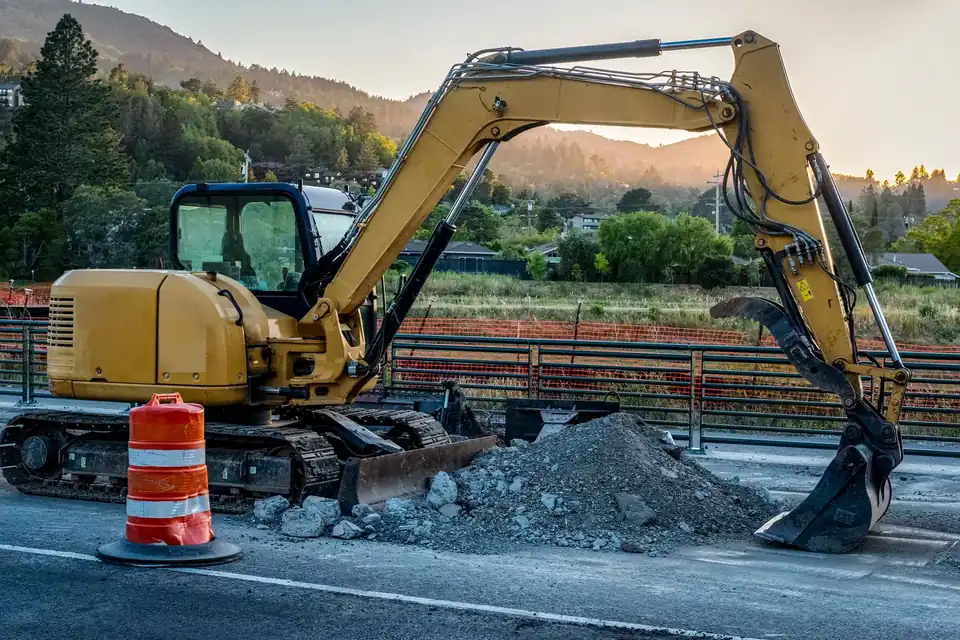
Types of trenching
Last updated
The types of trenching, compared
Trenching methods differ in three ways: how the trench is cut, how its sides are kept from collapsing, and how wide and deep it ends up. These are the methods used in South Africa, from a house water connection to a fibre route along a suburban verge.
| Method | How it works | Typical size | Used for |
|---|---|---|---|
| Open-cut, bucket | A TLB, mini excavator or excavator digs with a bucket the width of the trench | As wide as the bucket; to about 4.45 m deep with a TLB, 6.72 m with a 20 t excavator | Water, sewer, stormwater, electrical, foundations |
| Sloped or benched | The sides are cut back at an angle, or in steps, so they can't fall in | Much wider at the top than at the bottom | Open sites with room to spare, where nobody wants to install shoring |
| Shored (trench box or hydraulic shores) | Vertical sides held by a steel box or struts while people work inside | Narrow, deep trenches | Deep sewer and stormwater lines, roads, tight sites |
| Chain trencher | A digging chain on a boom cuts a narrow slot as the machine drives forward | 150–305 mm wide, 1.1–1.6 m deep (Ditch Witch RT45 attachments) | Long, straight cable and irrigation runs in soft ground |
| Micro-trenching | A saw cuts a thin slot for fibre ducts; filled and sealed straight after | At most 50 mm wide, at least 300 mm deep (City of Cape Town) | Fibre ducts in pavements and verges |
| Trenchless (directional drilling, moling) | A drill or mole bores under the surface between two pits | Duct at least 600 mm below a road surface, preferably 1 m (City of Cape Town) | Road crossings, driveways, places that can't be dug up |
| Hand-dug | Spades and picks, often to expose existing services | Short and shallow | Test holes over cables and pipes before a machine digs near them |
On most building sites and plots, the answer is open-cut with a TLB: it digs, lifts out rocks and roots, and backfills with its front bucket. The other methods solve a specific problem: depth (shoring), long soft runs (chain trencher), finished surfaces (micro-trenching) or a road in the way (trenchless).
Types of trenching machines
TLB (backhoe loader)
The all-rounder. A JCB 3CX or similar digs about 4.45 m and backfills with its front bucket. R3,900–R5,150 a day with operator.
Mini excavator
For back yards and side passages: 1.5–6 t machines dig 2.2–4 m and fit through gates a TLB can't. R1,700–R3,000 a day with operator.
Excavator
For deep and long trenches. A 20–25 t machine (Cat 320 or similar) digs 6.72 m and handles hard ground. R3,500–R5,600 a day with operator.
Chain trencher
Walk-behind or ride-on. The Ditch Witch RT45, a 2,438 kg ride-on, is built for 1.2–1.5 m trenches and cuts 150–305 mm wide. Priced on WhatsApp.
Breaker on a TLB or excavator
Not a digger but often needed: it breaks the rock in the trench line. A breaker TLB is R5,000–R6,550 a day with operator.
Rammer
The narrow compactor that goes into the trench to compact the backfill in layers. R350–R470 a day machine only.
Which machine fits each job, with typical days and a worked price, is on trenching machine hire.
Trench widths, depths and backfill
The person who designs the pipe or cable sets the depth: your plumber, electrician, engineer, or the fibre company's design and the municipal wayleave. The machine digs to that line. What a municipality asks for in the road reserve shows how exact the rules get. The City of Cape Town's wayleave standards (version 4.0, September 2025) say, among other things:
- Spacing: new services at least 300 mm from existing municipal services, and where possible 1 m from medium-voltage and 1.5 m from high-voltage electrical cables.
- Telecoms space: at most 1.0 m wide, and no trenching within 1.0 m of the kerb unless approved.
- Backfill in layers: compacted in lifts of no more than 150 mm, at the material's optimum moisture content. Clay may not be used as backfill.
- Density: backfill in unmade verges compacted to at least 93% of maximum dry density, and tested along the trench (every 5 m in a roadway, every 20 m in a sidewalk).
- Bedding: bedding sand and a sand blanket around cables and ducts.
- Reinstatement: on micro-trenches, within 10 days of backfilling; on open trenches in a roadway, backfill the same day and reinstate within 7 days.
On your own property the rules are your engineer's, but the principle is the same: thin layers, the right moisture, and a compactor that fits the trench. A plate compactor bounces on clay in a narrow trench; a rammer drives it down. Trench width comes from the bucket, so ask for the narrowest bucket that leaves room to lay and bed the pipe: every extra 100 mm of width is more digging, more bedding sand and more backfill to compact.
Trenching in electrical work
Electrical trenching means trenches for underground cables: a supply from the meter to a house or outbuilding, a cable to a gate motor, borehole pump, pool pump or garden lights, or a feeder between buildings on a site or farm.
- Depth and protection are set by your electrician, who must comply with SANS 10142-1 and sign the certificate of compliance. Tell us the depth and width before we dig.
- Keep away from other services. In a road reserve, Cape Town wants 1 m clearance from medium-voltage and 1.5 m from high-voltage cables where possible, and a sand blanket around cables and ducts.
- Find live cables first. Regulation 13 requires the contractor to establish where electricity, water, gas and similar services are before digging near them. Where a cable might be close, it is located and hand-dug before the machine goes near.
Most electrical trenches are shallow and narrow, so a mini excavator or TLB does them in hours. For a long, straight cable run in soft soil, a chain trencher is quicker.
Trenching in agriculture
On farms, trenching mostly means laying water: irrigation mainlines from a dam or reservoir, stock-water pipelines to troughs, and subsurface drains for waterlogged lands. It also covers cut-off drains that lead stormwater away from lands and roads, and trenches for electrical cable to pumps.
- Long runs in soft soil suit a chain trencher, which cuts a narrow slot fast.
- Stony or rocky ground suits a TLB, which lifts out stones and roots and backfills as it goes.
- Big pipelines (large-diameter irrigation or bulk water) go to an excavator.
Farm trenches near a river, wetland or dam can touch on water-use rules; see our dam building guide.
Trenching and excavation safety
A trench collapse buries a person in seconds, and a cable strike can kill. Regulation 13 of the Construction Regulations, 2014 is the rule in South Africa; the full checklist is on trenching machine hire. In short:
- A competent person, appointed in writing, supervises the excavation and inspects it every day before the shift, after rain and after any fall of ground, and records it in a register.
- No one works in an unshored trench unless the sides are sloped to the soil's angle of repose or the competent person confirms in writing that the ground is stable. The regulation sets no "safe" depth.
- Keep loads off the edge: spoil, materials and machines stay back unless shoring is designed for them.
- A safe way in and out within 6 m of anyone working in the trench, and a barrier at least 1 m high where the public can reach it.
Ways to protect a trench
| System | How it works | When it fits |
|---|---|---|
| Sloping | Cut the sides back to the soil's angle of repose | Open ground with room; costs extra digging and backfill |
| Benching | Cut the sides in steps | Firm, cohesive soil; not in loose sand |
| Shoring | Timber or hydraulic struts and sheets brace vertical sides | Deep, narrow trenches next to roads, walls and other services |
| Trench box | A steel box set in the trench; people work inside it | Long pipelines where the box moves along with the work |
Which system to use is the competent person's call, and in doubtful ground an engineer's. Our operators dig from the top and keep the machine back from the edge.
Trenching regulations and permits
A trench can need up to three kinds of permission, from three different offices:
- Notify the Department of Employment and Labour. Under regulation 4 of the Construction Regulations, a contractor who intends to do construction work that includes excavation work must notify the provincial director in writing, on a form like Annexure 2, at least 7 days before the work starts. (Bigger projects need a construction work permit under regulation 3 instead.)
- Get a wayleave for municipal ground. Any trench in a road reserve, pavement or verge needs municipal permission. Cape Town's Wayleaves By-law lists "trenching and micro-trenching" and all forms of trenchless excavation among the work that needs a wayleave. Its standards add that road crossings must be done trenchless, open trenching in a roadway needs written permission, and work under surfaced roads and footways carries a five-year defects period. In Johannesburg the Johannesburg Roads Agency issues wayleaves for the road reserve.
- Book the foundation inspection. For foundation trenches, the National Building Regulations require notice to the municipality and its inspector's approval before concrete goes in.
On your own property, a service trench usually needs no wayleave, but the underground services still have to be found first. If you're unsure which applies, WhatsApp us the address and the route and we'll tell you what to check before the machine comes.
What trenching costs
We price trenching by the machine day, because the metres dug in a day depend on depth, soil and how many services must be dug around. A TLB is R3,900–R5,150 a day with operator, a mini excavator R1,700–R3,000 a day with operator and a 20–25 t excavator R3,500–R5,600 a day with operator, all with an operator, excluding VAT, with transport as its own line. Two TLB days come to R7,800–R10,300 before transport.
Worked prices per metre in soft ground, clay and rock are on trenching price per metre. Every machine price is on plant hire rates.
WhatsApp us the trench length and depthQuestions people ask
What is the difference between trenching and excavation?
A trench is a type of excavation: one that is longer than it is wide, dug to lay a pipe, cable or foundation. Excavation covers every hole, from a basement to a dam basin. The same regulation (regulation 13 of the Construction Regulations, 2014) covers both.
How deep can a trench be before it needs shoring?
South Africa's regulation sets no safe depth. Nobody may work in a trench unless its sides are shored or braced, sloped back to the soil's angle of repose, or the competent person has confirmed in writing that the ground is stable. Loose sand, wet clay and old fill can collapse in a trench shallower than a person.
What is micro-trenching?
A narrow slot sawn into a pavement or verge to lay fibre ducts, then filled and sealed the same day. In Cape Town it needs written permission and a specific design, it is allowed in verges but not in roads, the slot may be at most 50 mm wide, and it must be at least 300 mm deep with 200 mm cover over the duct.
Can a chain trencher dig through rock?
Not well. A chain trencher is quick in soft, stone-free soil and slows badly in rock, rubble and big roots. Soft rock is TLB work; hard rock needs a hydraulic breaker on a TLB (R5,000–R6,550 a day with operator) or an excavator.
Who digs the trench, and who goes in it?
Our operator digs from the top with the machine, so nobody stands in the trench while it digs. People only go in to lay the pipe or cable, and only once the trench is safe under regulation 13 and the competent person has inspected it that day.
Related
Sources we checked
- Construction Regulations, 2014 (GN R.84), regulation 13: excavation work
- Construction Regulations, 2014 (GN R.84), regulation 4: notification of construction work
- City of Cape Town, Roads Infrastructure Management wayleave standards, version 4.0 (September 2025)
- City of Cape Town Wayleaves By-law, 2026
- Johannesburg Roads Agency: wayleaves for work in the road reserve
- National Building Regulations (GN R.2378), regulation A22: notice and inspection of foundation trenches
- Ditch Witch RT45 ride-on trencher literature (digging depth, width and weight by attachment)
- JCB 3CX backhoe loader specifications (JCB spec sheet P995-B)
- Cat 320 hydraulic excavator specifications (Caterpillar)
Need a machine?
WhatsApp us the job, the town and the dates. We confirm the machine, the start date and the price in writing before the machine moves.
WhatsApp us now