What is stormwater? An earthworks and drainage guide
Last updated
What is stormwater?
Stormwater is the rain that doesn't soak into the ground. It runs off roofs, roads, paving and compacted soil, collects in gutters and channels, and flows through stormwater drains and pipes to the nearest stream, river, wetland or the sea.
Two facts shape every stormwater job in South Africa:
- Stormwater and sewage are separate systems. The stormwater pipes in the street are not the sewer. Roof downpipes and yard drains belong on the stormwater side; toilets, kitchens and washing machines on the sewer side. Cross-connections overload sewage works in storms and put sewage into rivers.
- Stormwater is not treated. What goes down a stormwater drain, from cement slurry to engine oil, ends up in a river or on a beach.
Building on open land changes the water. Veld soaks up much of a storm; a roof and a paved yard shed almost all of it, and faster. That's why plans for anything bigger than a house usually come with a stormwater design, and why so much earthworks is really drainage work.
How does stormwater drainage work?
Every drainage system, from a single stand to a township, does the same three things: it gets water off the surfaces, carries it away, and lets it out somewhere it can do no harm.
- Falls on the ground. Earthworks shape the ground and paving to slope away from buildings, so water moves before it can pond against a wall or soak in under a foundation.
- Collection. Gutters and downpipes on roofs; surface channels, catch pits and grated inlets on paving; kerbs and kerb inlets on roads.
- Conveyance. Pipes, open channels, culverts under roads and grassed swales carry the water downhill.
- Control and outfall. On bigger sites the water passes through an attenuation pond or tank before it is let out, slowly, to the municipal system or a watercourse, often through a structure that stops it scouring the bank.
The machine side is digging and shaping: a TLB for pipe trenches, swales, French drains and soakaways on a stand; an excavator for deep pipes and pond basins; a grader for long falls on roads and building platforms; and a roller to compact backfill and pond embankments. Trench work is covered on trenching.
Attenuation, swales and soakaways
| Structure | What it does | Machine that usually builds it |
|---|---|---|
| Attenuation pond or tank | Holds runoff back during a storm and lets it out slowly through a small outlet, so the peak flow leaving the site stays low | Excavator for the basin, dozer or grader to shape banks, roller to compact them |
| Swale | A shallow, wide, grassed channel that slows water down, lets some soak in and traps silt | TLB or grader |
| Berm (cut-off bank) | A low bank across a slope that stops water from higher ground reaching a building or road | TLB, bobcat or dozer, then compaction |
| French drain | A trench filled with stone (often around a perforated pipe) that collects water from the ground and leads it away | TLB or mini excavator |
| Soakaway | A stone-filled pit that lets collected water soak into permeable ground | TLB or mini excavator |
| Pipe culvert | Carries a stream or drain under a road or driveway | TLB or excavator, plus compaction around the pipe |
Attenuation is the one most developments need. The idea is simple: the site must not send water downstream faster after it is built than before. Your civil engineer sizes the pond or tank for the site's area, surfaces and rainfall; our operators dig it to the engineer's levels. A soakaway only works in sand or other permeable ground; in clay it fills and stays full.
Why stormwater management is important
- Flooding: unmanaged runoff floods buildings, yards and the neighbours downhill.
- Erosion: fast water strips topsoil, cuts gullies in slopes and undermines roads, walls and foundations.
- Foundations and soil: water ponding against a building softens the ground under it. The residual granite soils of Johannesburg's northern suburbs can collapse when they get wet under load, which is why falls and drainage around buildings matter so much there.
- Sinkholes on dolomite: the Council for Geoscience puts roughly a quarter of Gauteng on dolomitic land, and sinkholes there are usually set off by water. In 2025 the City of Tshwane declared 63 sinkholes a disaster, and one of the most active in Centurion opened after a stormwater drain failed.
Why is stormwater pollution a problem?
Because nothing removes it. Litter, oil, paint, cement washings and sewage from cross-connections go straight into rivers and the sea, and silt from bare building sites clogs drains and smothers streams. On an earthworks site, the practical rules are: keep stockpiles away from inlets, don't wash mixers or tools into a drain, slow and settle site runoff in a swale or sump before it leaves, and grass or cover bare slopes as soon as the levels are done.
Municipal stormwater by-laws, in principle
Each municipality sets its own stormwater rules in by-laws and its development conditions, so check yours before you dig. The principles are much the same across the metros:
- Only stormwater in the stormwater system. No sewage, cement slurry, paint, oil or chemicals.
- No connecting without approval. Connecting a private drain to the municipal stormwater system, or changing a municipal drain or watercourse, needs the municipality's approval.
- Developments manage their own runoff. Building plans and site development plans for bigger sites usually need a stormwater plan, often with attenuation.
- Work in the road reserve needs a wayleave. Laying a pipe across a verge or road is excavation on municipal land; in Cape Town, for example, the Wayleaves By-law, 2026 covers excavation and trenching on City property.
What are earthworks?
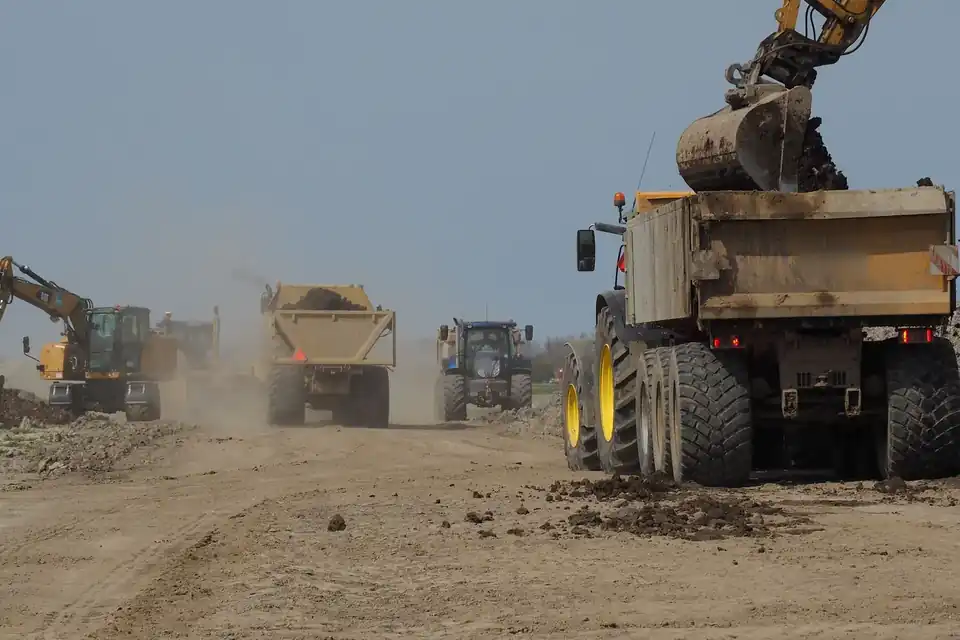
Earthworks are all the work that changes the shape of the ground: digging it out, building it up, compacting it and shaping it so it drains. The job page earthworks and excavation covers how we price and run earthworks; this guide explains the terms.
Types of earthworks
| Type | What it is | Usual machines |
|---|---|---|
| Site clearing and stripping | Removing bush, stumps and topsoil | TLB, dozer, excavator (site clearing) |
| Excavation (cut) | Digging out high ground, basements, pools and foundations | TLB, excavator |
| Fill and embankments | Building up low ground, building platforms, road beds and dam walls in compacted layers | Dozer, grader, water truck, roller |
| Trenching | Narrow digs for pipes, cables and stormwater | TLB, mini excavator (trenching) |
| Grading and levelling | Trimming the ground to final levels and falls | Grader, bobcat (land levelling) |
| Drainage earthworks | Swales, berms, ponds, culverts | TLB, excavator, grader |
| Dams and roads | Specialised fills and cuts | The full team (dam building, gravel roads) |
Cut and fill explained
Cut is ground dug away to get down to the planned level; fill is material placed and compacted to build up to it. On a sloping site the most economical building platform usually balances the two: soil cut from the high side is pushed or hauled to the low side, so little is trucked away or bought in.
A worked example: a 20 m × 30 m building platform for a house on ground that falls 2 m along its 30 m length. Set the level halfway, and the high half is a wedge of cut averaging 0.5 m deep over 300 m², about 150 cubes; the low half needs about 150 cubes of fill. On paper it balances. In practice the engineer adjusts the level, because:
- Topsoil can't go in the fill. It is stripped first and kept for the garden, so it doesn't count.
- Not all cut is good fill. Clay that swells, rubble and organic soil may have to go to spoil, with better material imported.
- Volumes change. Soil bulks up when dug and shrinks again when compacted (next sections).
- Edges need slopes. A cut face or fill bank can't stand vertical; its slope, or a retaining wall, comes from the engineer.
Compaction layers and density tests
Fill is placed and compacted in layers because a roller only compacts so deep. From BOMAG's data for 12–14 t single drum rollers, the most a layer can be in one pass sequence is about 0.5–0.6 m for gravel and sand and only 0.2–0.3 m for silt and clay. Specifications usually ask for thinner layers still, often 150 mm, because high densities are easier to reach and to test in thin lifts.
Moisture: the other half of compaction
Each soil compacts best at its optimum moisture content (OMC). Too dry and the grains won't pack; too wet and the roller pumps water instead of squeezing out air. A water truck wets each layer before rolling, or the layer is opened and dried in the sun if it's too wet.
What "93% MDD" means
Compaction is specified as a percentage of the material's maximum dry density (MDD), the densest it gets in the lab at its optimum moisture (the SANS 3001 test). A real road drawing filed with the Department of Water and Sanitation, for example, asks for 93% of MDD on the subgrade, 95% on fill layers, 97% on the G6 selected layer and 98% on the cemented subbase: the higher the layer, the denser it must be.
How density is tested on site
- Nuclear density gauge (SANS 3001-NG5): quick readings of density and moisture on each layer, done by a soils lab technician.
- Sand replacement: a hole is dug, the soil weighed, and the hole's volume measured by filling it with calibrated sand.
The lab compares the result with the MDD. A layer that fails is watered or dried and rolled again, or dug out and redone, before the next layer goes on. The machines are on roller and compactor hire: a 10–12 t roller is R2,150–R5,600 a day with operator.
Bulking factors: why a hole fills more trucks than its size
Soil in the ground (bank volume) has its grains packed tight. Dig it and air gaps open up, so the same soil takes more space in the tipper (loose volume). Then roll it into a fill and it packs down again (compacted volume).
| Material | Bulking factor | Swell |
|---|---|---|
| Sand, gravel | about 1.12 | 12% |
| Clay | about 1.22 | 22% |
| Earth (packed soil) | about 1.25 | 25% |
| Topsoil | about 1.43 | 43% |
| Crushed or blasted rock | about 1.67 | 67% |
Example: a basement 10 m × 8 m × 3 m deep in clay is 240 bank cubes, which becomes about 293 loose cubes: roughly 30 loads of a 10 cube tipper. The opposite applies to fill you buy: natural gravel weighs about 1.93 t a loose cube and 2.17 t in the ground, so order at least 12% more loose gravel than the compacted volume you need. Load weights per truck size are on tipper loads and cubes.
Earthworks safety: the excavation rules
Construction Regulation 13 (GN R.84 of 2014) sets the rules for excavation work. The main points for anyone planning a dig:
- Excavation work is supervised by a competent person appointed in writing, and the ground's stability is evaluated before digging starts.
- Nobody works in an excavation that isn't shored or braced, unless the sides are sloped to at least the angle of repose, or the competent person confirms in writing that the material is stable.
- No loads, spoil or machines near the edge where they could collapse it.
- Where a dig could affect an adjoining building, wall or road, steps are taken to keep it stable.
- Safe access within 6 m of anyone working in a trench.
- Electricity, water, gas and similar services located before work that could affect them.
- Excavations inspected daily before each shift and after rain, a fall of ground or blasting, with results in a site register.
- Excavations open to the public protected by a barrier at least 1 m high, with lights or markers at night.
Hiring machines for earthworks and stormwater
Every machine comes with an experienced operator, priced in writing with transport as its own line:
- TLB: swales, French drains, soakaways and pipe trenches on a stand, R3,900–R5,150 a day with operator.
- Excavator, 20–25 t: attenuation pond basins, deep stormwater pipes and bulk cut, R3,500–R5,600 a day with operator.
- Grader: falls on building platforms and roads, R4,500–R6,000 a day with operator.
- Rollers and compactors: fill layers and pond banks, from a rammer at R350–R470 a day machine only to a 10–12 t roller at R2,150–R5,600 a day.
How a full earthworks job is run and priced: earthworks and excavation.
WhatsApp us your earthworks or drainage jobQuestions people ask
What is stormwater runoff?
Stormwater runoff is the rain that flows over the surface instead of soaking into the ground. Roofs, paving, tar and compacted soil let almost none soak in, so the more of a site is built over, the more water runs off and the faster it arrives at the drains. On the way it picks up litter, oil, silt and anything else lying on the ground.
What are stormwater drains?
They are the openings and pipes that collect runoff: grated inlets and kerb openings along roads, channels and catch pits in parking areas, and the pipes and culverts that carry the water to a river or outfall. On a property, gutters, downpipes, surface channels and French drains feed the same system.
What is stormwater harvesting?
Collecting runoff from roofs, paving or a larger catchment into tanks or ponds and using it, mostly for irrigation, washing down and flushing toilets. Roof water collected in tanks is usually called rainwater harvesting; stormwater harvesting usually means bigger areas such as car parks, sports fields or a whole development draining to a pond. The earthworks side is the pond basin, the level base for the tanks and the pipes, all dug with a TLB or excavator.
What does earthworks mean?
Earthworks means any work that moves or reshapes soil and rock: digging out (cut), building up (fill), trenching, levelling, compacting and shaping slopes, drains and dams. Builders use it for everything that happens to the ground before the foundations and services go in.
What is bulk earthworks?
The large-volume part of earthworks: cutting and filling whole building platforms, road beds or dam walls with excavators, bulldozers, ADTs or tippers, graders and rollers, measured in hundreds or thousands of cubes. Detail work such as foundation trenches and service trenches follows afterwards.
What safety shoes are needed for earthworks?
Safety boots with a protective toe cap and a puncture-resistant, slip-resistant sole, worn with a hard hat and a high-visibility vest. Look for boots marked to SANS 20345 (the South African adoption of ISO 20345). On wet clay sites, boots with a deep tread and ankle support matter as much as the toe cap.
Related
Sources we checked
- Construction Regulations 2014 (GN R.84) - regulation 13 (excavation work)
- SANS 3001 civil engineering test methods list (CSIR)
- Typical road cross-section with layer compaction requirements, drawing P07495-00-WW-SWP-0001-001 (Department of Water and Sanitation filing)
- BOMAG BW 213 D-5, DH-5 and PDH-5 single drum roller technical data sheet (BOMAG)
- Caterpillar earthwork volumes reference tables (loose and bank material weights, load factors)
- Gauteng Provincial Government, MEC Mamabolo assessed areas affected by sinkholes in the City of Tshwane (May 2025)
- Council for Geoscience, Development possibilities on dolomitic ground (presentation to Parliament, 27 February 2013)
- University of Pretoria, Collapse of residual Archaean granitic soils in South Africa
- City of Cape Town: Wayleaves By-law, 2026 (Provincial Gazette Extraordinary 9252, 18 June 2026)
Need a machine?
WhatsApp us the job, the town and the dates. We confirm the machine, the start date and the price in writing before the machine moves.
WhatsApp us now