Crane hire
Last updated
Crane hire prices with an operator
Every crane comes with a certified operator. Prices are per day, excluding VAT. Inside a main centre the crane drives to site and travel is small; further out, travel is quoted as its own line.
| Size | Rate | Price |
|---|---|---|
| 20–25 t mobile crane | Per day, with operator | about R4,500 * |
| 40 t mobile crane | Per day, with operator | about R7,600 * |
| 80 t mobile crane | Per day, with operator | about R22,000 * |
* Few price points for this one, so treat it as a guide; the exact price comes back on WhatsApp.
We have few price points for mobile cranes, so treat these as a guide. Your exact price, for the crane your lift actually needs, comes back in writing on WhatsApp. Hourly minimums, standing time and how the total is built are on mobile crane hire rates.
Get a crane price on WhatsAppWhat can a 25 t crane lift? Capacity against radius
A crane's size is the most it lifts at its shortest radius, close to the crane. The further out the hook goes, the less it lifts. Radius is measured from the centre of the crane's slewing ring (where it turns) to the centre of the load, not from the edge of the crane.
| Radius | 20–25 t crane (Tadano GR-250N or similar) | 40 t crane (Liebherr LTM 1040-2.1 or similar) | 80–90 t crane (Liebherr LTM 1090-4.2 or similar) |
|---|---|---|---|
| 3 m | 25.0 t | 30.6 t | 59.2 t |
| 5 m | 19.6 t | 21.6 t | 46.7 t |
| 8 m | 11.4 t | 13.0 t | 31.4 t |
| 10 m | 7.8 t | 9.1 t | 24.7 t |
| 16 m | 3.45 t | 4.4 t | 13.8 t |
| 20 m | 2.15 t | 3.0 t | 9.9 t |
| 24 m | 1.4 t | 2.1 t | 7.4 t |
| 30 m | out of reach (0.9 t at 27.9 m) | 1.2 t | 4.9 t |
| 40 m | out of reach | out of reach | 2.8 t |
So a 25 t crane is a 25 t crane only within about 3.5 m. At 10 m it lifts under a third of that, and at 20 m under a tenth. The 40 t figures use 6.5 t of counterweight and the 90 t figures 22.5 t; the larger cranes lift more over the rear at short radius (40 t at 2.5 m and 90 t at 3 m), but you can't count on being straight over the rear on a real site.
How to read it for your lift
- Weigh everything that hangs on the hook. The load, plus slings, shackles, spreader beam and the crane's own hook block. Load charts count the hook block as part of the load: on the 25 t crane above, the main hook block alone is 220 kg.
- Measure the radius. From where the crane can stand (centre of the crane) to where the load must land, and to where it is picked up. The longer of the two decides the size.
- Check the height. The boom must clear the roof edge or wall. Longer boom means a lower capacity at the same radius.
- Leave a margin. Don't plan a lift at 100% of the chart.
Worked example: a 2 t steel beam has to land 20 m from where the crane can stand. The 25 t crane is rated 2.15 t at 20 m, and its 220 kg hook block counts toward that, leaving about 1.9 t: not enough for 2 t plus slings. The 40 t crane, rated 3.0 t at 20 m, does the lift with room to spare. That's why we ask for the weight and the radius before we price.
Charts assume the crane is level on firm ground with the outriggers fully out. They are also calculated for wind up to 9 m/s (33 km/h) on a load with about 1 m² of surface per tonne; panels, sheeting and large flat items catch more wind, so the operator works to a lower wind limit for those.
Mobile crane sizes we hire
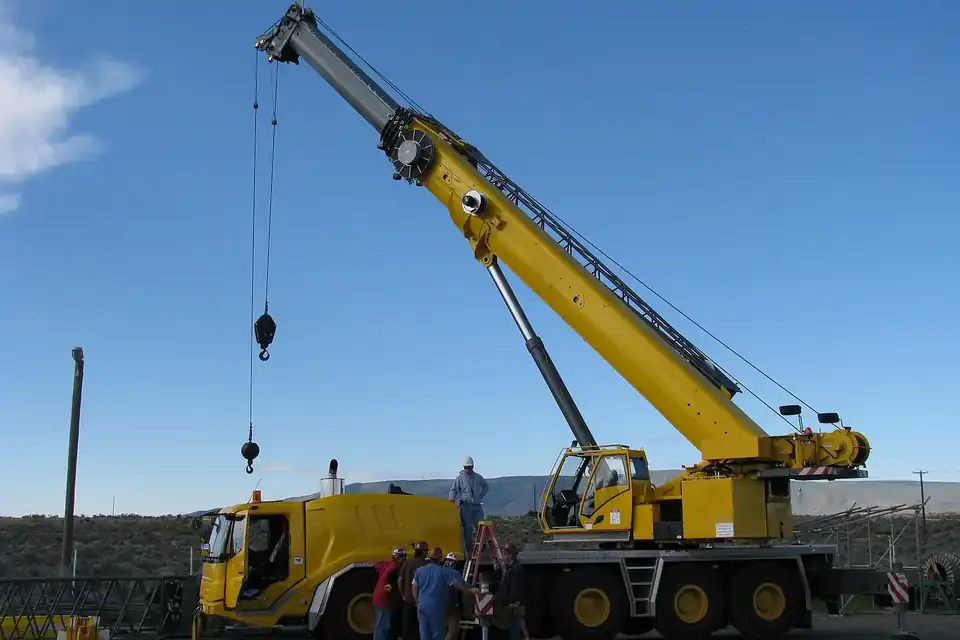
Our mobile cranes are hydraulic telescopic cranes on wheels: they drive to site on the road, set up on four outriggers and lift with a boom that extends in sections. Bigger cranes than 80 t are priced on WhatsApp.
| Size | Maximum lift | Main boom | Reach and height | On the road | Day rate |
|---|---|---|---|---|---|
| 20–25 t (Tadano GR-250N or similar) | 25 t at up to 3.5 m | 9.35–30.5 m | 27.9 m max radius, 31.3 m lifting height on the main boom; jib 8.2 or 13 m | 2 axles, about 25.6 t; outriggers 6.6 m wide fully out | about R4,500 |
| 40 t (Liebherr LTM 1040-2.1 or similar) | 40 t at 2.5 m (over the rear) | 10.5–35 m | 31 m max radius on the main boom; 9.5 m folding jib | 2 axles, 12 t per axle; up to 6.5 t counterweight | about R7,600 |
| 80–90 t (Liebherr LTM 1090-4.2 or similar) | 90 t at 3 m (over the rear) | 11.4–60 m | 62 m max radius, 76 m hoist height with jib | 4 axles, 12 t per axle; 22.5 t counterweight | about R22,000 |
| 100 t and up (Liebherr LTM 1100-5.3 or similar) | 100 t at 3 m (over the rear) | 13–62 m | 26.5 t at 10 m, 11.2 t at 20 m, 3.5 t at 40 m | 5 axles, about 15.5 m long | Exact price on WhatsApp |
Most house, farm and small commercial lifts fit the 20–25 t crane. The 40 t earns its keep when the radius is long or the load is a few tonnes at 15–20 m. The 80–90 t is for heavy plant, big tanks, steel frames and long reaches over buildings.
Smaller jobs: for a light load near the road, a crane truck lifts it and carries it in one trip. For moving pallets and material around a site, a telehandler or a forklift is often the better machine.
Typical crane lifts and which size they need
Roof trusses
Trusses are light, so reach decides the crane. A 25 t crane still lifts 2.15 t at 20 m, enough to set trusses across most house and church roofs from the street side. "Crane hire for roof trusses" is mostly a 20–25 t job.
Structural steel
Beams, columns and portal frames. Steel frames for workshops and warehouses usually need the 40 t or the 80–90 t, because the heaviest members sit at the longest radius.
Water and fuel tanks
Plastic tanks on stands are light but bulky and catch the wind. Steel and fuel tanks get heavy fast: send the tank's mass from its plate and the stand height.
Machinery and generators
Compressors, generators, transformers and factory machines in and out of buildings. These need lifting points and often a spreader beam; send the mass and the lifting point positions.
Aircon units and plant on roofs
Rooftop condensers and air-handling units, lifted over the building edge. Height and radius over the parapet decide the size; the unit's mass is on its nameplate.
Containers and precast
Containers on and off trucks, precast slabs, culverts and septic tanks. The container's tare (empty) mass is printed on the doors; add the contents.
Mobile crane or crane truck?
A crane truck is a truck with a folding (knuckle-boom) crane behind the cab and a deck that carries the load. A mobile crane only lifts; it carries nothing. Pick the crane truck when you need to lift and deliver, and the mobile crane when you need weight at reach or height.
| Crane truck (30 t·m crane, Palfinger PK 32080 or similar) | 20–25 t mobile crane (Tadano GR-250N or similar) | |
|---|---|---|
| Lift at about 10 m | 2.9 t at 9.9 m | 7.8 t at 10 m |
| Longest reach | 14.3 m hydraulic, about 21 m with manual extensions | 27.9 m radius, 31.3 m height on the main boom |
| Carries the load | Yes, on its deck | No |
| Day rate with operator | R2,500–R5,200 (8–10 t class) | about R4,500 |
More on sizes, reach charts and deck space: crane truck hire.
Load-test certificates: what the law asks for
Every crane we send is load-tested. The Driven Machinery Regulations, 2015 (reg 18) set the rules for lifting machines, and they apply to every mobile crane on your site:
- Thorough examination and performance (load) test by a lifting machinery inspector of a registered lifting machinery entity (LME): before first use, every time the crane is dismantled and re-erected, and then at intervals of no more than 12 months (reg 18(5)(a)).
- No new test for each site. Mobile cranes are excluded from the performance test after each redeployment within that 12-month period (reg 18(5)(c)), so the current certificate travels with the crane.
- Six-monthly examination of ropes, hooks, sheaves, brakes and safety devices by a competent person (reg 18(6)).
- Load indicator on any power-driven lifting machine over 5,000 kg capacity, and/or a load-limiting device that stops the crane before it overloads at that radius (reg 18(9)).
- A register on your premises. If you use a leased (hired) crane, you must keep a register with its latest performance test and service records, not older than 12 months (reg 18(7)(b)).
We send copies of the crane's load-test certificate and service record before it arrives, on request, so your register is done before the first lift. The full rules, who may test a crane and what to check on the certificate are in our guide to lifting machinery load tests and on safety and certificates.
Operator certificates
Under reg 18(11), nobody may operate a lifting machine listed in the National Code of Practice for Training Providers of Lifting Machine Operators (Notice 5588 of 2024) without a certificate of training from an accredited training provider. The code gives each crane type its own certificate code:
| Code | Crane type |
|---|---|
| C43 | Hydraulic mobile crane up to 15,000 kg rated capacity |
| C33 | Hydraulic mobile crane up to 50,000 kg |
| C35 | Hydraulic mobile crane above 50,000 kg, as specified on the certificate |
| C32 | Truck-mounted crane, up to the capacity on the certificate |
| C34 / C36 | Hydraulic pick-and-carry crane, up to / above 50,000 kg |
The operator also carries a licence card valid for up to 24 months. On a construction site, the Construction Regulations (reg 23(1)(d)) add a medical certificate of fitness and written authorisation to operate, and a daily pre-use inspection recorded in a register (reg 23(1)(k)). Our operators arrive with their papers; copies come before the crane does, if you ask.
Rigger and banksman
The operator runs the crane. Two other jobs make a lift safe:
- Rigger: picks the slings and shackles, slings the load so it hangs level, and attaches tag lines to stop it spinning.
- Banksman (signaller): guides the operator by hand signals or radio when the operator can't see the load, for example lifting over a roof or into a building. On a blind lift, one person gives signals and everyone else stays clear of the load path.
The lifting tackle must meet reg 18(10): every sling assembly marked with its safe working load and an identification number, discarded at any sign of damage, and examined at least every three months by a competent person appointed in writing. If you don't have a rigger or banksman, tell us on WhatsApp and we include one in the written price.
What you prepare before the crane arrives
- The load: its mass (from the nameplate, delivery note or drawing), size and lifting points. Guessing the weight is the most common reason a lift stops.
- Radius and height: where the crane can stand, where the load is picked up and where it lands. A phone photo with a few tape measurements is enough for us to size the crane.
- Firm ground under the outriggers: on a 25 t crane (Tadano GR-250N or similar), one outrigger can carry up to 26.9 t. Spread over a 1 m × 1 m mat that is about 264 kPa on the ground; over a 1.5 m × 1.5 m mat, about 117 kPa. Keep outriggers off trenches, new fill, manholes, septic tanks, soakaways and wet clay.
- Outrigger space: fully out, the 25 t crane's outriggers are 6.6 m wide. Squeezed to 3.6 m, its capacity at 10 m drops from 7.8 t to 3.2 t. If the space is tight, tell us: a bigger crane on short outriggers can still be the right answer.
- Access: the gate, the turn into the site and overhead clearance (trees, cables, carports). A 25 t crane weighs about 25.6 t on two axles; paving and driveways can crack under it.
- Overhead power lines: nobody may come inside a power line's safety clearance in person or with objects without permission from the utility that runs the line (Electrical Machinery Regulations, reg 19(5)). Before work starts, the site must check for cables over, under or on the site (Construction Regulations, reg 24(a)). If a line is near the lift, arrange an outage or a written clearance with Eskom or the municipality first.
- Road closure and permits: if the crane or outriggers stand on a public road or pavement, get the municipality's permission and traffic control in place. The crane drives on public roads under the National Road Traffic Act (Construction Regulations, reg 23(2)(j)).
- People clear: nobody stands under a suspended load. Mark off the swing area of the crane's counterweight too.
Spider, mini, tower and other cranes
Most "crane hire near me" and "mobile crane hire" searches are for the telescopic mobile cranes above. Other types we get asked about:
- Spider cranes, mini cranes and small cranes: compact tracked cranes that fit through doorways and work inside buildings or on tight sites. WhatsApp us the door width, load and radius for the exact price.
- Telescopic crane hire: every mobile crane on this page has a telescopic boom.
- Crane-mounted truck hire: that's a crane truck; see crane truck hire.
- Tower cranes and self-erecting cranes: for long building projects. Under Construction Regulations reg 22 a tower crane needs a competent person to supervise its design and erection, a risk assessment, a wind-speed alarm and a firm, level base. Exact price and lead time on WhatsApp.
- Mobile gantry cranes: portable gantries for workshops and lifting engines or moulds. Ask on WhatsApp with the load and the span.
Overhead crane operators
An overhead (bridge) crane operator needs a certificate for that crane type: code C30 for pendant and radio-controlled overhead cranes, C31 for cab-controlled ones (National Code of Practice, 2024). Our operators come with our mobile cranes. When a factory's overhead crane can't reach, for example to take a machine out through the roller door, a mobile crane with our operator does the lift outside.
Not sure which type fits? Our guide to mobile crane types covers all-terrain, rough-terrain, truck-mounted, crawler, tower and pick-and-carry cranes.
How crane hire works
- WhatsApp the lift: the load's mass, the radius, the height, the town and the date. A photo of where the crane will stand helps.
- We size the crane and confirm in writing: crane size, date, hours, travel and any rigger, each as its own line.
- Pay the deposit to book the crane and operator.
- Certificates on request: copies of the load-test certificate and operator certificate arrive before the crane.
- The crane arrives, sets up and lifts. If it breaks down, we send a replacement crane or you don't pay for the downtime.
Travel: inside a main centre the crane drives to site and travel is small. Out of town it is quoted per kilometre. For example, Secunda is about 106 km from eMalahleni (Witbank) by road. Transport for a mobile crane there and back usually comes to R9,120–R11,020, shown as its own line on your quote. Full steps are on how hiring works.
WhatsApp us the lift detailsCrane hire near you
We send mobile cranes with operators to all 9 provinces: cities, farms, mines and industrial sites. Local prices, travel and the lifts most asked for in each town are on the town pages: crane hire in Johannesburg, Pretoria, Durban, Cape Town, Witbank and Polokwane.
- Crane hire in Bloemfontein
- Crane hire in Cape Town
- Crane hire in Durban
- Crane hire in East London
- Crane hire in Johannesburg
- Crane hire in Middelburg
- Crane hire in Nelspruit
- Crane hire in Newcastle
- Crane hire in Polokwane
- Crane hire in Port Elizabeth
- Crane hire in Pretoria
- Crane hire in Richards Bay
- Crane hire in Rustenburg
- Crane hire in Witbank
Need more than a crane on site? See plant hire rates for every machine.
Questions people ask
How much is crane hire per day?
A 20–25 t mobile crane with operator is about R4,500 a day with operator, a 40 t is about R7,600 a day and an 80 t is about R22,000 a day, excluding VAT. Travel outside the city and a rigger, if you need one, are added as their own lines. We have few price points for cranes, so treat these as a guide: the exact price for your lift comes back in writing on WhatsApp. See mobile crane hire rates.
How much does a crane cost per hour?
Mobile cranes are priced by the day or as a minimum charge for a short lift, because the crane still has to drive to site, set up its outriggers and rig before the first lift. Send the weight, the radius and the town and we confirm a two-hour or half-day price in writing. If the load is light and close to where a truck can park, a crane truck by the hour is cheaper: an 8–10 t crane truck is about R1,000 an hour with operator. See crane truck hire.
How much does it cost to hire a crane in South Africa?
Our day rates with an operator are the same in every province: about R4,500 for 20–25 t, about R7,600 for 40 t and about R22,000 for 80 t. What changes the total is the crane size your load and radius need, the hours on site, travel from the nearest main centre, a rigger if you need one, and the road permit and traffic control you arrange if the crane stands in the street.
How big is a 100 tonne crane?
A 100 t all-terrain crane (Liebherr LTM 1100-5.3 or similar) is a five-axle machine about 15.5 m long, 2.55 m wide and 4 m high on the road, carrying up to 12 t per axle. It has a 62 m telescopic boom and takes 22.5 t of counterweight. It lifts 100 t only at 3 m radius over the rear: at 10 m it lifts about 26.5 t, at 20 m about 11.2 t and at 40 m about 3.5 t. Bigger cranes are priced on WhatsApp.
Can a crane lift people?
Only in a man-cage built to an approved SANS standard, approved for the purpose by an inspector and after a risk assessment (Driven Machinery Regulations, reg 18(8)). For work at height, a cherry picker is the right machine: it's built to carry people.
Do I need a permit to put a crane in the street?
Yes. If the crane or its outriggers stand on a public road or pavement, you need the municipality's written permission and, where traffic has to be stopped, traffic control. Apply early. We give you the crane's set-up footprint for the application, for example about 6.6 m wide on full outriggers for a 25 t crane (Tadano GR-250N or similar).
Related
Sources we checked
- Driven Machinery Regulations 2015 (GN R.540), reg 18 lifting machines
- National Code of Practice for Training Providers of Lifting Machine Operators 2024 (Notice 5588), crane codes
- National Code of Practice 2024, clause 14 certification
- Construction Regulations 2014 (GN R.84), reg 23 construction vehicles and mobile plant
- Construction Regulations 2014 (GN R.84), reg 22 cranes (tower cranes)
- Construction Regulations 2014, reg 24 electrical installations and machinery
- Electrical Machinery Regulations 2011 (GN R.250), reg 19 overhead power lines
- Tadano GR-250N 25 t crane specifications and load chart
- Liebherr LTM 1040-2.1 technical data
- Liebherr LTM 1090-4.2 technical data
- Liebherr LTM 1100-5.3 technical data
- Palfinger PK 32080 loader crane leaflet
Need a mobile crane?
WhatsApp us the job, the town and the dates. We confirm the machine, the start date and the price in writing before the machine moves.
WhatsApp us now