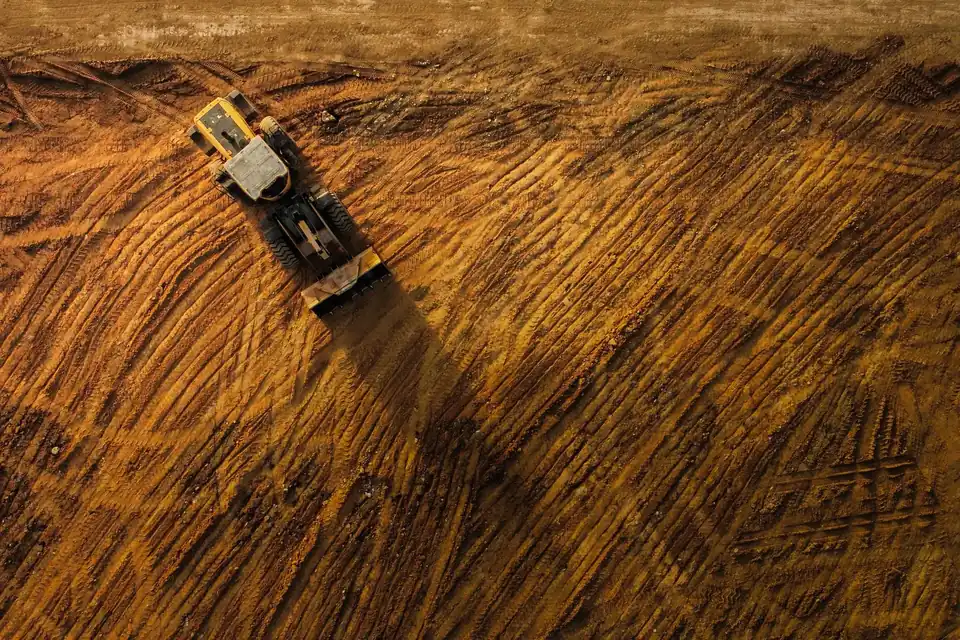
Bush clearing and site clearing
Last updated
How site clearing works, step by step
Site clearing (also called land clearing or clearing and grubbing) takes bush, trees, stumps, roots and rubble off a piece of land so it can be built on, farmed or fenced. Whether it's a 500 m² plot or 50 hectares of thornveld, the order of work is the same.
- Walk the site and mark what stays. Peg the boundaries, tie tape on trees you want to keep, and mark any pipes, cables, septic tanks or boreholes. A machine can't avoid what nobody told the operator about.
- Check the rules for your land. Indigenous bush over 1 hectare, protected trees and virgin farmland each need permission first (details below). A town plot covered in grass, weeds and rubble usually needs none. An old house or outbuilding on the land is a demolition job first, with its own permits.
- Cut and push the bush. The TLB's front bucket or the bulldozer's blade pushes shrubs and small trees over and into heaps.
- Grub out stumps and roots. Stumps left in the ground rot and leave soft spots under slabs and roads, so they come out whole. The TLB's backhoe or an excavator digs around the stump and levers it out.
- Strip and stockpile the topsoil. The top layer is good for gardens and rehabilitation but too soft to build on. It goes in a separate heap.
- Load and cart. Cut bush, stumps and rubble are loaded onto tipper trucks and taken off site. On farms, bush is often pushed into windrows (long heaps) and left or chipped.
- Rough-level the ground. The machine fills the stump holes and leaves the site ready for setting out, ploughing or the next stage: earthworks, levelling and compaction or trenching for services.
Bush clearing machines: which one for your land
Most house plots need one machine. Bigger land needs two or three working together, so the pushing, digging and loading never wait for each other.
| The clearing job | Machine | Per day |
|---|---|---|
| Overgrown house plot: grass, shrubs, rubble, a few small trees | TLB (JCB 3CX or similar, about 7.3 t) | R3,900–R5,150 |
| Tight yard or stand with narrow access | Bobcat (skid steer) | R2,400–R3,700 |
| Trees and big stumps that must come out with the roots | Excavator, 20–25 t | R3,500–R5,600 |
| Hectares of dense bush or thorn on farm or development land | Bulldozer, D6 class | R5,000–R7,750 |
| Loading big heaps of cut bush and soil onto trucks | Front end loader, 950 class | R3,400–R3,800 |
| Carting it away | 10 cube tipper truck with driver | R3,700–R5,250 |
| Shaping the ground after clearing (site clearing and grading) | Grader, 140 class | R4,500–R6,000 |
A TLB is the best all-round bush clearing machine for plots because it does everything on one machine: the front bucket pushes and loads, and the backhoe at the back digs out stumps (it reaches about 4.4 m deep with a standard arm). The bulldozer only pushes, so on farm land we pair it with an excavator to pull trees and load trucks. Every machine comes with an experienced operator; you don't need to drive anything.
Send us photos of the land on WhatsAppHow long site clearing takes
This is a rough planning guide for normal soil and a dry site. Dense thorn, big trees, rock, wet clay and slopes all add time. Send photos and the size, and we'll tell you the days before you book.
| Job | Machines | Typical time |
|---|---|---|
| House plot up to about 1,000 m², grass, weeds and rubble | TLB + 1 tipper | 1 day |
| House plot with trees and stumps | TLB + tipper | 1–2 days |
| Site clearing for construction on a few plots (topsoil stripped) | TLB or excavator, tippers, grader | 2–5 days |
| 1 hectare of medium bush on a farm | Bulldozer + excavator | 1–3 days |
| Several hectares of dense thorn | Bulldozer, excavator, loader, tippers | 1–3 weeks |
Land clearing cost: per hour, per day and per hectare
You pay for the machine time and the transport, not per tree or per square metre. That keeps the price honest: a light plot costs a light price.
- By the hour: a TLB is R320–R410 an hour dry (you pay the diesel), useful for a few hours of tidying.
- A one-day plot clearing: one TLB day is R3,900–R5,150 a day with operator, plus tipper loads to cart the material. A 6 cube tipper load in Gauteng is R1,250–R1,900.
- A two-day plot with trees: two TLB days come to R7,800–R10,300 before carting and transport.
- Per hectare on farms: worked out from bulldozer and excavator days. Three bulldozer days are R15,000–R23,250.
Here is a worked example for bush clearing in Limpopo: three days of a D6-class bulldozer on a farm near Mokopane, with the lowbed transport both ways from Polokwane.
| Example quote (for illustration only) | Amount |
|---|---|
| D6 class bulldozer (18–25 t), 3 days at R5,000–R7,750 a day with operator | R15,000–R23,250 |
| Transport both ways to Mokopane | R6,000–R9,500 |
| Example total, excl. VAT | R21,000–R32,750 |
Prices exclude VAT. Your own price comes back in writing on WhatsApp before the machine moves. All machine prices are on plant hire rates.
Get a land clearing priceWhat you must sort out before clearing
Most house plots in town need no permission to clear grass, weeds and rubble. Natural bush, trees and farmland are different. These rules sit with the landowner, so check them before booking machines.
Indigenous vegetation: when you need environmental authorisation
Under the national EIA Regulations, activity 27 of GN R.983 of 2014 (as amended in 2017), clearing 1 hectare or more, but less than 20 hectares, of indigenous vegetation needs an environmental authorisation from the provincial environmental department before work starts. Clearing 20 hectares or more is a separate listed activity that needs a full assessment. In sensitive areas set out by each province, such as critical biodiversity areas, the trigger drops to 300 m².
"Indigenous vegetation" here means naturally occurring indigenous plants where the topsoil has not been lawfully disturbed in the last 10 years. So a field ploughed three years ago is not indigenous vegetation, but bush that has stood for decades is. The exceptions are clearing for a linear activity (such as a road or pipeline route) and clearing done under an approved maintenance management plan. An environmental assessment practitioner can tell you which applies to your land.
Protected trees
The National Forests Act, section 15, says no one may cut, damage or destroy a protected tree without a licence from the Department of Forestry, Fisheries and the Environment. The protected list includes the camel thorn, shepherd's tree, marula, leadwood and baobab, all common on bushveld farms. Breaking the rule is a first-category offence with up to three years' imprisonment. Mark these trees before we start, and the operator works around them.
Virgin farmland and slopes
The Conservation of Agricultural Resources Act (regulation 2) says no land user may cultivate virgin soil, meaning land not cultivated in the past 10 years, without written permission. You apply at your local agricultural extension office at least three months before you plan to plough. Land steeper than 20% also needs written permission before cultivation (regulation 3).
Alien invasive plants
Clearing alien invasives is a duty, not just a choice: the Alien and Invasive Species Regulations, 2020 require every landowner and occupier to control listed category 1a, 1b and 3 invasive species and stop them spreading. A stand of pure alien invasives is not indigenous vegetation, so the 1-hectare rule above doesn't apply to it. Stumps of some invasive trees regrow, so they need to come out whole or be treated.
Underground services, boundaries and neighbours
- Services: grubbing stumps digs into the ground, so find out where water pipes, sewer lines, electrical cables and fibre run before we start. The Construction Regulations (regulation 13) require anyone excavating to establish where electricity, water, gas and similar services are first. The municipality's service plans and any as-built drawings of the property help.
- Boundaries: have the pegs found or replaced by a land surveyor if you're not sure where your land ends. Clearing a neighbour's trees by mistake is expensive.
- Heritage: on a development changing the character of a site bigger than 5,000 m², the National Heritage Resources Act requires you to notify the provincial heritage authority first.
The rules in more depth, with the paperwork, are in our site clearing guide.
Land clearing for farming and for construction
Land clearing for farming
Farm clearing is usually about bush encroachment: thorn trees thickening up on grazing land, or old lands that have gone back to bush. A bulldozer pushes the bush into windrows, an excavator pulls bigger trees with their roots, and the land is left ready for ploughing or grazing. Remember the 1-hectare authorisation rule for indigenous bush and the CARA permission for virgin soil.
Site clearing before construction
On a building site the aim is clean, firm, level ground. After the bush and stumps come out, the topsoil is stripped and stockpiled, and the ground is levelled for setting out. Stump holes must be filled and compacted in layers, or the slab can crack later. Then the site moves on to earthworks and foundations.
Plot clearing in Gqeberha and Cape Town, bush clearing in Limpopo
Plot clearing in Gqeberha (Port Elizabeth)
Most Gqeberha plot clearing is overgrown residential stands being readied for building or sale: a TLB day and a few tipper loads. Gqeberha (Port Elizabeth) is one of the main centres we send machines from. The TLB drives to site, so travel is small and confirmed on WhatsApp with your price. More on local machines: plant hire in Gqeberha.
Plot clearing in Cape Town
In Cape Town, tight stands often suit a bobcat, which arrives on a trailer. Cape Town is one of the main centres we send machines from. Transport for a bobcat there and back usually comes to R1,300–R3,840, shown as its own line on your quote. Natural fynbos is the thing to watch: in the Western Cape, clearing 300 m² or more of indigenous vegetation inside a critical biodiversity area, or within 100 m inland of the high-water mark of the sea, needs environmental authorisation. See plant hire in Cape Town.
Bush clearing in Limpopo
Limpopo bush clearing is mostly farm work: thorn encroachment on grazing and old lands going back to bush, done with a bulldozer and an excavator. Marula, leadwood, shepherd's tree and baobab are protected trees and must be left standing unless you hold a licence. Polokwane is one of the main centres we send machines from. Transport for a bulldozer there and back usually comes to R6,000–R9,500, shown as its own line on your quote. See plant hire in Limpopo and Polokwane.
WhatsApp us your plot or farmQuestions people ask
What are the steps involved in site clearance?
Site clearance runs in seven steps: mark what stays and where the boundaries and services are, get any permission the land needs, cut and push the bush, grub out the stumps and roots, strip and stockpile the topsoil, load and cart the cut material, then rough-level the ground. On a house plot one TLB does steps three to seven. The full sequence is in the section how site clearing works.
What is the fastest way to clear land?
With the right machine for the size: a TLB for a house plot, a bulldozer for hectares of bush, and an excavator to pull trees with their roots, with tippers carting at the same time so the machines never wait. The fastest legal way also means checking the rules first: clearing 1 ha or more of indigenous vegetation without authorisation can stop the job and lead to an order to rehabilitate the land.
What is land clearing and what are its steps?
Land clearing is removing the bush, trees, stumps, roots and rubble from a piece of land so it can be built on, farmed or fenced. The steps are the same as site clearance: plan and mark, get permission where needed, cut or push, grub out roots, keep the topsoil, cart the material and level. Farm clearing adds one more check: under the Conservation of Agricultural Resources Act you need written permission before ploughing virgin soil.
What's it called when you clear land?
Builders call it site clearance or clearing and grubbing (grubbing is digging out the stumps and roots). Farmers say bush clearing or land clearing, and in Afrikaans it is often called ontbossing. Removing thorn bush that has thickened up on grazing land is called bush thinning when some trees are left standing.
How much does land clearing cost per hectare?
We price land clearing by the machine day, not per hectare, because a hectare of open grassland and a hectare of dense thorn bush take very different times. As a guide, a D6-class bulldozer is R5,000–R7,750 a day with operator and a 20–25 t excavator R3,500–R5,600 a day with operator, with transport as its own line. Send photos of the land and the size (1 hectare is 10,000 m², about 2.5 acres) and we'll price the days in writing.
What machine is used for bush clearing?
A TLB clears house plots and small stands; a bobcat clears tight yards; a 20–25 t excavator pulls trees and stumps out with the roots; a bulldozer pushes large areas of bush; tipper trucks or a front end loader move the cut material. Most plots need just the TLB and a tipper.
Related
Sources we checked
- EIA Regulations 2014 - Notice 1 of activities (GN R.983 of 2014 as amended) activity 27
- Environmental Impact Assessment Regulations 2014 (GN R.982) - definitions
- Conservation of Agricultural Resources Act 43 of 1983 - regulation 2 (cultivation of virgin soil)
- Conservation of Agricultural Resources Act 43 of 1983 - regulation 3 (cultivation of land with slopes)
- National Forests Act 84 of 1998 - section 15 (protected trees)
- List of protected tree species under the National Forests Act (GN 2984 of 2023)
- Alien and Invasive Species Regulations 2020 - regulation 7 (general obligations)
- Construction Regulations 2014 (GN R.84) - regulation 13 (excavation work)
- JCB 3CX backhoe loader specification sheet (dig depth and operating weight)
Need a machine?
WhatsApp us the job, the town and the dates. We confirm the machine, the start date and the price in writing before the machine moves.
WhatsApp us now