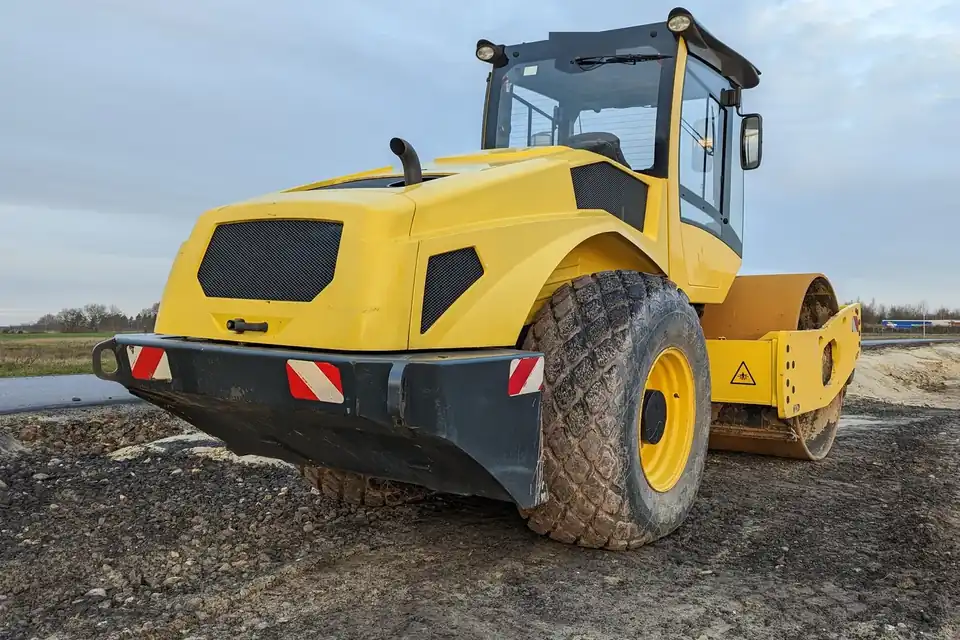
Compactor and roller hire
Last updated
Compactors and rollers we hire
We send everything from a hand-guided rammer for a pipe trench to an 18 t roller for a road or dam wall, anywhere in South Africa. Rollers come with an experienced operator; plates and rammers are delivered machine only for your team to run.
| Machine | Best for | Per day |
|---|---|---|
| Rammer (trench compactor, “jumping jack”) | Pipe and cable trenches, backfill around foundations, clay | R350–R470 machine only |
| Plate compactor (forward only) | Paving beds and blocks, patios, sand and fine gravel | R270–R370 machine only |
| Reversible plate compactor | Driveway and slab bases, thicker gravel layers, tight corners | R400–R630 machine only |
| Small roller, 1.5–3 t (walk-behind or ride-on) | Small roads, parking bays, courts, asphalt patching, paths | R1,050–R1,800 with operator |
| 10–12 t roller (smooth drum or padfoot) | Road layers, building platforms, large fills, subgrade | R2,150–R5,600 with operator |
| 15–18 t roller | Big earthworks, dam walls, mine roads, thick rock fill | R2,600–R2,850 with operator |
| Tow-behind grid roller | Breaking down oversize gravel and soft rock on farm roads | about R1,800 machine only |
Every rate, unit and a worked example are on roller and compactor hire rates. Not sure which machine? WhatsApp us the area, the material and the layer thickness and we'll tell you.
Get your compactor price on WhatsAppPlate compactor hire
A plate compactor is a vibrating steel plate with a small engine, walked over the ground by one person. It's the everyday machine for paving and small areas.
| Machine | Example model | Weight | Working width | Force | Area per hour |
|---|---|---|---|---|---|
| Forward plate | Wacker Neuson VP1550 or similar | 92 kg | 500 mm | 15 kN | 690 m² |
| Reversible plate | Wacker Neuson DPU6555 or similar | 482 kg | 550 mm (710 mm overall) | 65 kN | 1,200 m² |
| Rammer | Wacker Neuson BS60-4 or similar | 72 kg | 280 mm shoe | 18 kN impact, 656 blows/min | 148 m² |
- Forward plate (about 90 kg): paving bedding sand, bedding blocks in with a rubber or urethane pad so they don't chip, patios and footpaths. Light enough for two people to lift into a bakkie.
- Reversible plate (about 480 kg): drives forwards and backwards, so it works into corners and against walls. With about four times the force of a forward plate, it compacts thicker layers of crusher run and gravel under driveways, slabs and small parking areas.
- Rammer: a narrow shoe that jumps about 11 times a second, driving the soil down. It's the machine for trenches and clay, where a plate just bounces.
Plates and rammers are hired machine only and arrive on a truck or trailer. Delivery in a main centre is usually R1,300–R3,840 there and back, so for a single day it often makes sense to book a plate and a rammer together.
Roller hire: small, 10–12 t and 15–18 t
Rollers are ride-on or walk-behind machines with one or two steel drums, most of them vibrating. They cover large areas far faster than a plate and compact much thicker layers.
| Size | Example model | Operating weight | Drum width | Centrifugal force |
|---|---|---|---|---|
| Small, 1.5–3 t (tandem, ride-on) | BOMAG BW 120 AD-5 or similar | about 2,700 kg | 1,200 mm | about 41 kN |
| 12 t smooth drum | BOMAG BW 213 D-5 or similar | 12,510 kg | 2,130 mm | 285 / 196 kN (high / low) |
| 12–14 t padfoot | BOMAG BW 213 PDH-5 or similar | 13,830 kg | 2,130 mm | 285 / 194 kN (high / low) |
- Small rollers (1.5–3 t), also called pedestrian, walk-behind, sit-on or 2.5 ton rollers: two vibrating drums, 1.2 m wide. For paths, small roads, parking bays, tennis and netball courts, and asphalt patching. Small rollers go on a trailer.
- 10–12 t single drum, the “road roller” or vibrating roller most people mean (BOMAG roller or similar): one big front drum, rubber-tyred drive at the back. The workhorse for road layers, building platforms and big fills. Moves on a lowbed.
- 15–18 t: heavier rollers for thick layers of rock fill, dam walls and mine roads, where a 12 t would need more passes.
Vibration has two settings: high amplitude (2.10 mm on a BW 213 D-5) drives energy deep into thick layers; low amplitude (1.10 mm) is for thinner layers and finishing without loosening the top.
Smooth drum vs padfoot roller
| Smooth drum | Padfoot (sheepsfoot, spiked) | |
|---|---|---|
| Best on | Sand, gravel, crushed stone, road base, asphalt (small tandem rollers) | Clay, silt, mixed soils with fines |
| How it compacts | Vibration settles grains into a dense layer | Pads knead and press the soil from the bottom of the layer up |
| Surface it leaves | Smooth and sealed, good for a finished layer | Rough, which bonds with the next layer |
| Typical jobs | Road subbase and base, building platforms, sand fill | Dam walls, embankments, clay subgrade and fill |
On a road or building platform built on clay, the job often uses both: a padfoot on the clay fill and subgrade, then a smooth drum on the gravel layers above.
Which compactor for which layer
Compaction is specified as a percentage of the material's maximum dry density (MDD), measured in a laboratory. Older specs call this “Mod AASHTO density”; newer ones cite the SANS 3001 test method for maximum dry density and optimum moisture content. A layer is tested on site and must reach the percentage the engineer set for it.
A real example: a paved road on a project filed with the Department of Water and Sanitation specifies:
| Layer | Thickness | Compaction | Machine that usually does it |
|---|---|---|---|
| C4 subbase (cemented) | 150 mm | 98% of MDD | 10–12 t smooth drum |
| G6 selected layer | 150 mm | 97% of MDD | 10–12 t smooth drum |
| Fill (G7 or better) | min. 150 mm per layer | 95% of MDD | 10–12 t smooth drum or padfoot |
| Subgrade (G8 or better) | in place | 93% of MDD | Padfoot on clay, smooth drum on sand |
The same drawing notes that maximum fill layer thickness depends on the compaction equipment. That's the key rule: the heavier the machine, the thicker the layer it can compact. BOMAG's figures for maximum compacted layer thickness show the range:
| Material | 12 t smooth drum (BW 213 D-5) | 13.8 t padfoot (BW 213 PDH-5) |
|---|---|---|
| Rock fill | 0.80 m | 0.90 m |
| Gravel, sand | 0.50 m | 0.60 m |
| Mixed soil | 0.40 m | 0.50 m |
| Silt, clay | 0.20 m | 0.30 m |
Road specs usually ask for thinner layers (often 150 mm) than these maximums, because high densities are easier to reach and test in thin lifts. Plates and rammers compact far thinner layers, so in trenches and small areas the material goes in and gets compacted in thin lifts.
Water is half the job
Soil only compacts properly near its optimum moisture content (OMC): too dry and the grains won't pack, too wet and the roller pumps water instead of air out. On roads and building platforms a water truck brings each layer to the right moisture before the roller passes. On small jobs, a hose and a wheelbarrow of water do the same for a plate.
Grid roller, paving compactors and other jobs
- Grid roller: a heavy steel mesh drum towed behind a tractor or grader. It crushes oversize gravel and soft rock and knits the road surface together, which makes it popular on farm roads and airstrips built from natural gravel.
- Paving compactor: a forward plate with a rubber or urethane pad, used to bed paving blocks into the sand and work in the joint sand without chipping the blocks.
- Ground or soil compactor: for soil, pick by area. Rammer for trenches, reversible plate for small bases, roller for anything bigger than a driveway.
- Big compaction jobs usually pair a roller with a grader and a water truck. See land levelling for building platforms and gravel roads and driveways for roads.
Roller and compactor prices
| Size | Rate | Price |
|---|---|---|
| Small roller (1.5–3 t) | Per day, with operator | R1,050–R1,800 |
| 10–12 t roller | Per day, with operator | R2,150–R5,600 |
| 10–12 t roller | Per hour, dry (operator included, you pay the diesel) | R260–R620 |
| 15–18 t roller | Per day, with operator | R2,600–R2,850 |
| Plate compactor (forward only) | Per day, machine only | R270–R370 |
| Reversible plate compactor | Per day, machine only | R400–R630 |
| Rammer (trench compactor) | Per day, machine only | R350–R470 |
| Tow-behind grid roller | Per day, machine only | about R1,800 * |
* Few price points for this one, so treat it as a guide; the exact price comes back on WhatsApp.
Plates, rammers and the grid roller are hired machine only; rollers include an operator. Transport is its own line: small machines travel on a truck or trailer, and 10 t+ rollers on a lowbed, which in a main centre usually comes to R6,000–R9,500 there and back. More detail and worked examples: roller and compactor hire rates.
Operators, safety and booking
Ride-on rollers are construction plant under Construction Regulation 23 (GN R.84 of 2014): the operator must be trained, certified competent, authorised in writing and hold a medical certificate of fitness, and must inspect the roller daily before use and record it in the register kept in the machine. Our roller operators meet these rules, and copies of their certificates come before the machine arrives, on request. See safety and certificates.
For plates and rammers, the person running the machine needs hearing protection, safety boots and gloves, and should take regular breaks from the vibration. Keep fuel away from hot engines and never run petrol machines inside a closed trench or room.
- WhatsApp the job: the area, the material (sand, gravel, clay, asphalt), the layer thickness, the town and dates.
- We confirm in writing: the machine and size, the rate basis and transport as its own line.
- Pay the deposit to book, and the compactor or roller arrives on your start date.
Full details: how it works. Compaction on bigger earthworks: earthworks. Local prices and transport: Johannesburg, Durban, Cape Town and every area we cover.
WhatsApp us your compaction jobQuestions people ask
How much does it cost to hire a compactor?
A forward plate compactor costs R270–R370 a day machine only, a reversible plate R400–R630 a day and a rammer R350–R470 a day. A 10–12 t roller costs R2,150–R5,600 a day with operator. Transport is its own line. Full prices: roller and compactor hire rates.
Which is better, a plate compactor or a roller?
It depends on the area and the layer. A plate compactor is right for paving beds, small driveways, patios and narrow spots. A roller is right for roads, building platforms, parking areas and any big open area, because it covers ground far faster and compacts thicker layers. In trenches and on clay, a rammer beats both.
What is a padfoot roller used for?
A padfoot (also called a sheepsfoot or spiked roller) has rows of raised pads on its drum. It's used on clay, silt and mixed soils: dam walls, subgrade, embankments and clay fills. The pads knead the soil and leave a rough surface that bonds with the next layer. On sand, gravel and crushed stone, a smooth drum works better.
Can I hire a roller for my lawn?
For levelling a large area before planting or laying instant lawn, a small 1.5–3 t roller with the vibration off firms the topsoil evenly. Don't vibrate topsoil hard: packed soil holds water badly and roots struggle. For a small garden lawn, a light hand roller is enough.
Do rollers come with an operator?
Yes. Every roller, walk-behind or ride-on, comes with an experienced operator. Plate compactors and rammers are hired machine only: we deliver them and your team runs them.
Related
Sources we checked
- Wacker Neuson VP1550AW vibratory plate technical data (Wacker Neuson)
- Wacker Neuson DPU6555Heh reversible plate technical data (Wacker Neuson)
- Wacker Neuson BS60-4As rammer technical data (Wacker Neuson)
- BOMAG BW 213 D-5, DH-5 and PDH-5 single drum roller technical data sheet (BOMAG)
- BOMAG BW 120 AD-5 tandem roller specifications (BOMAG)
- Typical road cross-section with layer compaction requirements, drawing P07495-00-WW-SWP-0001-001 (Department of Water and Sanitation filing)
- SANS 3001 civil engineering test methods list (CSIR)
- Construction Regulations 2014 (GN R.84) reg 23, construction vehicles and mobile plant
Need a roller?
WhatsApp us the job, the town and the dates. We confirm the machine, the start date and the price in writing before the machine moves.
WhatsApp us now