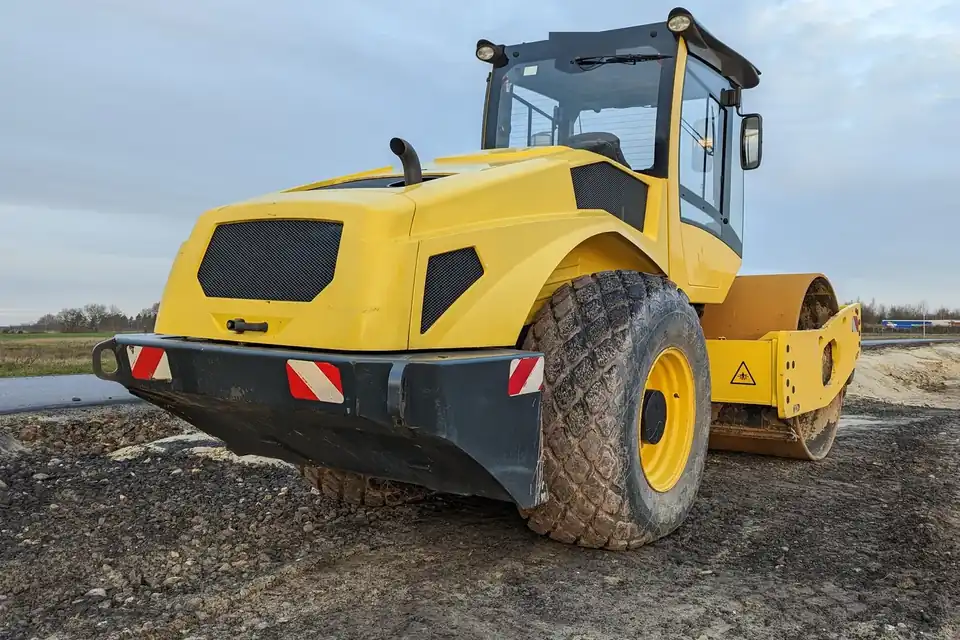
Types of rollers for compaction
Last updated
The four ways a compactor packs the ground
Every compaction machine squeezes air out of the soil using one or more of four forces. Knowing which force a machine uses tells you which soil it suits.
| Force | How it works | Works best on | Machines |
|---|---|---|---|
| Static weight | The machine's weight presses the surface down | Thin layers, finishing, topsoil | Any roller with vibration off |
| Vibration | A spinning weight shakes the grains so they settle into a dense layer | Sand, gravel, crushed stone, road base | Smooth drum and tandem rollers, plate compactors |
| Kneading | Pads or tyres press and work the soil, squeezing it from the bottom of the layer up | Clay, silt, mixed soils; asphalt (tyres) | Padfoot rollers, pneumatic rollers |
| Impact | A foot lifts and slams down, driving the soil in | Clay and backfill in narrow spaces | Rammers |
Sand and gravel are granular: the grains don't stick, so shaking them settles them. Clay is cohesive: the particles cling together, so it has to be kneaded or rammed. Put the wrong machine on the wrong soil and you can pass all day without reaching the density the engineer asked for.
Types of rollers and compaction equipment
| Type | What it looks like | Best for | Example weight | Price |
|---|---|---|---|---|
| Smooth drum (single drum vibratory) | One big steel drum at the front, rubber-tyred drive at the back | Road layers, building platforms, sand and gravel fill | 12,510 kg (BOMAG BW 213 D-5) | R2,150–R5,600 a day with operator |
| Padfoot (sheepsfoot) | The same machine with rows of raised pads on the drum | Clay fill, subgrade, embankments, dam walls | 13,830 kg (BOMAG BW 213 PDH-5) | R2,150–R5,600 a day with operator |
| Pneumatic (rubber-tyred) | Rows of smooth rubber tyres front and back, with ballast space | Asphalt, chip seals, proof rolling, stabilised layers | 8,500 kg base (BOMAG BW 28 RH) | Exact price on WhatsApp |
| Tandem (double drum) | Two vibrating steel drums, ride-on | Asphalt, paths, parking bays, small roads | about 2,700 kg (BOMAG BW 120 AD-5) | R1,050–R1,800 a day with operator |
| Heavy smooth drum, 15–18 t | A bigger single drum roller | Thick rock fill, dam walls, mine roads | 15–18 t class | R2,600–R2,850 a day with operator |
| Grid roller | A heavy steel-mesh drum towed by a tractor or grader | Breaking down oversize natural gravel on farm roads | Varies by model | about R1,800 a day, machine only |
| Reversible plate compactor | Walk-behind vibrating plate that goes forwards and backwards | Driveway and slab bases, thicker gravel, corners | 482 kg (Wacker Neuson DPU6555) | R400–R630 a day, machine only |
| Forward plate compactor | Light walk-behind plate | Paving sand and blocks, patios, footpaths | 92 kg (Wacker Neuson VP1550) | R270–R370 a day, machine only |
| Rammer ("jumping jack") | A narrow foot on an upright engine | Trenches, around foundations, clay | 72 kg (Wacker Neuson BS60-4) | R350–R470 a day, machine only |
Full specs for our plates, rammers, small, 12 t and padfoot rollers (drum widths, forces and area per hour) are on roller and compactor hire.
The pneumatic (rubber-tyred) roller
A pneumatic roller rolls on two rows of smooth rubber tyres instead of steel drums. The tyres flex and knead the surface, closing it up without crushing the stone in it. BOMAG's BW 28 RH weighs 8,500 kg as built, rolls a 2,045 mm wide strip, and comes in ballast versions rated up to 10, 12, 16, 18, 20, 24 and 28 t, using water, steel or concrete weights. The heavier you ballast it, the deeper it works.
BOMAG lists its work as asphalt compaction, surface dressing (chip seals), highway and airfield work, proof rolling, and lime- and cement-stabilised soils. Proof rolling means driving a heavy, ballasted roller over a finished layer to find soft spots that move under the tyres. On most private sites a pneumatic roller isn't needed; on road contracts with asphalt or seals it usually is. Pneumatic rollers are priced on WhatsApp.
Which compactor for which soil
| Material | Big area | Small area or trench | Thickest layer for a 12–14 t roller |
|---|---|---|---|
| Sand, gravel, crushed stone | Smooth drum, vibrating | Reversible or forward plate | 0.50 m (smooth drum); 0.60 m (padfoot) |
| Mixed soil (sand with clay) | Padfoot, then smooth drum to finish | Rammer or reversible plate | 0.40 m (smooth drum); 0.50 m (padfoot) |
| Clay and silt | Padfoot | Rammer | 0.20 m (smooth drum); 0.30 m (padfoot) |
| Rock fill | Heavy smooth drum (15–18 t on thick layers) | Not suited to small machines | 0.80 m (smooth drum); 0.90 m (padfoot) |
| Asphalt | Tandem, then pneumatic | Small tandem or forward plate | Set by the asphalt design |
| Topsoil and lawn beds | Small roller, vibration off | Hand roller | Don't compact hard: roots need air |
Those are maximums. Specifications usually ask for thinner layers, often 150 mm, because high densities are easier to reach and test in thin lifts. And moisture matters as much as the machine: soil only compacts properly near its optimum moisture content, which is why a water truck works ahead of the roller on roads and building platforms.
Which compactor for which layer
Compaction is specified per layer as a percentage of the material's maximum dry density (MDD), from a laboratory test. Typical requirements from real South African documents:
| Layer or job | Requirement | Usual compactor |
|---|---|---|
| Road subgrade | 93% of MDD (G8 or better) | Padfoot on clay, smooth drum on sand |
| Road fill | 95% of MDD, at least 150 mm a layer (G7 or better) | Smooth drum or padfoot |
| Selected layer and subbase | 97–98% of MDD, 150 mm layers | 10–12 t smooth drum |
| Trench backfill in a Cape Town road reserve | Lifts of no more than 150 mm at optimum moisture; clay not allowed as backfill; 93% of MDD in unmade verges | Rammer; plate in wider trenches |
| Farm dam clay core | 75–150 mm layers when machine-compacted, each moist and compacted before the next | Padfoot roller with a water truck |
| Paving bed | Bedding sand screeded, blocks bedded in after laying | Forward plate with a rubber pad |
On a site built on clay the job often uses both drum types: a padfoot on the clay fill and subgrade, then a smooth drum on the gravel layers above. The road layers in more detail are on gravel roads and driveways, and building platforms on land levelling.
Compaction roller sizes and weights
Weight sets how deep a compactor works and how big an area it covers. From the smallest to the biggest we send:
| Machine | Weight | Working width | How it gets to site |
|---|---|---|---|
| Rammer | 72 kg | 280 mm foot | Bakkie or trailer |
| Forward plate | 92 kg | 500 mm | Bakkie or trailer |
| Reversible plate | 482 kg | 550 mm | Truck or trailer |
| Small tandem roller | about 2.7 t | 1,200 mm | Trailer |
| Pneumatic roller | 8.5 t, ballasted heavier | 2,045 mm | Lowbed |
| Single drum roller | 10–12.5 t | 2,130 mm | Lowbed |
| Padfoot roller | about 13.8 t | 2,130 mm | Lowbed |
| Heavy single drum | 15–18 t | Confirmed on your quote | Lowbed |
Rollers from 10 t up travel on a lowbed, which in a main centre is usually R6,000–R9,500 there and back. Plates and rammers go on a truck or trailer for much less.
Compactor machine uses: the jobs we send them to
Roads and driveways
Grader, water truck and smooth drum roller on gravel layers; tandem roller on asphalt. See gravel roads and driveways.
Building platforms
Fill placed and compacted in layers before foundations. See land levelling.
Trenches
A rammer compacts backfill around pipes and cables in thin lifts. See trenching.
Paving and slabs
A plate compactor on the base and bedding sand; a reversible plate on thicker crusher run.
Dam walls
A padfoot roller on each wetted clay layer. See dam building.
Sports fields and yards
A small roller to firm a levelled surface, vibration off on topsoil.
Ride-on rollers are mobile plant under regulation 23 of the Construction Regulations, so our roller operators are trained, certified, medically fit and authorised in writing. Prices and worked examples: roller and compactor hire rates.
WhatsApp us the area, material and layerQuestions people ask
What is the difference between a vibratory and a static roller?
A static roller compacts with its weight alone. A vibratory roller has a spinning weight inside the drum that makes it hammer the ground many times a second, which settles sand and gravel much deeper: BOMAG rates a 12 t vibratory smooth drum for gravel and sand layers up to 0.50 m. Most rollers can vibrate or run static; the operator turns vibration off for finishing, topsoil and near fragile structures.
Which roller is used for asphalt?
A tandem roller (two smooth steel drums) for most asphalt: driveways, parking areas, patching and small roads. On bigger asphalt jobs and chip seals, a pneumatic (rubber-tyred) roller follows to knead and seal the surface; BOMAG lists asphalt and surface dressing as the pneumatic roller's main work.
How heavy is a road roller?
The road roller most people mean, a single smooth drum, is about 10–12 t (a BOMAG BW 213 D-5 is 12,510 kg). Small tandem rollers are 1.5–3 t, padfoot rollers about 14 t, and pneumatic rollers 8.5 t empty, ballasted up to much heavier on bigger versions.
Can a plate compactor compact clay?
Not well. Clay sticks together, so a vibrating plate tends to bounce on it instead of pushing it down. Use a rammer in trenches and small areas, and a padfoot roller on big clay areas. Keep each clay layer thin and at the right moisture.
Do your rollers come with an operator?
Yes, every roller comes with an experienced operator. Plate compactors, rammers and the tow-behind grid roller are hired machine only, delivered for your team to run.
Related
Sources we checked
- BOMAG BW 28 RH pneumatic tyred roller (BOMAG)
- BOMAG BW 213 D-5, DH-5 and PDH-5 single drum roller technical data sheet (BOMAG)
- BOMAG BW 120 AD-5 tandem roller specifications (BOMAG)
- Wacker Neuson VP1550AW vibratory plate technical data (Wacker Neuson)
- Wacker Neuson DPU6555Heh reversible plate technical data (Wacker Neuson)
- Wacker Neuson BS60-4As rammer technical data (Wacker Neuson)
- Typical road cross-section with layer compaction requirements, drawing P07495-00-WW-SWP-0001-001 (Department of Water and Sanitation filing)
- City of Cape Town, Roads Infrastructure Management wayleave standards, version 4.0 (September 2025)
- FAO Manual on small earth dams (Irrigation and Drainage Paper 64)
- Construction Regulations, 2014 (GN R.84), regulation 23: construction vehicles and mobile plant
Need a roller?
WhatsApp us the job, the town and the dates. We confirm the machine, the start date and the price in writing before the machine moves.
WhatsApp us now