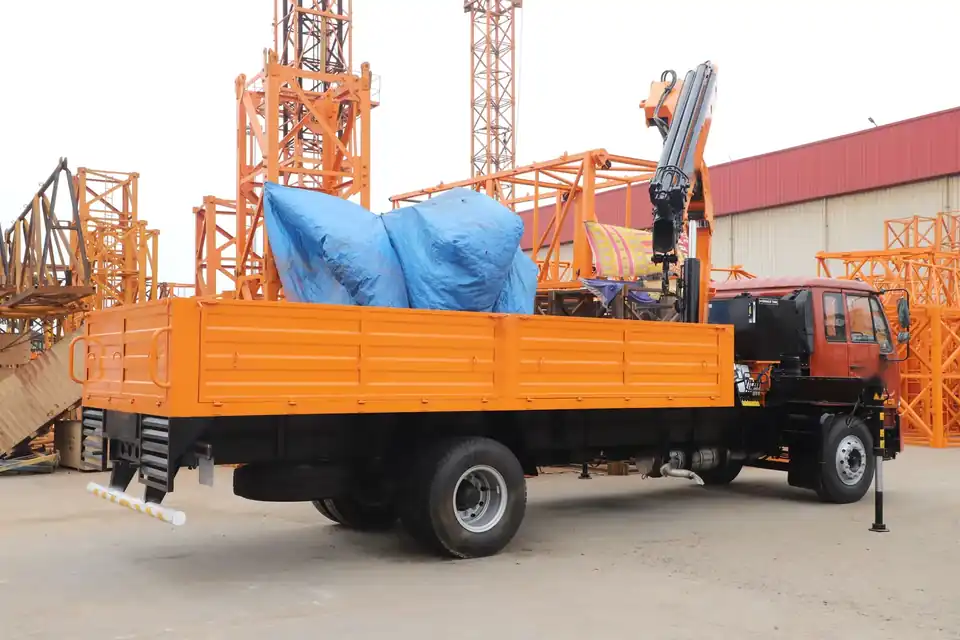
Truck mounted crane regulations
Last updated
Get a written price
- Send the job on WhatsApp: what you are doing, the town and the dates.
- Get your quote: the machine, the operator, transport and the total, in writing.
- Pay to book and the machine arrives on site with its operator.
We reply Monday to Friday 07:00–17:00, Saturday 07:00–13:00.
What is a truck-mounted crane?
A truck-mounted crane is a crane built onto a road truck, so it drives to site on its own wheels. In South Africa the words cover two different machines, and the rules treat their operators differently.
| Crane truck (knuckle-boom loader crane) | Truck crane (telescopic mobile crane) | |
|---|---|---|
| What it is | A folding crane behind the cab of a flatbed truck: the "hiab" | A telescopic boom crane on its own truck carrier, with no load deck |
| Carries the load? | Yes, on its own deck: lift, drive, offload | No; it lifts on site only |
| Rated by | Lifting moment in tonne-metres | Maximum capacity in tonnes at short radius |
| Operator code (2024 Code of Practice) | C32, truck-mounted crane | Mobile crane codes by capacity (C43, C33, C35) |
| Hire | Crane truck hire, R2,500–R5,200 a day for an 8–10 t class | Mobile crane hire, about R4,500 a day for a 20–25 t |
Truck-mounted crane vs boom truck: "boom truck" is an American term, usually for a telescopic (straight) boom crane mounted on a commercial truck with a deck. In South Africa most crane trucks have a knuckle boom instead, because it folds compactly behind the cab and leaves more deck. Both are lifting machines under the same regulations.
Truck-mounted crane regulations: the lifting rules
The Driven Machinery Regulations, 2015 (Government Notice R.540, under the Occupational Health and Safety Act) define a lifting machine as a power-driven machine built to raise, lower or move a load in suspension. A crane truck is one. These are the rules that apply to it:
| Rule | What it requires | Reg |
|---|---|---|
| Load test | Thorough examination and performance test before first use, after dismantling and re-erection, then at intervals of no more than 12 months, by a lifting machinery inspector (ECSA-registered) of a registered lifting machinery entity | 18(5) |
| Six-monthly check | Ropes, chains, hooks, sheaves, brakes and safety devices examined by a competent person at least every 6 months | 18(6) |
| Markings | Safe working load marked, with a load chart where the load varies with reach; a maker's plate with the serial number | 18(1) |
| Load indicator | Cranes over 5,000 kg capacity carry a load indicator and/or load-limiting device | 18(9) |
| Lifting tackle | Slings, shackles and beams marked with their safe working load and examined at least every 3 months | 18(10) |
| Register for a hired crane | The user keeps the latest performance test and service records on site, not older than 12 months; the hire company keeps full service history for 10 years | 18(7) |
| Operator certificate | A certificate of training for code C32 from an accredited training provider, and a licence card valid for up to 24 months | 18(11); Code of Practice 2024 |
| Lifting people | Only in an approved man-cage built to a SANS standard, after a risk assessment | 18(8) |
| Construction sites | Operator medically fit (certificate of fitness), authorised in writing, and the machine inspected daily before use | Construction Regs 23 |
| Power lines | Nobody brings the boom or load inside a line's safety clearance without the line operator's permission | Electrical Machinery Regs 19(5) |
The National Code of Practice for Training Providers of Lifting Machine Operators (Notice 5588 of 29 November 2024) replaced the 2015 code, R.539. The certificate shows the operator's name and ID number, the code, the capacity and any restrictions. A temporary licence lasts up to 6 months and is for operating under supervision only. More detail on testing, inspectors and registers: lifting machinery load tests.
Road rules for the truck
A crane truck is a goods vehicle when it drives, so the National Road Traffic Regulations apply on top of the lifting rules. The crane operator usually drives too, so one person needs both sets of papers.
Driving licence and PrDP
- Code C1: a goods vehicle with a gross vehicle mass (GVM) over 3,500 kg and up to 16,000 kg, with a trailer of no more than 750 kg (regulation 99).
- Code C: a goods vehicle over 16,000 kg GVM (regulation 99).
- Professional driving permit (PrDP): required for the driver of any goods vehicle over 3,500 kg GVM (regulation 115).
Mass limits
A truck's legal maximum is the lowest of its axle limits, its maker's GVM and the bridge formula (regulation 236). The axle limits are 7,700 kg on a steering axle, 9,000 kg on a single axle with dual wheels and 18,000 kg on a tandem (regulation 240). The crane's own mass counts against that: about 2.1 t for a Palfinger PK 18500, 3.1 t for a PK 32080, 3.9 t for a PK 42002 SH and 5.0 t for a PK 65002 SH, and 1.2–4.7 t across the HIAB X-HiPro 112 and 352 versions. So a crane truck carries less than the same truck without a crane, and a heavy crane sits mostly on the front axles. We confirm the deck length and payload of the truck in writing before it's booked for a load.
Before driving, the boom is folded and stowed as the maker requires and the load secured on the deck. If the truck has to stand in a public road to lift, the municipality's permission and traffic control must be in place first.
Outriggers: why the ground matters
A crane truck lifts on its stabilisers (outriggers), not its tyres. The legs push out sideways and down, lifting the weight off the springs and spreading it over a wider base. The maker's load chart only applies with the stabilisers set as the chart says. Typical spreads:
| Class | Crane (or similar) | Stabiliser spread |
|---|---|---|
| 8–10 t | Palfinger PK 18500 | 4.8 m |
| 12–15 t | Palfinger PK 42002 SH | 7.4 m |
| 20–34 t | Palfinger PK 65002 SH | 8.6 m |
- Room: plan for the full spread across the street or yard, plus space to walk round the truck.
- Firm, level ground: each leg puts a large load on a small pad. Keep them off trenches, manholes, stormwater pipes, kerbs and fresh fill, and use spreader mats on soft ground.
- Slopes: the truck must stand level within the maker's limit; a steep driveway may not work.
- Overhead lines: check before the boom goes up, not after.
Crane truck sizes and lifting capacity
Crane truck sizes are named after the crane. The number people quote ("an 8 ton crane truck") is usually the most it lifts close to the truck. What matters is the lift at your reach, and the rule of thumb is: load × reach can't exceed the lifting moment. A 30 t·m crane lifts at most about 3 t at 10 m; the Palfinger PK 32080 (30.4 t·m) is charted at 2.9 t at 9.9 m.
| Class | Crane | Most it lifts | Lifting moment | Hydraulic outreach | Price with operator |
|---|---|---|---|---|---|
| 8–10 t | Palfinger PK 18500 | 8,000 kg | 18.3 t·m | 14.6 m | R2,500–R5,200 a day |
| 12–15 t | Palfinger PK 42002 SH | 15,000 kg | 41.1 t·m | 21 m | R3,200–R5,200 a day |
| 20–34 t | Palfinger PK 65002 SH | 22,000 kg | 62 t·m | 20.4 m | about R1,900 an hour |
Remember the slings, shackles and any spreader beam are part of the load on the hook. The full load chart for a 30 t·m crane, deck space and payload are on crane truck hire, and the most-hired class in detail on 8 ton crane truck hire.
HIAB crane sizes
HIAB rates its cranes in kilonewton-metres (kNm). Divide by about 9.81 to get tonne-metres. Two examples from HIAB's X-HiPro range:
| Model | Lifting moment | Max hydraulic outreach | Crane weight |
|---|---|---|---|
| X-HiPro 112 | 90.4–105.7 kNm (about 9.2–10.8 t·m) | Up to 14.2 m | 1,220–1,750 kg |
| X-HiPro 352 | 314.4 kNm (about 32.1 t·m) | 11.7–21 m by version (22.6 m with manual extensions) | 4,036–4,694 kg |
So an X-HiPro 352 is in the same class as a Palfinger PK 32080: at most about 3 t at 10 m. Compare cranes by lifting moment and outreach, not by brand or the big number on the side.
Before a crane truck arrives: the paperwork
- Load-test certificate dated within 12 months, signed by an LMI of a registered LME, for the serial number on the crane's plate.
- Service record for your register of hired lifting machines.
- Operator's C32 certificate and licence card, valid past your job date, with a capacity at least as big as the crane.
- Driver's licence (C1 or C) and PrDP, if you want to see them.
- On a construction site: the operator's medical certificate of fitness and your written authorisation, and the daily inspection recorded.
- Lifting tackle marked with its safe working load and examined in the last three months.
Our crane trucks are load-tested and come with certified operators, and copies of the certificates come before the truck, on request. See safety and certificates and how hiring works.
WhatsApp us the load and the routeQuestions people ask
Does a crane truck need a load test certificate?
Yes. Regulation 18(5) of the Driven Machinery Regulations requires a thorough examination and performance test before first use, after it is dismantled and re-erected, and at intervals of no more than 12 months, by a lifting machinery inspector of a registered lifting machinery entity. Ask for the certificate before the truck arrives and check the serial number matches the crane's plate.
What licence do I need to drive a crane truck?
A Code C1 licence for a goods vehicle over 3,500 kg up to 16,000 kg gross vehicle mass, or Code C above 16,000 kg, plus a professional driving permit, which every driver of a goods vehicle over 3,500 kg GVM needs. Operating the crane is separate: that needs a C32 certificate of training and a valid licence card.
Can a crane truck lift people?
Only in a man-cage built to an approved SANS standard, approved by an inspector for that purpose, and after a risk assessment (regulation 18(8)). For work at height, hire a cherry picker, which is designed to carry people.
How long is a C32 operator licence valid?
The licence (carry) card is valid for up to 24 months. A temporary licence lasts up to 6 months and only allows operating under supervision (National Code of Practice, 2024, clauses 14.2 and 14.3).
What does HIAB mean?
HIAB is a crane brand. Many people use "hiab" for any truck with a folding crane behind the cab, the same way "bobcat" is used for any skid steer. A hiab, crane truck, loader crane and truck-mounted knuckle-boom crane all mean the same kind of machine.
Related
Sources we checked
- Driven Machinery Regulations, 2015 (GN R.540), regulation 18: lifting machines and lifting tackle
- Notice 5588 of 2024: National Code of Practice for Training Providers of Lifting Machine Operators
- National Code of Practice 2024: crane codes
- National Code of Practice 2024: clause 14, certification
- Construction Regulations, 2014 (GN R.84), regulation 23: construction vehicles and mobile plant
- Electrical Machinery Regulations, 2011 (GN R.250), regulation 19: overhead power lines
- National Road Traffic Regulations, regulation 99: categories of driving licences
- National Road Traffic Regulations, regulation 115: drivers who must hold a professional driving permit
- National Road Traffic Regulations, regulation 236: permissible maximum vehicle mass
- National Road Traffic Regulations, regulation 240: axle massload limits
- Palfinger PK 18500 loader crane technical data
- Palfinger PK 32080 loader crane leaflet (lifting capacities)
- Palfinger PK 42002 SH technical data
- Palfinger PK 65002 SH technical data
- HIAB X-HiPro 112 loader crane (HIAB)
- HIAB X-HiPro 352 loader crane (HIAB)
Need a crane truck?
WhatsApp us the job, the town and the dates. We confirm the machine, the start date and the price in writing before the machine moves.
WhatsApp us now