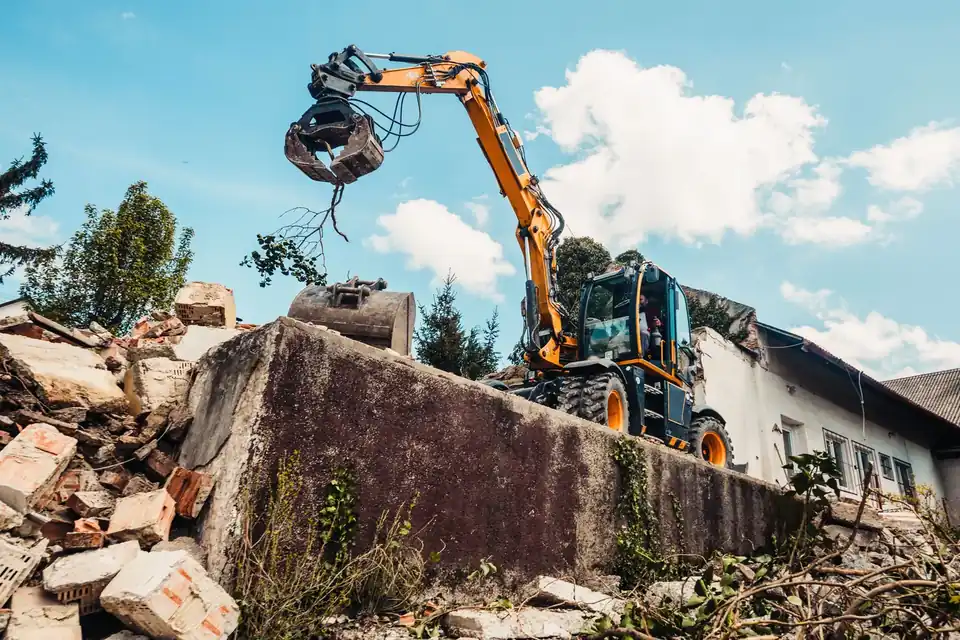
What is demolition?
Last updated
What demolition means
Demolition is taking a structure down on purpose, in a planned order, so that it comes down where and when it's meant to, and leaving the site clear and safe. A house demolition covers far more than knocking walls over: the services are cut off, hazardous materials removed, salvage stripped out, the structure brought down, the slab and foundations broken out, the rubble sorted and carted, and the holes filled.
The law treats it seriously because a half-demolished building is unpredictable. Regulation 14 of the Construction Regulations, 2014 puts every demolition under a competent person appointed in writing, and the municipality decides whether a building may come down at all.
Types of demolition
| Type | What it is | Used for | Machines |
|---|---|---|---|
| Mechanical | A machine pulls, pushes, breaks and crushes the structure from the outside, top down | Houses, outbuildings, commercial and industrial buildings | 20–25 t excavator with breaker or shear (R3,500–R5,600 a day); breaker TLB (R5,000–R6,550 a day) |
| Selective (strip-out) | Chosen parts come out while the rest stays: interiors, roofs, walls, extensions | Renovations, shopfronts, salvage before a full demolition | Bobcat with breaker (R3,000–R3,600 a day), jackhammers, hand tools |
| Manual | Hand tools and handheld breakers, piece by piece | Semi-detached and terraced houses, party walls, places no machine can reach | Heavy jackhammer (R380–R610 a day, machine only) |
| Deconstruction | Careful dismantling to reuse materials | Old buildings with good timber, roof sheets, bricks and fittings | Mostly hand work, a crane truck or TLB to lift materials |
| Heavy industrial | Large machines on concrete frames, steel structures and thick foundations | Factories, warehouses, plant | 36–55 t excavator (R6,500–R8,100 a day), planned with an engineer |
| Explosive | Charges placed to bring a tall structure down in one go | Chimneys, towers, high-rise buildings | Specialist blasting work; the explosives use must be notified (Construction Regulations, regulation 4) |
A breaker (hydraulic hammer) smashes concrete, brick and rock. A shear or pulveriser crushes and cuts concrete and steel more quietly. Most South African house demolitions are mechanical with a bit of manual work at the boundaries, where a shared wall or a neighbour's building is close.
The order of work: how a building comes down
A demolition follows the reverse of construction: last in, first out. The order matters for safety (nobody under unsupported parts of the structure, which regulation 14 forbids) and for cost (clean, sorted rubble is cheaper to get rid of).
- Survey and method. For anything more than a simple house, an engineer surveys the structure and a written method statement sets the order of work. Regulation 14 requires both.
- Services off. Electricity, water, gas and sewer disconnected and made safe at the boundary, and their positions established before work starts.
- Hazardous materials out. Asbestos roof sheets, gutters, downpipes and ceiling boards come off first, by a registered asbestos contractor, with a clearance certificate before any machine moves in.
- Soft strip and salvage. Doors, windows, fittings, geysers, roof sheets and roof timbers come out by hand.
- Roof structure, then walls from the top down, pulled inwards, away from the street and neighbours. Floors above ground come down before the walls that hold them.
- Slab and foundations broken out with the breaker; pool shells broken and holes left by basements opened up for filling.
- Sort and load. Concrete and brick, steel and timber kept apart where possible and loaded onto tipper trucks.
- Fill, compact and level. Foundation trenches and holes backfilled in compacted layers, and the site left level and safe.
The municipality can forbid a demolition method it considers dangerous to people or property (regulation E3), and a part-demolished building may not be left in a dangerous state. Our operators bring buildings down from the top, away from people, with nobody inside the danger zone.
Permits and notices for a demolition
| What | Rule | From or to whom |
|---|---|---|
| Written permission to demolish | National Building Regulations, E1 | The municipality |
| At least 10 days' notice of the start date (weekends and public holidays don't count) | National Building Regulations, A22 | The municipality, on its form |
| Heritage permit if any part is older than 60 years | National Heritage Resources Act, section 34 | The provincial heritage resources authority |
| Notice of construction work at least 7 days before (demolition, excavation, work at height or explosives) | Construction Regulations, regulation 4 | The provincial director, Department of Employment and Labour |
| Asbestos inventory, then 7 days' notice of asbestos work | Asbestos Abatement Regulations, 2020, regulations 4 and 10 | A competent person; the Department of Employment and Labour |
| Competent person in writing, engineering survey, method statement | Construction Regulations, regulation 14 | Appointed by the contractor |
Start the paperwork first: the machines take days, the permits take weeks. How each permit works, and the Pretoria process, are on demolition and demolition in Pretoria.
Demolition contractor licence: what's actually required
There is no single "demolition licence" in the rules above. What a demolition contractor must have depends on the job:
- A competent person appointed in writing to supervise the demolition, with the engineering survey and method statement regulation 14 requires.
- The regulation 4 notice to the Department of Employment and Labour before demolition, excavation, work at height or blasting.
- A registered asbestos contractor for any asbestos removal, appointed alongside an approved inspection authority, with a clearance certificate at the end.
- Certified machine operators. Excavators, TLBs and bobcats are mobile plant: the operator must be trained, certified competent, medically fit and authorised in writing (Construction Regulations, regulation 23).
- A CIDB grading for public-sector work. Government and municipal tenders state the CIDB contractor grading designation they need, and only contractors registered at that grade or higher are evaluated.
We send demolition machines with certified operators, and copies of their certificates come before the machine, on request. See safety and certificates.
Demolition checklist
Use this as your checklist template, in order.
Weeks before
- Find the building's age from the original plans or title deed history (older than 60 years: heritage permit).
- Have a competent person check for asbestos and draw up the inventory.
- Apply to the municipality for written permission to demolish.
- For anything framed, multi-storey or close to neighbours: engineer's survey and method statement.
- Book the asbestos removal and its notice, if needed.
Days before
- Give the municipality at least 10 working days' notice of the start date.
- The contractor sends the Department of Employment and Labour notice at least 7 days before.
- Arrange disconnection of electricity, water and gas; cap the sewer.
- Tell the neighbours the dates; photograph shared walls and their condition.
- Plan where the tippers stand and turn, and arrange street permission if they must stand in the road.
- Strip anything you want to keep or sell.
On the day
- Asbestos clearance certificate in hand before the machine starts.
- Site fenced or barricaded; signs up; public and children kept out.
- Dust control ready: hose or water truck.
- Operator and supervisor walk the site together: services, boundaries, what stays.
After
- Rubble carted and weighbridge tickets kept.
- Holes and trenches backfilled and compacted; site levelled.
- Site left safe and secure if building doesn't start straight away.
Rubble: how much, and where it goes
Clean demolition rubble (concrete, brick and soil) weighs about 1.07 t a loose cube. A 10 cube tipper carries about 10.7 t of it, and is R3,700–R5,250 a day with operator with its driver, or about R2,300 a load on short runs in Gauteng. Landfills charge by mass on their weighbridge, so sorted, clean rubble (or rubble taken to a crushing site) costs less to get rid of than mixed waste. The conversions are in how many cubes in a ton.
For the machine side, three days of a 20–25 t excavator come to R10,500–R16,800 and three days of a breaker TLB R15,000–R19,650, before transport, tipper loads and VAT. Worked examples with transport are on demolition; every machine price is on plant hire rates.
Send photos of the building on WhatsAppQuestions people ask
What is selective demolition?
Taking out chosen parts of a building while the rest stays standing: interior walls, ceilings, floors, a roof, an extension. It's done mostly by hand and with small machines like a bobcat with a breaker, because the structure that stays must not be damaged. Strip-out before a full demolition, to salvage doors, windows, roof timbers and steel, is selective demolition too.
Is demolition the same as deconstruction?
Deconstruction is careful, mostly hand demolition aimed at saving materials for reuse: roof sheets, timber, bricks, doors and fittings. It takes longer than knocking a building down by machine, but what's salvaged can be sold, and there's less rubble to cart and pay landfill fees on.
How long after giving notice can demolition start?
The municipality needs at least 10 days' notice of the start date, not counting Saturdays, Sundays and public holidays (regulation A22), and its written permission must be in hand (regulation E1). The contractor must also notify the Department of Employment and Labour at least 7 days before (Construction Regulations, regulation 4). If there's asbestos, the asbestos work needs its own 7 days' notice before it starts.
Can I demolish a wall or outbuilding myself?
The same permission rules apply to any building, large or small: regulation E1 says no one may demolish a building without the local authority's prior written permission. Check the age (over 60 years needs a heritage permit) and whether there's asbestos, and keep children and neighbours well clear. A breaker TLB takes down a garage or boundary wall in half a day to a day.
What happens to the rubble?
It is sorted where possible (concrete and brick, steel, timber) and carted by tipper truck to a landfill or a crushing site. Clean rubble weighs about 1.07 t a loose cube, so a 10 cube tipper carries about 10.7 t. Landfills charge by mass on their weighbridge.
Related
Sources we checked
- National Building Regulations (GN R.2378), regulation E1: demolition of any building
- National Building Regulations (GN R.2378), regulation A22: notice of intention to demolish
- National Building Regulations (GN R.2378), regulation E3: prohibition of dangerous methods
- Construction Regulations, 2014 (GN R.84), regulation 4: notification of construction work
- Construction Regulations, 2014 (GN R.84), regulation 14: demolition work
- National Heritage Resources Act 25 of 1999, section 34: structures older than 60 years
- Asbestos Abatement Regulations, 2020 (GN R.1196 of 2020)
- Asbestos Abatement Regulations, 2020, regulation 4: inventory of asbestos in place
- Asbestos Abatement Regulations, 2020, regulation 10: notification of asbestos work
- Construction Regulations, 2014 (GN R.84), regulation 23: construction vehicles and mobile plant
- CIDB Standard for Uniformity, clause 4.5: applying the cidb register of contractors in public procurement
- Kansas Department of Health and Environment Policy 10-02, C&D waste volume-to-weight factors
Need a machine?
WhatsApp us the job, the town and the dates. We confirm the machine, the start date and the price in writing before the machine moves.
WhatsApp us now