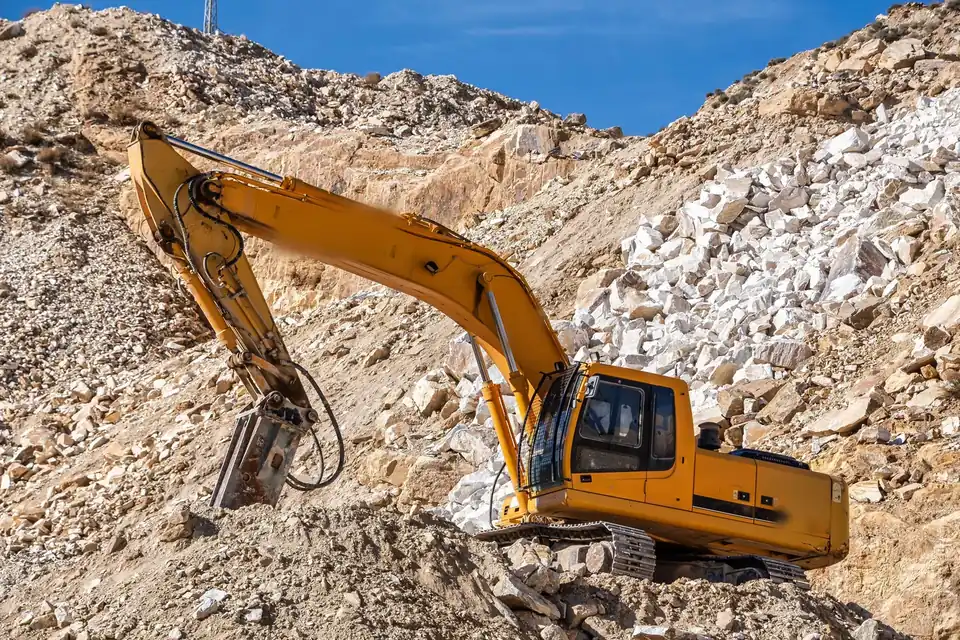
Excavator types and sizes
Last updated
Excavator types
An excavator is a digging machine with a boom, stick (arm) and bucket on an upper body that turns a full 360 degrees on its undercarriage. The type is mostly about what it stands on and how far it reaches.
| Type | What it is | Best for |
|---|---|---|
| Crawler (tracked) excavator | The standard excavator on steel tracks, from about 8 t to 70 t and more | Trenches, foundations, bulk earthworks, loading trucks, rough or soft ground |
| Mini excavator | A small crawler excavator, about 1.5–6 t, often with a dozer blade | Yards, gardens, behind houses, cable and irrigation trenches, narrow access |
| Wheeled excavator | An excavator on rubber tyres that drives between nearby sites | Town roads, paved sites, municipal pipe work where it moves often |
| Long-reach excavator | A crawler with an extra-long boom and stick and a small bucket | Dredging dams and rivers, cleaning canals, deep foundations, sloping banks |
| Amphibious excavator | An excavator on sealed pontoon tracks that float | Dredging, wetlands, silted dams, swamps where a normal machine would sink |
| Demolition (high-reach) excavator | A heavy crawler with a tall boom and shears or crusher jaws | Taking down buildings from the top, floor by floor |
| Mining excavator and face shovel | Very large hydraulic excavators, some with the bucket facing forward | Loading haul trucks in opencast mines and quarries |
| Dragline | A huge crane-like machine that drags a bucket on steel ropes | Stripping overburden in big opencast coal mines |
Nearly every modern excavator is hydraulic: oil under pressure moves the boom, stick, bucket and tracks. The only common non-hydraulic diggers today are rope machines such as draglines and electric rope shovels on big mines. So “hydraulic excavator” and “excavator” mean the same thing on a building site.
Excavator sizes and weights
Excavators are sized by operating weight: the machine with its standard bucket, fuel and operator. Weight drives everything else, from dig depth and bucket size to which lowbed carries it.
| Class | Example | Operating weight | Max dig depth | Reach at ground | Bucket |
|---|---|---|---|---|---|
| Mini (1.5–6 t) | Bobcat E35z or similar | 3,383 kg | 3.12 m | n/a | small, sized by width |
| Medium, 20–25 t | Cat 320 or similar | 22,600 kg | 6.72 m | 9.86 m | 1.19 m³ |
| Medium, 30 t | Cat 330 or similar | 31,400 kg | 7.25 m | 10.69 m | 1.80 m³ |
| Large, 36–55 t | Cat 352 or similar | 48,900–50,500 kg | 7.51–8.21 m | 11.71 m | 1.90–2.69 m³ |
| Large, 70 t+ | Cat 374 or similar | 73,890 kg | 7.66 m (mass boom) | 11.47 m | 4.4–4.6 m³ |
| Mining (largest) | Liebherr R‑9800 | 800,000 kg | n/a | n/a | 47.5 m³ |
Model numbers explained: most makers put the weight class in the model name. A Cat 320 is a 20 t class machine (22.6 t as equipped), a 330 is 31.4 t, a 352 about 49–50 t and a 374 about 74 t. Komatsu (PC200, PC300 and up), Kobelco, Volvo and John Deere follow a similar idea, so the number tells you roughly which class you're looking at.
Why depth doesn't grow as fast as weight: big machines carry shorter, stronger “mass” booms for digging force and big buckets. A 74 t machine with a mass boom digs 7.66 m, about the same as a 31 t with a reach boom, but carries about two and a half times as much per bucket (4.4 m³ against 1.8 m³).
What is the largest excavator?
Among hydraulic excavators, the Liebherr R‑9800 is one of the biggest built: about 800 t with a backhoe (810 t as a face shovel), a 47.5 m³ backhoe bucket and an engine rating of 2,984 kW. Machines like it load the biggest haul trucks on large opencast mines. Rope-operated draglines and bucket-wheel excavators on the biggest coal mines are larger still.
For civil and construction work, the biggest class we hire is 70 t and up (Cat 374 or similar), at about R11,000 a day with an operator. See excavator hire rates.
Excavator uses
- Trenching for sewer, water, stormwater and electrical lines. See trenching.
- Foundations and basements: digging footings, pile caps and basement boxes.
- Bulk earthworks: cutting slopes, building platforms and loading tippers or ADTs. See earthworks.
- Dams and water: digging farm dams, cleaning silt, shaping walls and spillways. See dam building.
- Rock breaking and demolition with a hydraulic breaker, grab or shears. See demolition.
- Land clearing with a grab or mulcher head. See site clearing.
- Mining and quarrying: overburden stripping and loading haul trucks. See mining plant hire.
- Lowering pipes and loads: when an excavator lifts a suspended load it's working as a lifting machine, and lifting rules apply to that lift.
Wheeled excavator vs tracked
A wheeled excavator such as a Cat M318 or similar weighs up to 19,950 kg, reaches 9.21 m along the ground and drives at up to 35 km/h on its tyres. A tracked 20 t class excavator (Cat 320 or similar, 22,600 kg) reaches 9.86 m and digs 6.72 m, but moves between sites on a lowbed.
| Wheeled | Tracked (crawler) | |
|---|---|---|
| Moving between nearby sites | Drives itself | Lowbed both ways |
| Soft, wet or steep ground | Poor; tyres sink and slip | Good; tracks spread the weight |
| Damage to paving and tar | Low on rubber tyres | Higher; steel tracks scuff surfaces |
| Stability when digging | Needs outriggers or blade down | Stable on the tracks |
| Where it's used most | Town and road work | Almost everything else |
On most South African sites, from clay plots to mines, tracked excavators are the norm. Wheeled excavators earn their keep in towns where the machine moves between several small jobs in a day.
Long-reach and amphibious excavators
A long-reach excavator swaps the normal boom and stick for much longer ones. On a Cat 352 Long Reach the reach goes to 19.6 m and the dig depth to 13.04 m, but the bucket shrinks to 1.0 m³ or less, because the long arm can't hold a full-size bucket. It's the machine for cleaning dams, rivers and canals from the bank, and for digging where the machine can't get close.
An amphibious excavator sits on sealed, buoyant pontoons with tracks around them, so it can float and work in water and swamp. It's used to dredge silted dams and work in wetlands, where a normal excavator would bog down. Wetland and river work often needs environmental and water-use authorisation, so check that before planning the machine.
Dozer vs excavator
A bulldozer pushes; an excavator digs and loads. A D6 class dozer (about 22–24 t, 161 kW) carries a semi-universal blade of about 5.7 m³ and an optional rear ripper. A D9 class (about 50 t) carries a 13.6 m³ semi-universal or 16.6 m³ universal blade and rips up to 1,231 mm deep with a single shank.
| Excavator | Bulldozer | |
|---|---|---|
| Main action | Digs down, swings, loads | Pushes forward, spreads, rips |
| Digs below its tracks | Yes, 6.7 m for a 20 t | No, works at ground level |
| Loads trucks | Yes | No (pushes to a loader or excavator) |
| Spreading fill and shaping | Slow | Fast |
| Bush clearing | With a grab or mulcher | Fast with the blade and ripper |
| Day rate with operator | R3,500–R5,600 (20–25 t) | R5,000–R7,750 (D6 class) |
Use an excavator for trenches, foundations, dams below ground and loading. Use a dozer for clearing bush, pushing up dam walls, spreading fill and ripping rock or hard ground. More on dozers: bulldozer hire and the bulldozer guide.
Excavator vs TLB, loader and bobcat
Excavator vs TLB (backhoe)
A TLB (JCB 3CX or similar) weighs about 8 t, digs up to 5.44 m with an extending dipper, has a 1.0 m³ shovel on the front and drives to site at up to 40 km/h. A 20 t excavator digs deeper (6.72 m) with a bucket almost three times bigger, but needs a lowbed. TLBs win on short, mixed jobs on plots; excavators win on long trenches, depth, rock and loading. See TLB hire.
Excavator vs front end loader (wheel loader)
A front end loader scoops loose material from a stockpile or face and carries it on tyres to a truck or heap; a 950 class loader has a 1.5–3.5 m³ bucket. It can't dig below the level it stands on. An excavator digs in place and loads from where it stands. Quarries and mines often use both. See front end loader hire.
Excavator vs bobcat (skid steer)
A bobcat is a small loader with lift arms that clears rubble, moves soil and runs attachments such as a breaker, auger or broom. It doesn't dig deep holes. For digging in tight spaces, compare it with a mini excavator. A bobcat costs R2,400–R3,700 a day with operator; a mini excavator R1,700–R3,000 a day with operator. See bobcat hire.
Excavator vs dump truck
They work as a team: the excavator digs and loads, the dump truck (a tipper or an ADT) carries the load away. Sizing them together matters: a 1.19 m³ bucket fills a 10 cube tipper in about 8–9 passes. See tipper truck hire and ADT dump truck hire.
Excavator vs tractor
A farm tractor pulls and powers implements: ploughs, trailers, slashers. It digs only with a backhoe fitted, which turns it into something like a TLB. For digging dams, trenches or foundations on a farm, an excavator or TLB does the job in a fraction of the time.
Excavator vs dragline
A dragline throws a bucket out on steel ropes and drags it back towards itself, reaching far beyond any excavator. It's built for stripping overburden on large opencast mines and isn't moved from job to job. A hydraulic excavator is far more precise and is the machine for everything from trenches to loading.
Excavator machine checklist (daily pre-use inspection)
Construction Regulation 23(1)(k) requires the authorised operator to inspect construction vehicles and mobile plant every day before use, using a checklist, and record the findings in a register kept in the machine. A typical excavator checklist covers:
- Fluids: engine oil, hydraulic oil, coolant and fuel levels; leaks under the machine.
- Hydraulics: hoses, rams and fittings for leaks, chafing and damage.
- Undercarriage: track tension, rollers, sprockets and loose or missing bolts.
- Bucket and attachments: teeth, pins and bushes, and the quick-hitch locking pin engaged.
- Cab and safety: seatbelt, mirrors or camera, windows, lights, fire extinguisher, and the cab protection intact.
- Warning devices: the hooter and the automatic reversing alarm working (reg 23(1)(i) and (j)).
- Controls: safety lever, slew brake and travel controls working before digging starts.
Our operators do this check every morning and keep the register in the machine. More on operator certificates and safety: safety and certificates.
Hiring an excavator
We hire mini excavators and crawler excavators from 20 t to 70 t+, each with an experienced operator, anywhere in South Africa. A 20–25 t costs R3,500–R5,600 a day with operator; lowbed transport both ways is its own line on the quote.
- Excavator hire: every size, specs, transport and how booking works.
- Excavator hire rates: hourly, daily and monthly prices, with a worked example.
- 20 ton excavator hire: the all-round size.
- Mini excavator hire and the mini excavator guide.
Questions people ask
What are the different types of excavators?
Crawler (tracked) excavators, wheeled excavators, mini excavators, long-reach excavators, amphibious (floating) excavators, and for mines, draglines and large hydraulic mining shovels. A TLB (backhoe loader) has a digging arm too but is a different machine: a tractor with a loader on the front and a backhoe on the back.
Is a bulldozer better than an excavator?
Neither; they do different jobs. A bulldozer pushes and spreads material across the ground and rips hard ground with its rear ripper. An excavator digs below the level it stands on and loads trucks. Big earthworks usually use both: the excavator digs and loads, the dozer spreads and shapes.
What size excavator do I need?
Match the size to the depth and space. A 1.5–6 t mini digs to about 3 m in tight yards; a 20–25 t digs about 6.7 m and handles most trenches and foundations; 30 t and up are for deeper sewers, bulk earthworks, quarries and mines. See excavator hire for every size and what it suits.
What is the difference between a digger and an excavator?
Nothing, in most cases: “digger” is the everyday word for an excavator. Some people also call a TLB a digger, so say the depth and job when you ask for one and we'll send the right machine.
What does trackhoe mean?
Trackhoe is an American word for a tracked (crawler) excavator. In South Africa people say excavator, and in the UK a “360” or “360 digger”, because the upper body turns a full 360 degrees.
What is a poclain?
Poclain is a French company whose founder built its first hydraulic excavator in 1950. In some countries the brand name stuck as a general word for a hydraulic excavator, the way people say “bobcat” for any skid steer loader. A poclain and an excavator are the same kind of machine.
Related
Sources we checked
- Cat 320 hydraulic excavator specifications (Caterpillar)
- Cat 330 hydraulic excavator specifications (Caterpillar)
- Cat 352 and 352 Long Reach specifications (Caterpillar)
- Cat 352 technical specifications sheet (Caterpillar, via Lectura)
- Cat 374 hydraulic excavator specifications (Caterpillar South Africa)
- Cat M318 wheeled excavator specifications (Caterpillar)
- Bobcat E35z mini excavator specifications (Bobcat)
- Liebherr R‑9800 mining excavator specifications (Liebherr)
- Cat D6 dozer specifications (Caterpillar)
- Cat D9 dozer specifications (Caterpillar dealer spec page)
- JCB 3CX backhoe loader specifications (JCB)
- Poclain company history (Poclain)
- Construction Regulations 2014 (GN R.84) reg 23, construction vehicles and mobile plant
Need a machine?
WhatsApp us the job, the town and the dates. We confirm the machine, the start date and the price in writing before the machine moves.
WhatsApp us now