What is a TLB?
Last updated
What does TLB stand for?
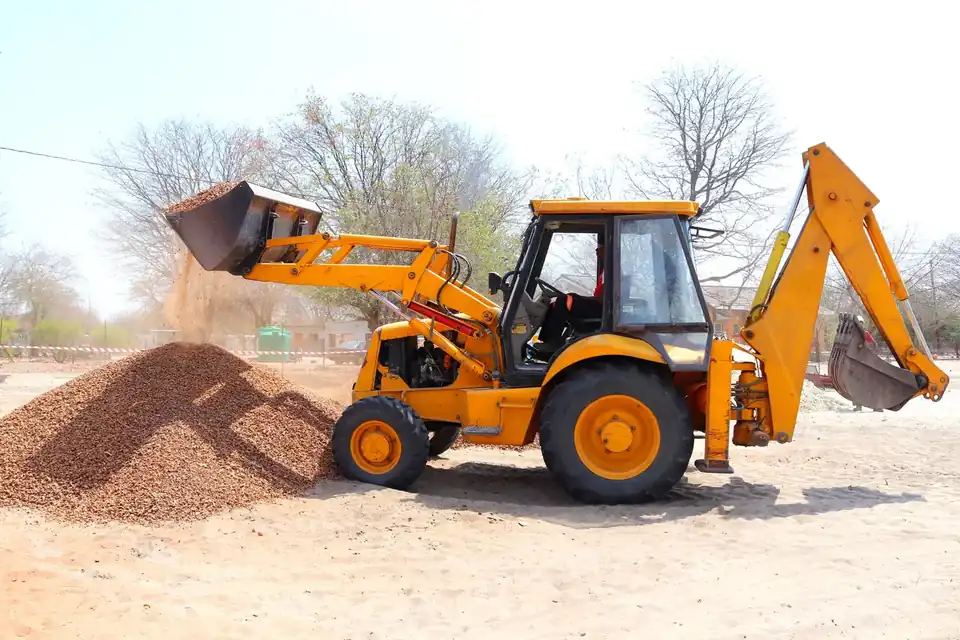
TLB stands for tractor-loader-backhoe. The tractor is the wheeled base with the engine and cab, the loader is the wide bucket on the front, and the backhoe is the digging arm on the back that pulls its bucket towards the machine.
Manufacturers call it a backhoe loader. In South Africa you'll also hear digger loader, or simply “a JCB”, after the best-known make. They all mean the same machine: the one that turns up on a house plot, digs the foundations, loads the rubble onto a tipper and backfills afterwards.
A TLB is construction plant, the everyday machine of building sites, farms and municipal maintenance teams across the country, because one machine and one operator cover digging, loading and levelling, and the TLB drives itself from job to job on the road.
Looking for a different TLB? In computing, TLB means translation lookaside buffer, a small cache in a processor that speeds up memory address look-ups. In lending, TLB is short for term loan B. This guide is about the machine.
How a TLB works
The loader end (front)
The front bucket holds about 1 m³: the Cat 428's multi-purpose bucket is 1.03 m³. The arms lift about 3.5 t to full height on a JCB 3CX and tip at 2.74 m, high enough to load a tipper truck. A multi-purpose (6-in-1) bucket also opens like a clam, so it can grab, doze, level and load. Pallet forks can be fitted for moving material.
The backhoe end (back)
The backhoe is a boom, a dipper (the second arm) and a digging bucket. It swings through 180° behind the machine. Before digging, the operator lowers two stabiliser legs, which lift the back wheels and steady the TLB; with them down a JCB 3CX is 3.30 m wide. An extending dipper slides out to dig deeper: from 4.45 m to 5.63 m on a JCB 3CX.
The cab, drive and controls
The operator sits in one cab and turns the seat to face the loader or the backhoe. Most TLBs are 4x4 and travel on the road at 37–40 km/h (Cat 428), so a TLB drives to site with no lowbed. The backhoe is worked with levers or, on newer machines, joysticks; JCB lists both manual and “Advanced EasyControl” control types for its 3CX range.
| Spec | Figure |
|---|---|
| Operating weight | about 7.6 t (JCB 3CX with cab) to 8.27 t (Cat 428) |
| Max dig depth, standard dipper | 4.45–4.78 m |
| Max dig depth, extending dipper | 5.63–5.70 m |
| Backhoe reach from the swing pivot | 5.44 m, 6.55 m extended (JCB 3CX) |
| Loader bucket | 1.03 m³ (Cat 428 multi-purpose) |
| Width over the front bucket | 2.35 m (JCB 3CX) |
| Travel length and height | 7.19 m and 3.43 m (JCB 3CX, backhoe folded) |
| Fuel tank | 130 litres (JCB 3CX) |
TLB vs excavator: what's the difference?
A TLB is a wheeled, two-ended machine that digs, loads and drives on the road. An excavator is a tracked machine with one digging arm that rotates a full 360° and digs deeper and faster, but has to be carried to site on a lowbed.
| TLB (JCB 3CX or Cat 428, or similar) | Excavator, 20–25 t (Cat 320 or similar) | Mini excavator (Bobcat E35z or similar) | |
|---|---|---|---|
| Weight | 7.6–8.3 t | 22.6 t | 3.4–3.5 t |
| Max dig depth | 4.45–4.78 m (5.6–5.7 m extending) | 6.72 m | 3.12 m (3.42 m long dipper) |
| Runs on | Wheels | Steel tracks | Rubber tracks |
| Digging arm | 180° swing at the back | Whole upper body turns 360° | Turns 360°, zero tail swing |
| Front loader bucket | Yes, about 1 m³ | No | No (small dozer blade) |
| Gets to site | Drives on the road | Lowbed | Trailer |
| Best for | Small and medium jobs that mix digging, loading and backfilling | Deep trenches, bulk earthworks, rock, long runs | Tight access and narrow yards |
| Hire per day | R3,900–R5,150 | R3,500–R5,600 | R1,700–R3,000 |
- Choose a TLB for a house plot, a farm job or a municipal repair: one machine digs, loads and backfills, and there's no lowbed to pay for.
- Choose an excavator for digging deeper than about 5 m, long pipelines, dams and bulk earthworks, or hard ground. See excavator hire and our excavator guide.
- Choose a mini excavator where a TLB won't fit: the smallest are under 1 m wide. See mini excavator hire.
Backhoe vs excavator vs bulldozer
A bulldozer has no digging arm at all: it pushes material with a wide blade at the front and rips hard ground with a ripper at the back. It's the machine for bulk clearing, dam walls and roads, not trenches. See bulldozer hire. “Digger” is an everyday word for either a TLB or an excavator, so it's worth saying which one you mean when you book.
Backhoe vs excavator controls
An excavator operator works from one seat facing forward, with joysticks for the arm and swing and levers or pedals for the tracks. A TLB operator switches between the loader controls facing forward and the backhoe controls facing back. The skills overlap but aren't the same, which is why operator training is machine-specific.
TLB sizes
| Size | Example | Weight | Dig depth | Width |
|---|---|---|---|---|
| Compact (mini) TLB | JCB 1CX or similar | about 3.2 t | 2.54 m (3.07 m extending) | 1.58 m |
| Standard 4x4 TLB | JCB 3CX, Cat 428 or similar | 7.6–8.3 t | 4.45–4.78 m (5.6–5.7 m extending) | 2.35 m |
| Large TLB, long dipper | JCB 4CX 15 ft or similar | about 8.9 t | 4.95 m (6.12 m extending) | 2.35 m |
The standard 4x4 TLB does most jobs. A compact TLB has a loader bucket of only about 0.3 m³, so it suits small, tight sites rather than loading trucks. A wheel loader (front end loader) is a different machine again: a loader bucket and no backhoe, built for loading trucks and working stockpiles. See front end loader hire.
What does a TLB operator need in South Africa?
Regulation 23 of the Construction Regulations, 2014 covers construction vehicles and mobile plant, which includes TLBs. It requires the machine to be operated by a person who:
- has received appropriate training, is certified competent and holds proof of competency. This proof of competency is what people mean by a “TLB certificate” or “TLB licence”;
- is authorised in writing to operate that machine, by the employer;
- holds a medical certificate of fitness to operate it, issued by an occupational health practitioner in the form of Annexure 3 to the regulations.
The same regulation requires the operator to inspect the machine every day before use against a checklist and record the findings in a register kept in the machine.
The TLB certificate: training and unit standards
Accredited training providers have assessed TLB operators against SAQA unit standard 257028, “Operate Tractor Loader Backhoe” (NQF level 3, 13 credits). Its registration has ended, but SAQA lists 30 June 2027 as the last date for enrolment and 30 June 2030 as the last date for achievement. The certificate is issued by the training provider that assessed the operator, so that's where to ask for a copy or a replacement. Course fees and lengths are set by each provider.
When the Driven Machinery Regulations apply
A TLB is construction plant. If it's used to lift suspended loads, it's being used as a lifting machine, and the Driven Machinery Regulations, 2015 (GN R.540) apply to that use, including the rules on lifting machine inspections and operator training. For regular lifting, a crane truck is the machine built for it. See crane truck hire.
Do you need a licence to drive a TLB on a public road?
Yes, a driving licence, but there's no separate TLB code. Regulation 99(4)(a) of the National Road Traffic Regulations lists the driving licence codes, and Code B includes authorisation to drive “a motor vehicle which is a type of mobile agricultural or industrial equipment or machinery not designed principally for the conveyance of persons or goods”, as well as a tractor. A TLB is that kind of machine.
Codes C1, C, EB, EC1 and EC all include the vehicles a Code B licence covers, so their holders may drive a TLB on the road too. The Construction Regulations add that plant travelling or working on public roads must comply with the National Road Traffic Act.
Two different things: the driving licence covers the road; the proof of competency, written authorisation and medical certificate cover working the machine on site. An operator needs both. When you hire a TLB from us, the operator comes with them, and we send copies before the machine arrives if you ask. More on safety and certificates.
Hiring a TLB
A standard 4x4 TLB with an experienced operator costs R3,900–R5,150 a day with operator, or R320–R410 an hour dry (you pay the diesel). With a hydraulic breaker it's R5,000–R6,550 a day with operator. Transport is its own line, and because a TLB drives to site, travel around our main centres is small.
- TLB hire: jobs, specs, what's included and the towns we cover.
- TLB hire rates: hourly, daily and monthly prices with worked examples.
- Trenching and site clearing: the two jobs TLBs do most.
Questions people ask
What is a TLB machine used for?
Digging trenches and foundations, loading tippers, backfilling, clearing rubble and light bush, spreading gravel and, with a hydraulic breaker fitted, breaking concrete and rock. It's the standard machine for house plots, farms and municipal maintenance because one TLB does all of that and drives itself between jobs.
Is a TLB the same as a JCB?
In everyday South African speech, yes: people say “a JCB” for any TLB. Strictly, JCB is a manufacturer whose 3CX is one of the best-known TLBs; other makers build the same type of machine, such as the Cat 428. JCB also makes excavators and loaders, so on a formal order it's clearer to write “TLB” or “backhoe loader”.
How deep can a TLB dig?
A standard 4x4 TLB digs 4.45 m (JCB 3CX) to 4.78 m (Cat 428) with a standard dipper, and 5.63–5.70 m with an extending dipper. A large TLB with a long dipper, such as a JCB 4CX 15 ft, reaches 6.12 m. For deeper work you need an excavator: a 20–25 t machine such as a Cat 320 digs 6.72 m.
Is a TLB a truck?
No. A TLB is a digging machine built on a tractor, not a truck: it carries nothing except what's in its bucket. It's often booked together with a tipper truck, which carries the soil or rubble away while the TLB loads it.
How heavy is a TLB?
A standard 4x4 TLB weighs about 7.6 t (JCB 3CX with cab) to 8.27 t (Cat 428), and the Cat 428's maximum operating weight is 11 t. A compact TLB such as a JCB 1CX is about 3.2 t. The weight matters for soft ground, paving and driveways, so tell us if the machine has to cross any of those.
Do I need a licence to drive a TLB?
On a public road, yes: under regulation 99 of the National Road Traffic Regulations, a Code B driving licence authorises driving mobile industrial machinery such as a TLB. On site, the operator also needs proof of competency, written authorisation and a medical certificate of fitness under regulation 23 of the Construction Regulations. When you hire from us, the operator comes with all of that.
Related
Sources we checked
- JCB 3CX and 4CX backhoe loader specifications (JCB spec sheet P995-B)
- Cat 428 backhoe loader specifications (Caterpillar)
- Cat 428 backhoe loader, South Africa specifications (Caterpillar)
- JCB 1CX compact backhoe loader specifications (JCB spec sheet)
- Cat 320 hydraulic excavator specifications (Caterpillar)
- Bobcat E35z mini excavator specifications (Bobcat)
- Construction Regulations, 2014 (GN R.84), regulation 23: construction vehicles and mobile plant
- National Road Traffic Regulations, 2000 (GN R. 225), regulation 99: categories of driving licences
- SAQA unit standard 257028: Operate Tractor Loader Backhoe
- Driven Machinery Regulations, 2015 (GN R.540), regulation 18: lifting machines
Need a TLB?
WhatsApp us the job, the town and the dates. We confirm the machine, the start date and the price in writing before the machine moves.
WhatsApp us now