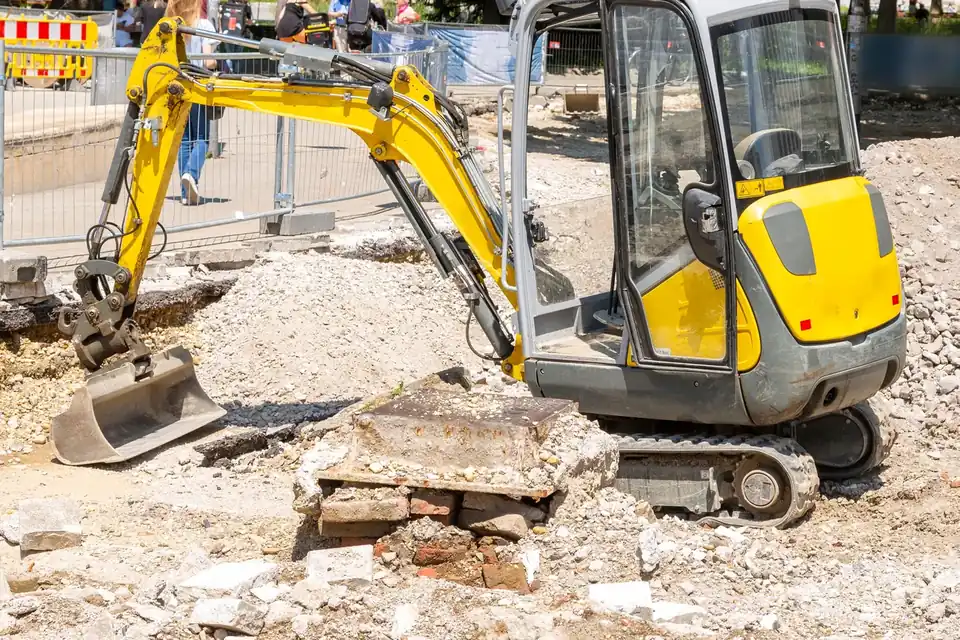
Bobcat mini excavator specs and sizes
Last updated
Bobcat mini excavator specs, size by size
These are Bobcat's own published figures for six of its mini excavators, from the 1 t class to the 6 t class. Bobcat is the brand most South Africans picture when they say "mini digger", so the table doubles as a size chart for the whole category.
| Model | Operating weight | Max dig depth | Width | Reach at ground | Dump height | Tail swing |
|---|---|---|---|---|---|---|
| E10z | 1,176 kg | 1.80 m | 0.71 m (tracks in) | – | – | Zero house swing |
| E20z | 1,930 kg | 2.39 m | 0.98–1.36 m | 4.31 m | 2.57 m | Zero |
| E26 | 2,950 kg | 2.91 m | 1.55 m | 4.88 m | 3.29 m | Minimal |
| E35z | 3,383–3,499 kg | 3.12 m (3.42 m long dipper) | 1.75 m | 5.35 m | 3.34 m | Zero |
| E50z | 4,819 kg | 3.55 m | 1.96 m | 5.92 m | 3.95 m | Minimal (55 mm overhang) |
| E60 | 5,586 kg | 3.98 m | 1.96 m | – | – | – |
Three patterns run through every mini excavator range, whatever the brand:
- Dig depth grows slowly with weight. Going from 1.2 t to 5.6 t (almost five times the weight) only doubles the depth, from 1.8 m to about 4.0 m. If you need more than 4 m, no mini will do it; you need a TLB or a full-size excavator.
- Width jumps at about 2 t. Machines up to about 2 t pull their tracks in to under 1 m (the E20z goes from 1.36 m down to 0.98 m) so they pass through a garden gate or doorway. From the 2.5–3 t class up, the tracks are fixed at about 1.5–2 m.
- Dump height decides whether it can load a tipper. The E20z dumps at 2.57 m; the E50z at 3.95 m. The bigger machines load a tipper truck over its side; the small ones are better tipping onto a heap for a bobcat to carry out.
Cat, John Deere and other mini excavator sizes
Most makers put the weight class in the model name, so a model number tells you the size before you read the spec sheet. John Deere's range shows it clearly:
| Model | Operating weight | Max dig depth (standard / long arm) | Transport width |
|---|---|---|---|
| 17 | 1,720 kg | 2.19 m | 1.28 m |
| 26 | 2,620–2,770 kg | 2.59 m | 1.50 m |
| 30 | 3,105–3,275 kg | 2.79 m | 1.74 m |
| 35 | 3,520–3,690 kg | 3.06 m / 3.46 m | 1.74 m |
| 50 | 4,790–4,920 kg | 3.53 m / 3.83 m | 2.00 m |
| 60 | 6,010–6,180 kg | 3.77 m / 4.12 m | 2.00 m |
Cat mini excavator sizes follow the same logic with a "30" in front: the Cat 303.5 CR is the 3.5 t class, weighing 3,480 kg with a canopy and up to 4,190 kg with a cab and steel tracks. It digs 2.81 m with the standard stick and 3.11 m with the long stick, on a 1.78 m track. "CR" stands for Cat's compact radius design.
Put the three brands side by side and the classes line up: a Bobcat E35z, a Deere 35 and a Cat 303.5 CR all weigh about 3.5 t, dig about 3.1 m and are about 1.75 m wide. That's why we quote by class and send "Bobcat E35z or similar": the job is decided by the class, not the colour of the machine.
Which mini excavator size for which job
| Class | Digs to | Gets through | Typical jobs |
|---|---|---|---|
| About 1 t (micro) | About 1.8 m | A doorway (71 cm on the E10z) | Inside buildings, courtyards, through houses to back yards. Below our hire range: WhatsApp us the measurements. |
| 1.5–2 t | 2.2–2.4 m | A 1 m gate (tracks in) | Garden trenches, irrigation, small footings, French drains behind houses |
| 2.5–3 t | 2.6–2.9 m | About 1.6–1.8 m | Service trenches, boundary wall footings, small pools |
| 3.5 t | 3.1 m (3.4 m long arm) | About 1.8 m | Septic tanks, soakaways, extension foundations, sewer connections |
| 5–6 t | 3.5–4.1 m | About 2 m | Pools, deeper sewer lines, loading tippers all day |
Measure the narrowest point on the way in (gate, side passage, carport pillars) and the deepest point you need to reach, and send both with your request. Prices and transport for each class are on mini excavator hire.
Zero tail swing, minimal and conventional: what the difference is
When a mini excavator turns, the back of the upper body (the counterweight) swings round. How far it sticks out past the tracks decides how close to a wall the machine can work.
- Zero tail swing: the back stays inside the width of the tracks all the way round. Cat lists the 303.5 CR's tail swing radius at 890 mm, exactly half its 1,780 mm track width, so the tail never passes the tracks. Bobcat's E20z and E35z are zero tail swing, and Bobcat calls its smallest versions "zero house swing".
- Minimal (reduced) tail swing: the tail pokes out a little. On the Bobcat E50z it overhangs the tracks by only 55 mm.
- Conventional tail swing: the counterweight sticks out further, as on a full-size excavator. Add Cat's optional extra counterweight to the 303.5 CR and its tail swing grows to 1,005 mm, about 115 mm past the tracks on each side.
Why it matters: with zero tail swing, the operator can dig hard up against a wall, fence or neighbour's boundary and turn to dump without the counterweight hitting anything, and nobody standing beside the tracks gets clipped. Extra counterweight is fitted for stability when lifting or breaking; on tight house plots, zero tail swing is usually worth more.
Rubber tracks vs steel tracks
Most mini excavators run on rubber tracks as standard, with steel tracks as an option: Bobcat lists rubber as standard on the E20z and E26, and Cat fits 300 mm rubber belts to the 303.5 CR, with 300 mm steel tracks as an option that adds 130 kg.
| Rubber tracks | Steel tracks | |
|---|---|---|
| Best on | Lawns, paving, tar driveways, finished gardens, kerbs | Broken rock, demolition rubble, sharp stone, steep loose ground |
| Marks the surface | Little, if the operator avoids sharp turns on paving | Yes: grips by biting into the ground |
| Weakness | Cut by sharp rubble and rebar | Heavier, noisier, damages finished surfaces |
Our mini excavators run on rubber tracks, which suit nearly all house and garden work. If your site is mostly rubble or rock, say so in your WhatsApp and we'll plan for it. Boards or mats over a lawn spread the load further on wet ground.
Retractable undercarriage: the smallest minis widen and narrow their tracks hydraulically. The operator narrows them to get through the gate, then widens them again before digging, because a wider stance is more stable when the arm is out over the side.
Mini excavator attachments
The arm takes more than a digging bucket. These are the attachments Bobcat lists for its mini excavators, and the jobs each does:
Digging and trenching buckets
Digging buckets in several widths; a narrow trenching bucket digs a deep, tidy trench for a pipe or cable without extra spoil.
Grading bucket
A wide, smooth-lipped bucket for levelling, backfilling, shaping beds and cleaning out ditches.
Hydraulic breaker
Breaks concrete, compacted gravel and rock. Never dig concrete with a normal bucket.
Auger
Drills holes for fence posts, palisade, poles and trees, with bits in different diameters.
Hydraulic clamp
Grips against the bucket to pick and place boulders, retaining-wall blocks and logs.
Skeleton bucket and tilt coupler
The skeleton bucket sieves out roots and rocks; a tilt coupler angles the bucket for slopes and drains.
Every mini excavator we send comes with a digging bucket. Breakers, augers and other attachments are priced on WhatsApp for your job. If the job is mostly breaking, a jackhammer may be enough for a small area, and a breaker TLB for a big one.
Mini excavator vs excavator, skid steer and backhoe
Mini excavator vs excavator
Both are tracked excavators with a cab that turns 360°; the difference is size. A mini is under about 6 t, travels on a trailer and digs 1.8–4 m. A 20–25 t excavator (Cat 320 or similar, about 22.6 t) digs 6.72 m, needs a lowbed and costs R3,500–R5,600 a day with operator against R1,700–R3,000 for a mini. Choose the big machine for deep sewers, bulk earthworks and hard ground; the mini for anything inside a property. More in our excavator guide.
Mini excavator vs skid steer (bobcat)
A skid steer loader has no digging arm. It moves, loads and spreads material with a front bucket or forks, and runs attachments like brooms and augers. The two are often hired together: the mini digs the trench or pool, the skid steer carries the soil out to the street where the tipper waits. A skid steer is R2,400–R3,700 a day with operator. See bobcat hire.
Mini excavator vs backhoe (TLB)
A TLB (JCB 3CX or similar) digs 4.45–4.78 m with its backhoe, loads trucks with its front bucket and drives to site on the road, so it has no trailer cost. But it is 2.35 m wide and 3.30 m with its stabilisers down, weighs about 7–8 t and can't work hard against a wall. On an open plot the TLB is better value at R3,900–R5,150 a day; in a back garden, a side passage or on soft ground, the mini wins. More in our TLB guide.
Hiring a mini excavator from Basalt
We send 1.5–6 t mini excavators, Bobcat E-series or similar, with an experienced operator to any province. The price is R1,700–R3,000 a day with operator, excluding VAT, with smaller machines usually toward the lower end. The machine travels on a trailer, and transport both ways is its own line: in Cape Town it is usually R1,300–R3,840 there and back, and the local detail is on mini excavator hire in Cape Town.
Our operators are trained, certified competent, medically fit and authorised in writing, as regulation 23 of the Construction Regulations, 2014 requires for mobile plant, and they inspect the machine before work every day. See safety and certificates and how hiring works.
Get a mini excavator price on WhatsAppQuestions people ask
How big is a Bobcat E35?
The Bobcat E35z weighs 3,383–3,499 kg, is 1.75 m wide and digs 3.12 m deep (3.42 m with the long dipper). It reaches 5.35 m along the ground, dumps at 3.34 m and is zero tail swing. It's the most useful size for house plots: septic tanks, footings and service trenches.
How deep can a 1 ton mini excavator dig?
About 1.8 m. The 1,176 kg Bobcat E10z digs 1.8 m deep and narrows its tracks to 71 cm to pass through a doorway or side gate. A 1.7–1.9 t machine (Bobcat E20z or John Deere 17 class) digs about 2.2–2.4 m.
What do the numbers in mini excavator names mean?
Usually the weight class. A John Deere 35 weighs 3,520–3,690 kg and a 60 weighs 6,010–6,180 kg; a Cat 303.5 CR is a 3.5 t class machine (3,480–4,190 kg). Bobcat's E-numbers follow the same idea loosely: the E10z is about 1.2 t and the E50z about 4.8 t.
Can a mini excavator break concrete?
Yes, with a hydraulic breaker fitted in place of the bucket. Bobcat warns against digging concrete with a normal bucket, because it wears the bucket and strains the boom. For a slab or driveway bigger than a few square metres, a TLB with a breaker (R5,000–R6,550 a day with operator) is usually quicker.
Do your mini excavators come with an operator?
Yes, always. The Construction Regulations require mobile plant to be run by a trained, certified and medically fit operator authorised in writing, and our operators are. Copies of their certificates come before the machine, on request.
Related
Sources we checked
- Bobcat E10z mini excavator specifications (Bobcat)
- Bobcat E20z mini excavator specifications (Bobcat)
- Bobcat E26 mini excavator specifications (Bobcat)
- Bobcat E35z mini excavator specifications (Bobcat)
- Bobcat E50z mini excavator specifications (Bobcat)
- Bobcat E60 mini excavator specifications (Bobcat)
- Bobcat mini excavator buyer's guide: machines and attachments (Bobcat)
- Bobcat mini excavator attachments (Bobcat)
- Cat 303.5 CR mini excavator specifications (Caterpillar South Africa)
- John Deere compact excavator product comparison (Deere and Company)
- Cat 320 hydraulic excavator specifications (Caterpillar)
- JCB 3CX backhoe loader specifications (JCB spec sheet P995-B)
- Construction Regulations, 2014 (GN R.84), regulation 23: construction vehicles and mobile plant
Need a mini excavator?
WhatsApp us the job, the town and the dates. We confirm the machine, the start date and the price in writing before the machine moves.
WhatsApp us now