Types of dozer
Last updated
Get a written price
- Send the job on WhatsApp: what you are doing, the town and the dates.
- Get your quote: the machine, the operator, transport and the total, in writing.
- Pay to book and the machine arrives on site with its operator.
We reply Monday to Friday 07:00–17:00, Saturday 07:00–13:00.
What is a dozer?
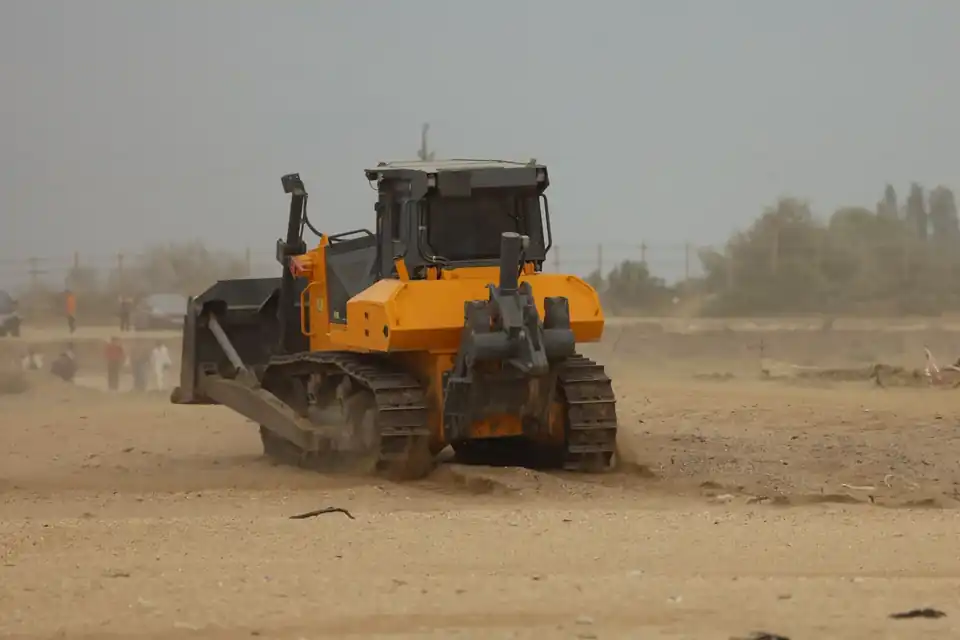
A dozer (bulldozer) is a heavy tractor with a wide steel blade on the front for pushing, cutting and spreading, and usually a ripper on the back for tearing up hard ground. It's the machine for moving a lot of material a short way: clearing bush, pushing up dam walls, spreading fill and ripping rock.
Three things set dozers apart from each other: what they run on (tracks or tyres), the blade, and the size class. The rest of this guide takes them one at a time, then compares the dozer with the excavator, grader and loader so you can pick the right machine.
Crawler dozer vs wheel dozer
| Crawler dozer (tracks) | Wheel dozer (tyres) | |
|---|---|---|
| Runs on | Steel tracks | Large rubber tyres, articulated (bends in the middle to steer) |
| Grip and pushing power | Highest: the tracks grip loose soil, clay and rock | Lower; tyres slip in soft or wet ground |
| Speed between work areas | Slow | Much faster, so it covers big areas |
| Ground | Rough, soft, steep and rocky ground | Firm, level ground: stockpiles, haul roads, loading areas |
| Ripper | Usually fitted | Usually not |
| Typical jobs | Bush clearing, dams, earthworks, ripping, pioneer roads, mine overburden | Coal stockpiles at mines and power stations, clean-up around shovels and loading points |
Almost every dozer on a farm, dam or building site in South Africa is a crawler. Within crawlers there are two variants worth knowing: LGP (low ground pressure) machines on wide shoes for soft ground, and small dozers with a six-way blade that angles and tilts hydraulically for fine grading and backfilling.
Dozer blade types: S, U and SU
The blade decides what a dozer is good at. Wings (the ends bent forward) hold material in front of the blade on a long push; a straighter, shorter blade cuts into hard ground better and grades more finely.
| Blade | Shape | Best for |
|---|---|---|
| Straight (S) | Short and flat, no wings | Fine grading, spreading, backfilling, digging into hard material |
| Universal (U) | Tall with large wings, curved like a scoop | Carrying lots of loose material over long pushes: stockpiles, sand, coal |
| Semi-universal (SU) | Short wings: between the two | General earthmoving and clearing; the usual blade on D6 to D9 class machines |
| Angle blade / six-way | Angles left or right (six-way also tilts) | Side-casting soil: pioneer roads, backfilling trenches, fine grading on small dozers |
| Coal blade | A very large U blade | Pushing light coal on stockpiles |
Blade sizes from the manufacturer's data for common models (or similar): a D6 class carries a 5.7 m³ SU blade, a D8 class an 8.7 m³ SU blade, and a D9 class a 13.6 m³ SU or 16.6 m³ U blade. For coal stockpiles the D9 class can carry a 36.8 m³ coal blade.
Dozer rippers: single shank and multi-shank
The ripper is a hook-shaped steel tooth (shank) on the back of the dozer that's pushed down into the ground and dragged forward to crack it open, so the blade can push it or a loader can pick it up.
- Single shank: one tooth carries the dozer's full weight and power, so it rips deepest and breaks the hardest material: weathered rock, shale, calcrete and hardpan. A D9 class rips up to 1,231 mm deep with a standard single shank, or 1,727 mm with a deep-ripping shank.
- Multi-shank: usually three shorter teeth that rip shallower but cover more width per pass, for softer material and breaking up compacted ground. The D9 class multi-shank rips to 798 mm.
Ripping is often cheaper than breaking rock with a hammer, but it has limits: hard, unweathered rock that the ripper can't open needs a hydraulic breaker or blasting. On farms, deep ripping also breaks plough pans, the compacted layer under ploughing depth that stops roots and water. Rippers on the smallest dozers are optional or not offered, so if your job needs ripping, say so when you book.
Dozer sizes: D3 to D11 class
Dozer sizes are named after the Cat model numbers most people know: the higher the number, the bigger the machine. Other makers use their own numbers (Komatsu's D65, D155 and D375, for example), so classes are matched by operating weight.
| Class | Operating weight | Typical work | Hire with operator |
|---|---|---|---|
| D3–D4 | much lighter than a D6 | Small farms, firebreaks, small sites, fine grading | Exact price on WhatsApp |
| D5 | lighter than a D6 | Farm clearing, small dams, building platforms | Exact price on WhatsApp |
| D6 | 22,130–23,911 kg (Cat D6); 161 kW | Bush clearing, farm dams, building platforms, spreading fill | R5,000–R7,750 a day |
| D7 | between a D6 and a D8 | Bigger clearing and dams, ripping | Exact price on WhatsApp |
| D8 | 37,557 kg (Cat D8 GC); 226 kW | Big dams, heavy bush, ripping calcrete and shale | about R8,200 a day |
| D9 | 49,988 kg (Cat D9); 337 kW | Mine overburden, quarries, big earthworks, coal | R9,800–R11,000 a day |
| D10–D11 | heavier than a D9 | Large open-pit mines and heavy ripping | Send the job on WhatsApp |
Bigger isn't always better. A D9 pushes more per pass but costs more per day and needs a heavier multi-axle lowbed; on a farm dam, a D6 that's on site tomorrow usually beats a D9 next month. Pick the smallest class that can do the pushing and ripping your ground needs. Prices and the full spec table are on bulldozer hire.
Dozer vs excavator vs grader vs loader
| Dozer (D6 class) | Excavator (20–25 t) | Grader (140 class) | Front end loader (950 class) | |
|---|---|---|---|---|
| Main action | Pushes and rips | Digs and loads | Trims and spreads | Scoops and carries |
| Digs below itself? | No, shallow cuts only | Yes, about 6.7 m (Cat 320 or similar) | No | No |
| Accuracy of level | Rough to fair | Fair | High: a 3.7 m blade between the wheels | Low |
| Best jobs | Clearing, dam walls, spreading fill, ripping | Trenches, basements, dams below ground, loading trucks | Roads, building platforms, final levels | Loading tippers from stockpiles, moving heaps |
| Gets to site | Lowbed | Lowbed | Lowbed | Lowbed |
| Per day | R5,000–R7,750 | R3,500–R5,600 | R4,500–R6,000 | R3,400–R3,800 |
Which one for your job?
- Clearing hectares of bush: dozer, with an excavator to pull big trees and load trucks. See site clearing.
- Farm dam: excavator or dozer for the basin, dozer to spread the wall in layers, roller to compact. See dam building.
- Gravel road: dozer for a pioneer track on new ground, then grader, water truck and roller. See gravel roads.
- Loading trucks from a heap: front end loader, not a dozer.
- Trenches and foundations: excavator or TLB. More in the excavator guide.
Hiring a dozer: operator, transport and price
- Operator: every dozer comes with an experienced operator. Construction Regulation 23 requires the operator to be trained, certified competent, authorised in writing and to hold a medical certificate of fitness, and to inspect the machine daily before use, recording it in the register kept in the machine.
- Safety equipment: the dozer carries a hooter, an automatic reversing alarm and a cab that protects the operator from falling material and in a rollover.
- Transport: dozers travel on a lowbed both ways, quoted as its own line. Johannesburg is one of the main centres we send machines from. Transport for a bulldozer there and back usually comes to R6,000–R9,500, shown as its own line on your quote.
- Price: a D6 class is R5,000–R7,750 a day with operator, a D8 class about R8,200 a day and a D9 class R9,800–R11,000 a day, confirmed in writing before the dozer moves.
Full rates, specs and booking steps: bulldozer hire. Every other machine: types of plant and what each machine does.
WhatsApp us your dozer jobQuestions people ask
Is a dozer the same as a bulldozer?
Yes. Dozer is short for bulldozer: a tracked or wheeled tractor with a heavy blade on the front for pushing. You'll also hear crawler tractor, track-type tractor or simply “a D6” or “a D8”, after the size class.
Bulldozer vs front loader, which do I need?
A bulldozer pushes: it moves soil, bush and rock along the ground with its blade and rips hard ground. A front end loader scoops and carries: it fills its bucket from a heap and drives it to a truck or another heap. To clear land or push up a dam wall, use a dozer; to load tippers from a stockpile, use a loader. A 950 class loader (1.5–3.5 m³ bucket) is R3,400–R3,800 a day with operator; a D6 class dozer R5,000–R7,750 a day with operator.
Can a bulldozer dig a hole?
What is an LGP dozer?
LGP means low ground pressure. The dozer runs on wider track shoes, up to 915 mm on a Cat D6 or similar, so its weight spreads over a bigger area and it doesn't sink in soft, wet or sandy ground such as wetland edges, dam basins and coastal sand.
What is the difference between a bulldozer and a grader?
A bulldozer moves large amounts of material over short distances and rips hard ground. A grader moves thin layers accurately over long distances: its long blade sits between the wheels, so it trims to exact levels, cuts road crowns and drains, and spreads gravel evenly. On roads and building platforms the dozer often does the rough bulk work and the grader the finish.
Related
Sources we checked
Need a bulldozer?
WhatsApp us the job, the town and the dates. We confirm the machine, the start date and the price in writing before the machine moves.
WhatsApp us now