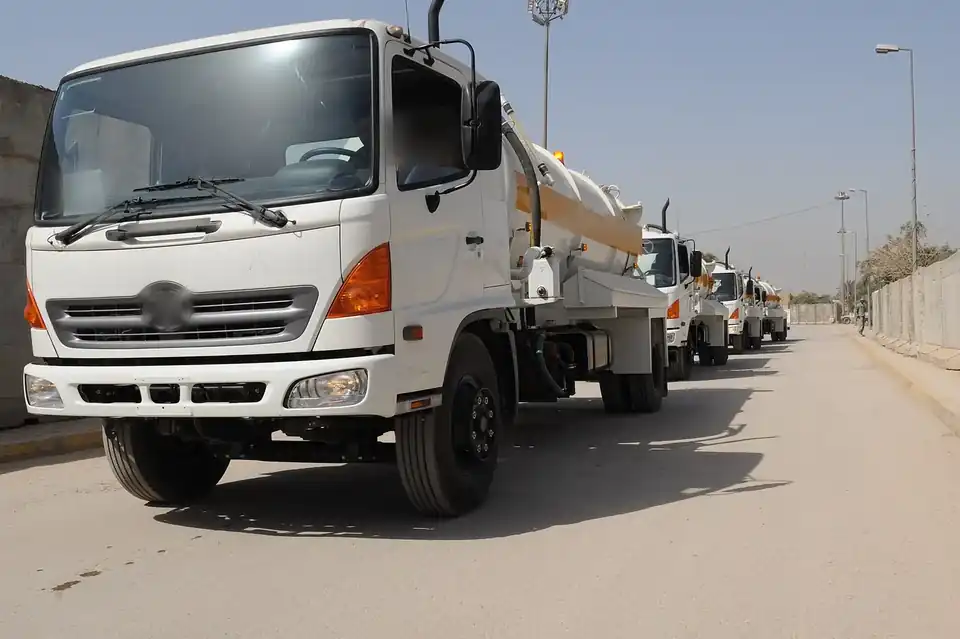
Water tanker sizes
Last updated
Get a written price
- Send the job on WhatsApp: what you are doing, the town and the dates.
- Get your quote: the machine, the operator, transport and the total, in writing.
- Pay to book and the machine arrives on site with its operator.
We reply Monday to Friday 07:00–17:00, Saturday 07:00–13:00.
What is a water tanker?
A water tanker is a truck that carries a tank of water, a pump and spray equipment. On construction sites, roads and mines it's also called a water truck, a water bowser or a water cart. It wets road layers before compaction, damps down dust on haul roads and sites, and stands by while firebreaks are burnt.
The size you need comes down to two things: how much water the job uses, and where the truck has to drive to put it there.
Water tanker sizes in litres
| Capacity | Water weight full | Usual truck | Used for |
|---|---|---|---|
| 8,000–12,000 litres | 8–12 t | Two- or three-axle rigid | Building sites, small roads, firebreak standby, filling site tanks |
| 14,000–18,000 litres | 14–18 t | Three- or four-axle rigid | Road layerworks, township roads, big sites |
| 23,000–25,000 litres | 23–25 t | Truck and trailer, semi-trailer tanker, or ADT bowser | Mine haul roads, long roads, bulk earthworks |
| 16,000–50,000 litres (ADT bowsers) | 16–50 t | Articulated dump truck chassis, off-road | Open-pit mines and quarries |
The ADT range is Bell's: its E-series water tankers run from 16,000 to 50,000 litres, with the 50,000 litre tank on the B60E. Prices for each road size are on water tanker hire.
Water tanker weight and capacity
A litre of water weighs 1 kg, so capacity in litres is the weight of the water in kilograms. The National Road Traffic Regulations limit what each axle may carry, which caps how much water a road truck can legally take:
| Truck | Axle limits | Legal gross |
|---|---|---|
| Two-axle rigid | 7,700 kg steering + 9,000 kg single (dual wheels) | 16,700 kg |
| Three-axle rigid (6x4) | 7,700 kg steering + 18,000 kg tandem | 25,700 kg |
| Four-axle rigid (8x4, twin steer) | 15,400 kg steering pair + 18,000 kg tandem | 33,400 kg |
Take off the truck and the tank and what's left is the water. A two-axle truck tops out around 10,000 litres. An 18,000 litre tank is 18 t of water, which leaves only about 7.7 t for the truck and tank on three axles, too little, so 16,000–18,000 litre tankers usually run on four. Above about 20,000 litres you're into a trailer or an off-road ADT bowser.
Water truck types and spray equipment
- Rigid water truck: the tank sits on the truck. The usual site truck from 8,000 to 18,000 litres.
- Truck and trailer or semi-trailer tanker: more litres on the road, for long roads and mines with good haul roads.
- ADT water bowser: the tank on an articulated dump truck, for pit ramps, soft ground and rough haul roads.
- Tanker trailer: towed by a tractor or truck on farms and small sites.
Spray equipment makes the difference on the job. A gravity-fed dribble bar lays an even film across the truck's width for compaction. A pressurised spray bar with nozzles pushes water down so wind doesn't carry it off a haul road. Side and batter sprays widen the spray. A water cannon throws a stream or fog more than 30 m, for stockpiles and firebreak edges, at 1,100–3,200 litres a minute on Bell's tankers.
How many loads for dust suppression?
Litres per pass = area in m² × litres per m². The rate is set on site: more on hot, windy days and busy roads, less in the early morning.
| Road width | At 0.5 L/m² | At 1 L/m² |
|---|---|---|
| 6 m | 3,000 L | 6,000 L |
| 8 m | 4,000 L | 8,000 L |
| 12 m (mine haul road) | 6,000 L | 12,000 L |
| 20 m (wide haul road) | 10,000 L | 20,000 L |
Then multiply by the passes. In US Bureau of Mines tests on unpaved haul roads, watering once an hour cut airborne dust by about 40%, and doubling the water raised that to about 55%. Example: 3 km of 8 m road watered at 0.5 L/m² once an hour over a 9-hour shift is 12,000 litres a pass × 9 = 108,000 litres, about seven loads of a 16,000 litre truck. That's one truck working all shift.
Planning dust control for a site or mine: see dust suppression.
How many loads for a compaction layer?
Water to add = layer volume × dry density × (target moisture − moisture already in it). The target is the optimum moisture content (OMC) from your soil lab's compaction test on the material.
| Layer | Volume | Add 3% moisture | Add 5% moisture |
|---|---|---|---|
| 1,000 m² building pad | 150 m³ | 9,000 L | 15,000 L |
| 500 m of 7 m road | 525 m³ | 31,500 L | 52,500 L |
| 1 km of 10 m road | 1,500 m³ | 90,000 L | 150,000 L |
Add extra on hot days, when water evaporates off the layer before the roller gets to it. On a road layer the water truck works with a grader mixing the water in and a roller following, so size the truck to keep up: 31,500 litres is two loads of a 16,000 litre truck.
Which water tanker size should you hire?
- 8,000–12,000 litres (R2,000–R2,300 a day with a driver): building sites, small building pads, firebreak standby, filling site tanks.
- 14,000–18,000 litres (R2,400–R2,800 a day): road layerworks and site dust control. The most-hired size.
- 23,000–25,000 litres (R4,000–R5,800 a day): mine haul roads and long roads, often by the month.
Prices exclude VAT; travel is its own line. Full rates and what's included: water tanker hire. Other machines for the same job: TLBs, excavators, tipper trucks, ADTs, and every price on plant hire rates. How booking works: how it works.
WhatsApp us the job for a water truck priceQuestions people ask
What size is a standard water tanker?
On building sites and roads the everyday sizes are 10,000 litres and 16,000–18,000 litres. Mines use 23,000–25,000 litre tankers and ADT bowsers of up to 50,000 litres. To hire, an 8,000–12,000 litre truck with a driver is R2,000–R2,300 a day and a 14,000–18,000 litre truck R2,400–R2,800 a day.
How much does a full water tanker weigh?
The water weighs 1 kg a litre, so a full 10,000 litre tank holds 10 t of water and an 18,000 litre tank 18 t, plus the truck and tank. That's why 16,000–18,000 litre tankers usually run on four axles: the road traffic regulations cap a three-axle truck at 25,700 kg by its axle limits.
How long does a water tanker take to empty?
On a spray bar, the time it takes to drive the length of road you're wetting. On a water cannon it's fast: Bell's cannons run at 1,100–3,200 litres a minute, so 18,000 litres lasts about 6 to 16 minutes.
How far does one load of water go on a road?
At 0.5 litres per square metre, one 16,000 litre load wets about 4 km of 8 m wide road. At 1 litre per square metre it covers about 2 km. The rate you need depends on the heat, the wind and the traffic on the road.
Related
Need a water truck?
WhatsApp us the job, the town and the dates. We confirm the machine, the start date and the price in writing before the machine moves.
WhatsApp us now