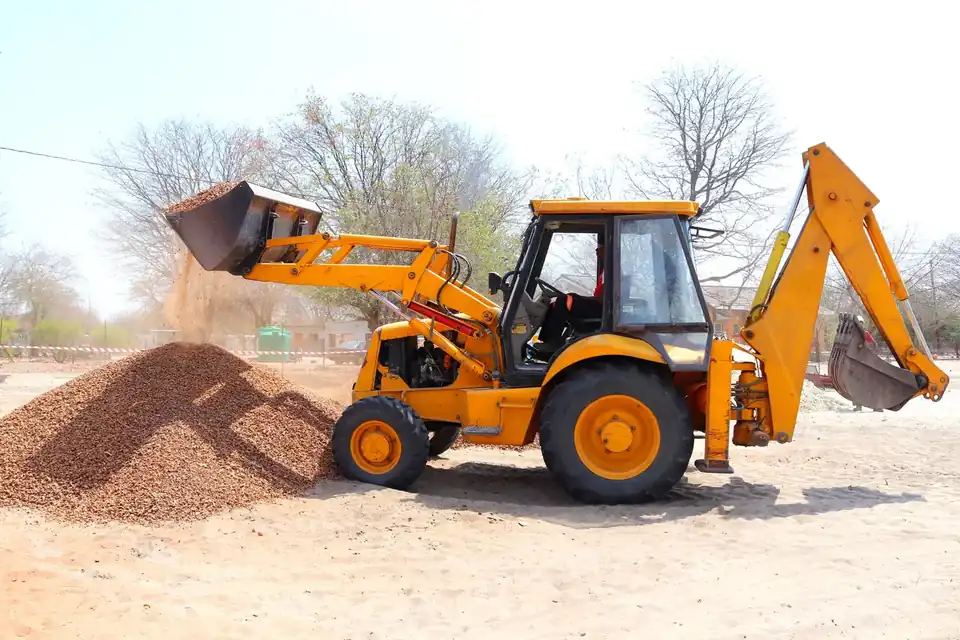
TLB hire in Cape Town
Last updated
Digger loader hire in Cape Town: prices
| Machine and basis | Price |
|---|---|
| Standard 4x4 TLB with operator, per day | R3,900–R5,150 |
| Standard TLB per hour, dry | R320–R410 |
| TLB with hydraulic breaker for mountain rock, per day | R5,000–R6,550 |
Cape Town is one of the main centres we send machines from. The TLB drives to site, so travel is small and confirmed on WhatsApp with your price. The rates page explains minimum hours and standing time: TLB hire rates.
Get a Cape Town TLB price on WhatsAppSand on the Flats, rock against the mountain
The Cape Flats and northern suburbs
The Cape Flats Aquifer, an extensive sandy and unconfined aquifer, underlies most of the metro's urban area, so from Bellville to Mitchells Plain and Khayelitsha the TLB is digging loose sand. It goes quickly, but sand won't stand in a vertical wall: trenches deeper than a shallow pipe run need the sides battered back or shored, and the backfill goes in thin, damp layers under a rammer or plate. Where the water table is high in winter, trenches can take water, so keep pumps on hand.
The City Bowl, Atlantic seaboard and southern suburbs
Against Table Mountain the stands are steep, the streets narrow and the ground stony. The TLB (JCB 3CX or similar) is 2.35 m wide over its front bucket and about 3.3 m with its stabilisers down, which rules it out of many side passages here. A mini excavator or a bobcat with a breaker often does the job better.
The City's wayleave rules shape the TLB's day
Inside your boundary you need no wayleave. A trench into a road reserve or onto other City property falls under the Wayleaves By-law, 2026 and the City's road-reserve standards:
- Wayleave first, then a permit to work. The wayleave is applied for on the City's Wayleave Management System, then the contractor gets a permit to work. Nothing starts before both are issued.
- Notice and timing. The City needs at least five working days' notice before work starts, and the work must start within 90 days of the wayleave being issued.
- Short digging hours. Open trenching in the road reserve runs between 09:00 and 15:30, outside peak traffic, so plan a shorter digging window on road-reserve days.
- Backfill the same day, reinstate within 7 days. A compactor follows the TLB, and the surface goes back within a week.
A shallow trial hole of up to 600 mm can go on a Miscellaneous Permit instead.
Winter is the wet season
The south-western Cape gets most of its rain in June, July and August (South African Weather Service). Wet sand weighs more per load and soft access holds up tippers, so bulk earthworks and sand moves go best from October to April. In summer the south-easter dries and lifts the sand instead: keep a water truck on bigger sites so dust doesn't stop the job.
Where we send TLBs around Cape Town
- Northern suburbs: new houses and complexes in Bellville, Brackenfell and Durbanville, and dams and farm roads on the Durbanville wine farms.
- Epping and Stikland: industrial yards, where the breaker TLB lifts old slabs before the bucket digs.
- The Cape Flats: extensions, sewer connections and sand moves, with TLBs, tippers and compactors.
- The Helderberg: foundations, pools and retaining walls in Somerset West, with rock towards the mountain.
- Stellenbosch: its own municipality, so wayleaves go through Stellenbosch rather than the City. Stellenbosch is about 52 km from Cape Town by road. Transport for a TLB there and back usually comes to R4,480–R5,400, shown as its own line on your quote.
Every machine in the metro: plant hire in Cape Town. The Boland and Garden Route: plant hire in the Western Cape. Along the coast: TLB hire in Gqeberha. Up the N1: TLB hire in Bloemfontein. Specs and operators: TLB hire.
WhatsApp your Cape Town TLB jobQuestions people ask
Is a digger loader the same as a TLB?
Yes. Digger loader is the name often used in the Western Cape for a TLB (tractor-loader-backhoe), also called a backhoe loader or a JCB: a loader bucket on the front and a digging arm on the back. Same machine, same price: R3,900–R5,150 a day with operator with an operator.
How shallow does a trial hole in a Cape Town road reserve have to be to skip the wayleave?
Up to 600 mm deep, on a Miscellaneous Permit. Anything deeper needs the full wayleave, and the City can still ask for one on any trial hole, so check before the TLB arrives.
Can a TLB work through a Cape Town winter?
Yes, with planning. Most rain falls in June, July and August, so keep open trenches short, put firm access in for tippers and agree standing time for washed-out days. Big sand moves and bulk earthworks are best booked between October and April.
Related
Sources we checked
- City of Cape Town: Wayleaves By-law, 2026 (Provincial Gazette Extraordinary 9252, 18 June 2026)
- City of Cape Town, Road reserves: wayleave process and standards
- Water SA (2021), Assessing the potential for managed aquifer recharge of the Cape Flats Aquifer
- SAnews (citing the South African Weather Service): parts of the Western Cape record lowest rainfall, 2 August 2026
- JCB 3CX and 4CX backhoe loader specifications (JCB spec sheet P995-B)
Need a TLB in Cape Town?
WhatsApp us the job, the town and the dates. We confirm the machine, the start date and the price in writing before the machine moves.
WhatsApp us now