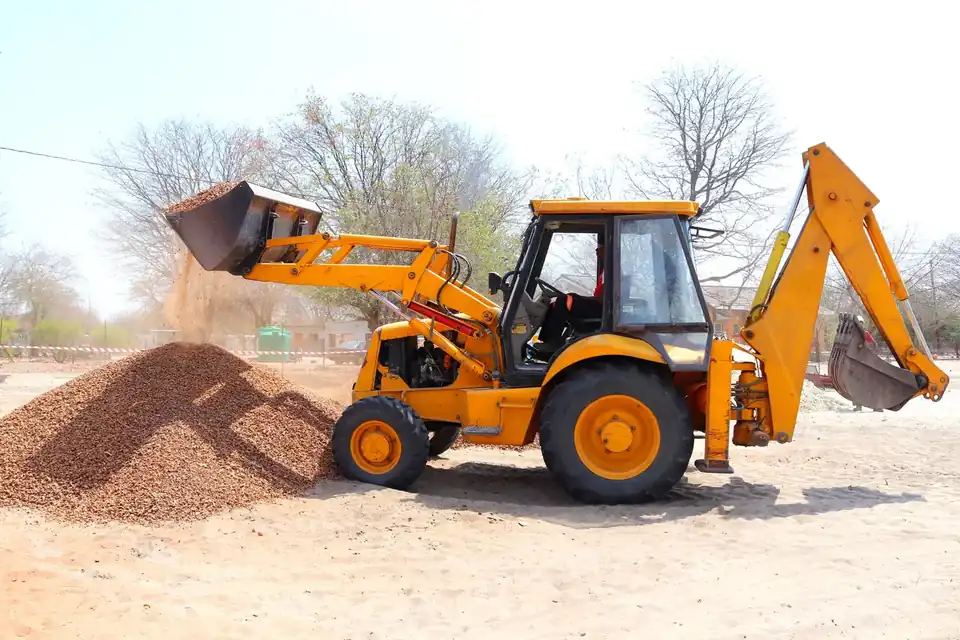
TLB hire in Polokwane
Last updated
TLB for hire in Polokwane: prices
A standard 4x4 TLB (JCB 3CX or similar) with an operator is R3,900–R5,150 a day with operator for an 8 to 9 hour day. Prices exclude VAT.
- By the hour, dry: R320–R410, with a minimum number of hours.
- With a hydraulic breaker for rock and concrete: R5,000–R6,550 a day with operator.
- Five days with an operator: R19,500–R25,750.
- A month of about 200 machine hours, dry: about R68,000.
Polokwane is one of the main centres we send machines from. The TLB drives to site, so travel is small and confirmed on WhatsApp with your price. The full rate breakdown is on TLB hire rates.
Get a Polokwane TLB price on WhatsAppWhat's under a Polokwane stand
Polokwane sits on the Pietersburg plain, which the municipality's 2007 environmental assessment describes as almost entirely a gneiss surface: the Hout River Gneiss, with Turfloop Granite in places. Gneiss is banded, so it weathers unevenly, and that is what decides how fast a TLB digs here.
| Ground | What the TLB finds | What to book |
|---|---|---|
| Red, freely drained soil (Hutton form) | Soft digging, often 0.4–1.2 m deep before weathered rock | Standard TLB; trenches stand while dry |
| Shallow soils on crests and koppies (Glenrosa and Mispah forms) | Rock a spade or two under the surface | Breaker TLB from the start |
| Weathered gneiss | Soil-like material with moderately hard core-stones and bands left inside it | Standard TLB, breaker on standby |
| Dolerite dykes, running north-east to south-west | Thin lines of rounded dolerite boulders | Lift out the boulders, or move the trench line |
Send a photo of a test hole and the stand with your request; it tells us which machine to send.
Little rain, but it comes hard
The same assessment puts Polokwane's rainfall at about 475 mm a year, mostly between November and March, against evaporation of 1,700–1,800 mm. Summer storms are heavy: up to 79 mm has fallen in 24 hours in January and 74 mm in December. For a TLB job that means:
- Keep new building out of the 1:100 year flood line, as the assessment recommends; the city's streams and drainage lines mostly run dry until a storm.
- In the storm months, backfill trenches the same day and keep spoil heaps out of the run-off.
- In the dry months, compaction needs water: book a water truck with the roller on road and yard jobs.
TLB jobs around Polokwane
Suburbs and new estates
Foundations, extensions, pools and boundary-wall footings, plus sewer and water connections. A connection that crosses the verge into the road reserve needs the municipality's approval first.
Townships and villages
Room additions, strip footings and septic tanks in Seshego and the villages around the city, where one TLB day usually covers the footings and the soakaway.
Plots and smallholdings
Water lines from the borehole, sheds, kraals and gravel driveways. Bushveld plots carry protected trees: the assessment lists leadwood (Combretum imberbe), marula (Sclerocarya birrea) and Elaeodendron transvaalensis, none of which may be removed without a permit.
Mine and contract work
The platinum mines of the northern Bushveld Complex around Mokopane take TLBs for pipelines, cable trenches and drainage on longer hires. Mokopane is about 62 km from Polokwane by road. Transport for a TLB there and back usually comes to R5,340–R6,440, shown as its own line on your quote.
When another machine is better
For bulk earthworks or long trenches through rock, a 20–25 t excavator with a breaker (R3,500–R5,600 a day with operator); for tight backyards, a mini excavator (R1,700–R3,000 a day with operator).
Every machine in the city: plant hire in Polokwane. Tzaneen to Lephalale: plant hire in Limpopo. Down the N1: TLB hire in Pretoria. In the Lowveld: TLB hire in Mbombela. Specs and operators: TLB hire.
WhatsApp your Polokwane TLB jobQuestions people ask
Can a TLB dig through rock in Polokwane?
Weathered gneiss, yes. Hard core-stones, dolerite boulders and solid rock on the koppies, no: that needs the breaker TLB (R5,000–R6,550 a day with operator). If a test hole hits rock within half a metre, or your plot sits on a rise, book the breaker from the first day.
Can I clear a plot with marula trees on it?
Not the marula, leadwood or other protected trees without a licence. Under the National Forests Act nobody may cut, damage or remove a protected tree without one. Mark them with tape before the TLB starts and we clear around them.
Do you send TLBs to Mokopane and Tzaneen?
Yes, from Polokwane, with travel both ways as its own line. Mokopane: R5,340–R6,440. Tzaneen: R8,180–R9,880. On a job of a week or more, that is spread across many days.
Related
Sources we checked
- Polokwane Local Municipality: Strategic assessment of environmental issues and sensitive areas in SDA 3 (Africa Geo-Environmental Services, May 2007)
- National Forests Act 84 of 1998, section 15 (protected trees)
- GCIS Pocket Guide to South Africa, Mineral resources (Bushveld Complex)
- JCB 3CX and 4CX backhoe loader specifications (JCB spec sheet P995-B)
- SMM (August 2026), An introduction to the Bushveld Complex (northern limb around Mokopane)
Need a TLB in Polokwane?
WhatsApp us the job, the town and the dates. We confirm the machine, the start date and the price in writing before the machine moves.
WhatsApp us now