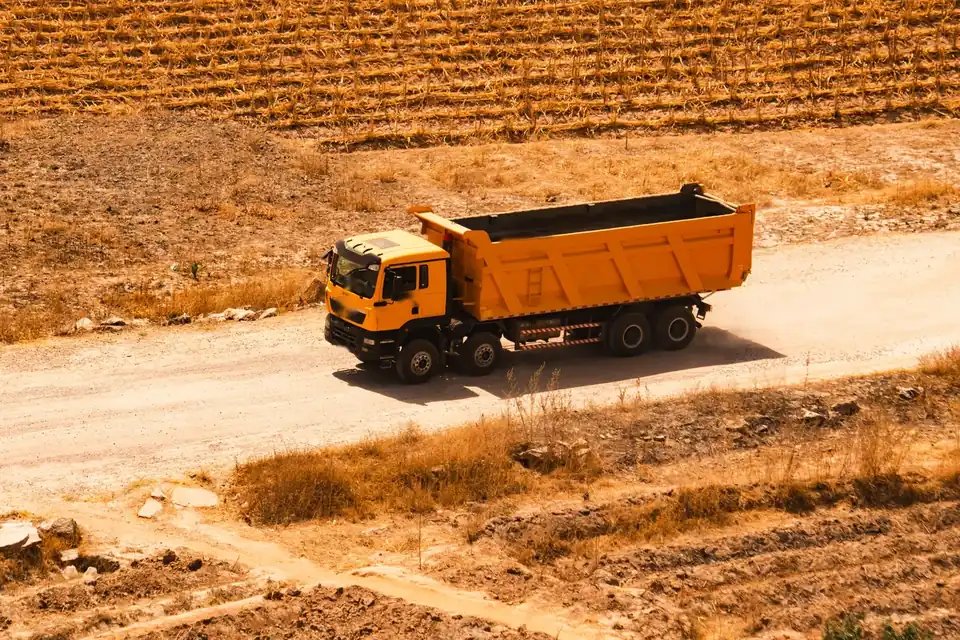
Tipper truck volume capacity
Last updated
Volume capacity vs load capacity
A tipper has two capacities, and the smaller one wins. The volume capacity is how much its body holds, in cubic metres ("cubes"). The load capacity is how many tons it may legally carry, worked out from its axles and its own empty mass. Which one you hit first depends on how heavy the material is.
- Volume (m³): the body's level-full size. A "10 cube" tipper has a 10 m³ body. Heaping the load above the sides adds a little more, if the mass allows and nothing can fall off.
- Load (tons): gross vehicle mass allowed, minus the truck's empty (tare) mass. The National Road Traffic Regulations set the gross limit as the lowest of the axle limits, the maker's rating and the bridge formula (regulation 236).
Tipper truck capacity by truck type
| Truck | Axles | Body volume | Gross mass | Empty | Legal payload | Break-even weight |
|---|---|---|---|---|---|---|
| 6 cube tipper (Tata LPK 1518) | Two (4x2) | 6 m³ | 16,200 kg | 5,265 kg | about 10.9 t | 1.82 t a cube |
| 10 cube tipper (Tata Prima 2528.K) | Three (6x4) | 10 m³ | 25,500 kg | 8,500 kg | about 17 t | 1.70 t a cube |
| 14–18 cube tipper (Tata Prima 3338.K) | Four (8x4) | up to 19 m³ | 33,000 kg | about 11,200 kg | about 20.5–21.8 t | about 1.15 t a cube |
| 34 t interlink side tipper | Seven | 25–45 m³ | 56,000 kg combination | about 21 t | about 34 t | 0.76 t a cube (45 m³ coal bins) |
| 30 t ADT (off-road only) | Three, articulated | about 17–19 m³ heaped | – | – | about 28–30 t | about 1.6 t a cube |
The break-even weight is the legal payload divided by the body volume. If a loose cube of your material weighs more than that number, the truck reaches its legal mass before the body is full. If it weighs less, the body fills first. Loose material weights from Caterpillar's tables: dry sand about 1.42 t a cube, crushed stone 1.60 t, clay 1.66 t, wet sand 1.84 t, clean rubble about 1.07 t and topsoil 0.95 t (the full table is in how many cubes in a ton). So:
- 6 cube: break-even 1.82 t, so it carries a full body of nearly everything; only wet sand (1.84 t) tips it just over.
- 10 cube: break-even 1.70 t, so dry sand, stone, soil and clay all fill the body; wet sand doesn't fit ten cubes.
- 14–18 cube: break-even about 1.15 t, so sand and stone reach the legal mass at about 13–15 cubes. It earns its keep on topsoil, rubble and other light bulk.
- Side tipper: coal trailers run 40–45 m³ bins because coal is light; dense ore like chrome reaches 34 t in about 25 m³.
Working out a tipper's legal load yourself
- Axle limits (regulation 240): 7,700 kg on a single steering axle, 9,000 kg on a single axle with dual wheels, 18,000 kg on a tandem of two dual-wheeled axles. Add up the truck's axles.
- The maker's rating: the gross vehicle mass on the truck's plate. The truck may never exceed it.
- The bridge formula (regulation 241): 2,100 × the distance from the first to the last axle in metres, plus 18,000 kg. Short trucks with many axles get caught here: an 8x4 with 6.5 m between its first and last axles is held to 31,650 kg.
- Take the lowest of the three and subtract the empty mass. That's your legal payload.
A worked 10 cube example: a 7,700 kg steering axle plus an 18,000 kg tandem is 25,700 kg, but the maker rates the truck at 25,500 kg, so 25,500 kg applies. Less 8,500 kg empty, about 17 t is left for the load. The 18 cube version of this sum, with the bridge formula, is on 18 cube tipper hire.
Overloaded trucks are fined and held at weighbridges, and the delay lands on your job, so we load to the legal mass, not the top of the body, and weighbridge tickets come on request.
Example: how many tipper loads for a hole?
Say you're carting away a 30 m³ hole dug in clay. Dug soil swells: a cube of clay in the ground becomes about 1.2 loose cubes, so the 30 m³ hole fills about 36 loose cubes of tipper. Loose clay weighs about 1.66 t a cube, so a full 10 m³ body is 16.6 t, just under the 17 t limit.
| Truck | Cubes a load | Loads | Why |
|---|---|---|---|
| 6 cube | 6 | 6 | Full body (10 t) is under its 10.9 t limit |
| 10 cube | 10 | 4 | Full body (16.6 t) is under its 17 t limit |
| 18 cube | about 13 | 3 | Legal mass (about 21.8 t) is reached at about 13 cubes |
On short Gauteng runs, six 6 cube loads come to R7,500–R11,400, or a 10 cube tipper with its driver is R3,700–R5,250 a day with operator and does four loads in a day if the tip is close. Rates for every size are on tipper truck hire.
Choosing the tipper size
- Access first. The 6 cube's short wheelbase turns in residential streets and fits under trees and wires. A typical 18 cube is over 9 m long with a turning circle of about 22.3 m, so it needs an open site.
- Then the material. Heavy material (sand, stone, clay) favours the 10 cube, which fills its body and its legal mass at about the same time. Light bulk (topsoil, rubble, woodchips) favours the 18 cube.
- Then the loader. A TLB loads 6 and 10 cube tippers well; a 20 t excavator keeps 18 cube trucks moving. See TLB hire.
- Licences. Any goods vehicle over 16,000 kg gross needs a Code C licence, and over 3,500 kg a professional driving permit; our drivers hold both.
Prices exclude VAT and include the driver. A 10 cube is R3,700–R5,250 a day with operator and a 14–18 cube R3,300–R4,000 a day with operator. Booking is a WhatsApp, a written price and a deposit: see how it works.
WhatsApp us the material and the cubesQuestions people ask
How many m³ does a tipper truck hold?
Usually 6, 10 or 14–19 m³, by truck size: a two-axle tipper carries a 6 m³ body, a three-axle 6x4 a 10 m³ body and a four-axle 8x4 up to about 19 m³. Interlink side tippers carry 25–45 m³ across two trailers. The body volume is the most it can hold level-full; the legal mass often stops it sooner.
What is the capacity of a 20 ton tipper?
"20 ton" usually means the four-axle 14–18 cube class. A typical 8x4 (Tata Prima 3338.K or similar) is rated 33,000 kg gross and weighs about 11,200 kg empty, leaving about 21.8 t of legal payload, or about 20.5 t if its axles are closer together. That's about 13.6 cubes of crushed stone or a full body of topsoil.
How many tons is a 10 cube tipper?
About 17 t legally. A typical 6x4 10 cube truck is rated 25,500 kg gross and weighs about 8,500 kg empty. Ten cubes of most dry materials fit inside that; ten cubes of wet sand (about 18.4 t) don't.
Can a tipper be loaded above the sides?
A heaped load holds more than the body's level-full volume, but the truck may still not exceed its legal mass, and nothing may be able to fall off on the road. With light material like topsoil we can heap a little; with sand and stone the legal mass is reached before the body is level-full on the bigger trucks.
Do tipper drivers need a special licence?
Yes. A goods vehicle over 16,000 kg gross needs a Code C licence, which covers our 10 and 18 cube tippers and even a 16,200 kg two-axle 6 cube truck. Every driver of a goods vehicle over 3,500 kg gross also needs a professional driving permit (PrDP). Our tipper drivers hold both.
Related
Sources we checked
- Tata LPK 1518 6 m³ tipper leaflet (GVM and tare)
- Tata Prima 2528.K 10 m³ tipper leaflet (GVM and tare)
- Tata Prima 3338.K 8x4 leaflet (GVM, tare, 19 m³ body)
- National Road Traffic Regulations, regulation 236: permissible maximum vehicle mass
- National Road Traffic Regulations, regulation 240: axle massload limits
- National Road Traffic Regulations, regulation 241: bridge formula
- National Road Traffic Regulations, regulation 99: categories of driving licences
- National Road Traffic Regulations, regulation 115: drivers who must hold a professional driving permit
- Caterpillar earthwork volumes reference tables (loose material weights)
Need a tipper truck?
WhatsApp us the job, the town and the dates. We confirm the machine, the start date and the price in writing before the machine moves.
WhatsApp us now