Types of forklift
Last updated
Get a written price
- Send the job on WhatsApp: what you are doing, the town and the dates.
- Get your quote: the machine, the operator, transport and the total, in writing.
- Pay to book and the machine arrives on site with its operator.
We reply Monday to Friday 07:00–17:00, Saturday 07:00–13:00.
Types of forklift at a glance
South Africa's National Code of Practice for training lifting machine operators (2024) lists forklifts by type, with a code for each. The code is what an operator's certificate refers to.
| Type | How it works | Where it works | Code |
|---|---|---|---|
| Counterbalance forklift | Forks on a mast at the front; a heavy counterweight at the back balances the load | Yards, loading bays, factories, warehouses with wide aisles | F1 up to 3,000 kg, F2 up to 7,000 kg, F3 up to 15,000 kg, F4 above |
| Reach truck | The mast or forks reach forward, then pull the load back over the wheelbase, so it stacks high in narrow aisles | Warehouses with racking | F5 up to 2,500 kg |
| Pallet jack (pallet truck) | Lifts a pallet just off the floor to move it; manual or battery-powered | Shop floors, warehouse floors, inside trucks | F12 (battery-powered); walk-behind lift trucks F6 below 2,000 kg, F7 above |
| Rough-terrain forklift | Big tyres, high clearance, often 4x4 | Building sites, farms, brick and timber yards | F11 |
| Telehandler | A telescopic boom instead of a mast: reaches forward and up | Building sites, farms | A separate machine: see telehandler hire |
| Side loader | Mast and forks on the side; carries long loads along its length | Timber, steel and pipe yards, long narrow aisles | F10 |
| Order picker and very narrow aisle (VNA) trucks | The operator rises with the forks, or the truck runs in guided aisles | High-bay warehouses and distribution centres | F8, F9 (order pickers); F13–F16 (VNA and rail-mounted stackers) |
The 3 main types of forklift
Counterbalance forklift
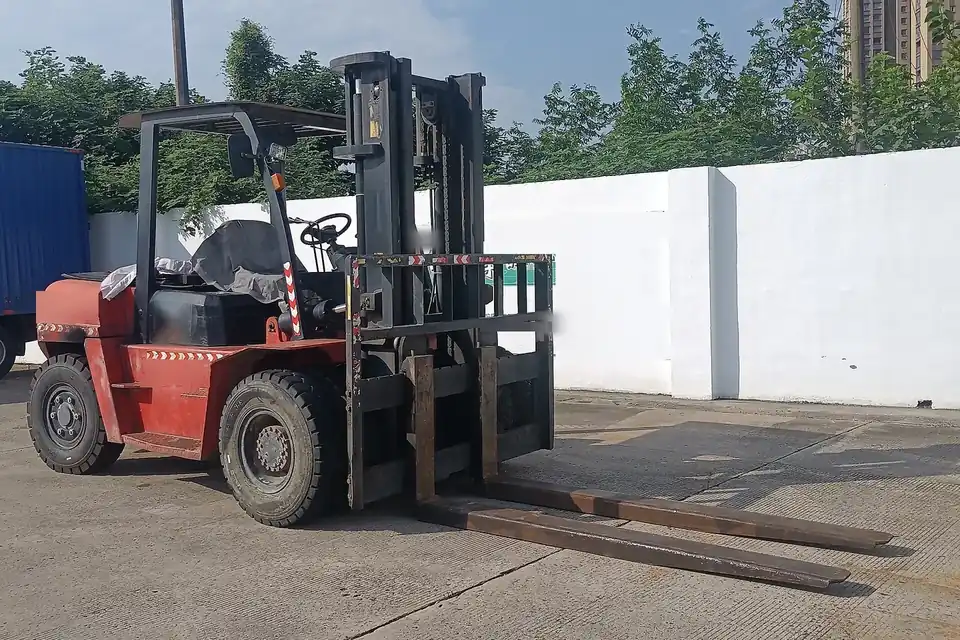
The standard forklift, and the one most people mean. The weight of the truck behind the front wheels balances the load on the forks, so there are no legs in front and it drives straight up to a truck deck or pallet. Common sizes run from 1.5 t to 3.5 t, with heavier trucks for steel and containers. A 2–3.5 t truck (Hyster H2.0–3.5A or similar) lifts its rated load at a 500 mm load centre, has a standard lift of about 3.9 m and turns in about 2.2–2.4 m. This is what we hire as forklift hire, in 1–2 t, 2.5–3 t and 3.5–5 t sizes.
Reach truck
A warehouse truck for racking. Outrigger legs at the front carry the weight, and the mast or forks extend forward to pick a pallet, then retract so the truck is short enough to turn in a narrow aisle. That lets a warehouse fit more racking into the same floor. Reach trucks are electric and need smooth, level floors; the code covers them up to 2,500 kg (F5).
Pallet jack (pallet truck)
Forks that slide under a pallet and lift it a few centimetres to roll it along. A manual hand pallet jack is pumped with the handle; a battery-powered pallet truck drives itself, with the operator walking behind or standing on it. They can't stack, so they move pallets from a truck to the floor, along aisles or around a shop. Battery-powered pallet trucks are lift trucks in the code (F12), so operators need training for them.
Other types: rough-terrain, telehandler, side loader
Rough-terrain forklift
Built for ground a standard forklift can't handle: big tread tyres, high ground clearance and usually four-wheel drive. It offloads bricks, blocks and roof sheets on building sites, and moves bins and bales on farms. The code lists it as F11. Ordinary counterbalance forklifts have small, hard tyres and need concrete or paving.
Telehandler
A telescopic handler: a boom that extends forward and up, with forks or a bucket on the end. It places pallets of bricks onto scaffolds and upper floors, over trenches and walls, where a forklift would have to drive right up to the stack. It's a separate machine with its own hire page: telehandler hire.
Side loader
The forks sit on the side of the truck, and long loads like timber, steel lengths and pipes ride along the deck. It drives down a narrow aisle with a long load that a front-loading forklift would have to carry crossways, blocking the aisle. Code F10.
Order pickers and VNA trucks
In big distribution centres, order pickers lift the operator with the forks to pick single items from high racks (F8 for first and second level, F9 for all levels), and very narrow aisle trucks work guided aisles barely wider than the truck (F13–F16).
Diesel, LPG or electric forklifts
- Diesel: outdoor yards and sites, heavy loads, rough concrete. Exhaust fumes rule out closed buildings.
- LPG (gas): cleaner than diesel and suited to work that moves between a shed and the yard, with good ventilation indoors. Bottles swap in minutes. Many counterbalance trucks come in diesel and LPG versions of the same model.
- Electric: warehouses, food stores and cold rooms: no exhaust and quiet. Charged between shifts, and best on smooth, level floors. Reach trucks, order pickers and pallet trucks are almost always electric.
Forklift capacity and load centre explained
A forklift's capacity is the weight it can lift at a set load centre, not any load up to that weight.
- Load centre is the distance from the front face of the forks to the load's centre of gravity. Common 1–3.5 t trucks are rated at 500 mm.
- Why it matters: the truck balances on its front wheels like a see-saw. The further out the load's centre, the more it tips the truck forward, so the safe load falls. An even pallet 1,000 mm deep has its centre at 500 mm: full capacity. A 1,200 mm crate has its centre at 600 mm, so the truck must lift less than its rating.
- Height matters too. On a 2 t truck (Hyster H2.0A or similar) the full 2,000 kg is good to 4.2 m on the forks, but only 1,770 kg at 5.5 m.
- Attachments such as fork extensions, side-shifts and jibs add weight in front of the wheels and move the load out, so they cut the safe load as well.
Every forklift carries a capacity plate showing the safe load at each lift height and load centre. Read it for your heaviest, longest and highest load before you choose the size. If you're unsure, WhatsApp us the load's weight and dimensions and the height it goes to.
Do you need a licence to drive a forklift in South Africa?
What the law asks for is a certificate of training. Forklifts are lift trucks, and lift trucks are lifting machines under the Driven Machinery Regulations, 2015 (GN R.540 of 24 June 2015, under the OHS Act 85 of 1993).
- Reg 18(11): nobody may operate a lifting machine listed in the National Code of Practice for Training Providers of Lifting Machine Operators unless they hold a certificate of training from an accredited training provider.
- The 2024 code (Notice 5588 of 29 November 2024, replacing the 2015 code) lists forklifts by type, F1 to F16, as in the table above. Make sure the certificate covers the type being driven: a counterbalance certificate is not a reach truck certificate.
- The machine needs its load test. Under reg 18, a lifting machine is examined and load-tested by a lifting machinery inspector of a registered lifting machinery entity before first use and at intervals of no more than 12 months. Whoever uses a leased one must keep the latest test and service records on site, not older than 12 months.
When you hire from us, we send copies of the load-test certificate, and the operator's certificate if you hire an operator, before the forklift arrives, on request. See safety and certificates.
Which forklift do I need?
| The job | The machine |
|---|---|
| Offloading pallets from trucks in a yard | 2.5–3 t counterbalance, diesel: R1,150–R1,600 a day |
| Moving stock in a warehouse, low racking | 1–2 t counterbalance, electric or LPG: R940–R1,600 a day |
| Heavy pallets, steel, machinery | 3.5–5 t counterbalance, diesel: R1,600–R1,900 a day |
| High racking in narrow aisles | Reach truck: exact price on WhatsApp |
| Bricks and blocks on a building site, mud or slopes | Rough-terrain forklift, or a telehandler to reach upper floors |
| Long timber, steel or pipes | Side loader: exact price on WhatsApp |
| Lifting one heavy item off a truck and setting it in place | A crane truck may do it in one visit |
All forklift prices are machine only, excluding VAT, with transport as its own line; a certified operator comes on request. Full prices are on forklift hire rates, and every machine we hire is on types of plant.
WhatsApp us the load and we'll pick the forkliftQuestions people ask
What are the 3 main types of forklifts?
Counterbalance forklifts, reach trucks and pallet jacks (pallet trucks). Between them they do almost all pallet work: the counterbalance loads trucks and works yards, the reach truck stacks high racking in narrow aisles, and the pallet jack moves pallets along the floor.
What is the most common type of forklift?
The counterbalance forklift. It's the familiar truck with forks at the front and a heavy counterweight at the back, usually rated 1.5–3.5 t, running on diesel, LPG or batteries. It works indoors and out, on any hard floor or yard.
What does load centre mean on a forklift?
The distance from the front face of the forks to the centre of gravity of the load. Forklifts are rated at a set load centre, 500 mm on common 1–3.5 t trucks. A load whose centre sits further out than that, like a long crate, can only be lifted at less than the rated capacity.
Is a pallet jack a forklift?
A battery-powered pallet truck is a lift truck: the 2024 National Code of Practice lists it as F12, so its operators need a certificate of training too. A manual hand pallet jack is not in the code's forklift list. Neither lifts a pallet more than just off the floor.
What's the difference between a forklift and a telehandler?
A forklift lifts straight up on a mast and needs hard, level ground. A telehandler has a telescopic boom that reaches forward and up, on big 4x4 tyres, so it places loads over obstacles and onto upper floors on rough sites. See telehandler hire.
Can I hire a forklift with a certified operator?
Yes. Our forklift prices are machine only, from R940–R1,600 a day for 1–2 t, and a certified operator comes on request, priced on WhatsApp. See forklift hire.
Related
Sources we checked
- National Code of Practice, 2024: forklift (lift truck) codes F1 to F16
- National Code of Practice for Training Providers of Lifting Machine Operators, 2024 (Notice 5588 of 29 November 2024)
- Driven Machinery Regulations, 2015 (GN R.540 of 24 June 2015), reg 18: lifting machines and operator certificates
- Hyster H2.0–3.5A product technical guide: capacity at 500 mm load centre, capacity at height, lift heights, fuel options
Need a machine?
WhatsApp us the job, the town and the dates. We confirm the machine, the start date and the price in writing before the machine moves.
WhatsApp us now